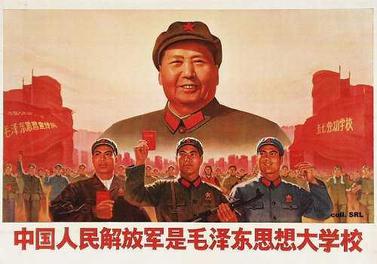
Communism in China
On October 1, 1949, Chinese Communist leader Mao Zedong declared the creation of the People's Republic of China (PRC). The announcement ended the costly full-scale civil war between the Chinese Communist Party (CCP) and the Nationalist Party, or Kuomintang (KMT), which broke out immediately following World War II and had been preceded by on and off conflict between the two sides since the 1920's. The creation of the PRC also completed the long process of governmental upheaval in China begun by the Chinese Revolution of 1911. The "fall" of mainland China to communism in 1949 led the United States to suspend diplomatic ties with the PRC for decades.
The Chinese Communist Party, founded in 1921 in Shanghai, originally existed as a study group working within the confines of the First United Front with the Nationalist Party. Chinese Communists joined with the Nationalist Army in the Northern Expedition of 1926-27 to rid the nation of the warlords that prevented the formation of a strong central government. This collaboration lasted until the "White Terror" of 1927, when the Nationalists turned on the Communists, killing them or purging them from the party.
After the Japanese invaded Manchuria in 1931, the Government of the Republic of China (ROC) faced the triple threat of Japanese invasion, Communist uprising, and warlord insurrections. Frustrated by the focus of the Nationalist leader Chiang Kai-shek on internal threats instead of the Japanese assault, a group of generals abducted Chiang in 1937 and forced him to reconsider cooperation with the Communist army. As with the first effort at cooperation between the Nationalist government and the CCP, this Second United Front was short-lived. The Nationalists expended needed resources on containing the Communists, rather than focusing entirely on Japan, while the Communists worked to strengthen their influence in rural society.
During World War II, popular support for the Communists increased. U.S. officials in China reported a dictatorial suppression of dissent in Nationalist-controlled areas. These undemocratic polices combined with wartime corruption made the Republic of China Government vulnerable to the Communist threat. The CCP, for its part, experienced success in its early efforts at land reform and was lauded by peasants for its unflagging efforts to fight against the Japanese invaders.
Japanese surrender set the stage for the resurgence of civil war in China. Though only nominally democratic, the Nationalist Government of Chiang Kai-shek continued to receive U.S. support both as its former war ally and as the sole option for preventing Communist control of China. U.S. forces flew tens of thousands of Nationalist Chinese troops into Japanese-controlled territory and allowed them to accept the Japanese surrender. The Soviet Union, meanwhile, occupied Manchuria and only pulled out when Chinese Communist forces were in place to claim that territory.
In 1945, the leaders of the Nationalist and Communist parties, Chiang Kai-shek and Mao Zedong, met for a series of talks on the formation of a post-war government. Both agreed on the importance of democracy, a unified military, and equality for all Chinese political parties. The truce was tenuous, however, and, in spite of repeated efforts by U.S. General George Marshall to broker an agreement, by 1946 the two sides were fighting an all-out civil war. Years of mistrust between the two sides thwarted efforts to form a coalition government.
As the civil war gained strength from 1947 to 1949, eventual Communist victory seemed more and more likely. Although the Communists did not hold any major cities after World War II, they had strong grassroots support, superior military organization and morale, and large stocks of weapons seized from Japanese supplies in Manchuria. Years of corruption and mismanagement had eroded popular support for the Nationalist Government. Early in 1947, the ROC Government was already looking to the island province of Taiwan, off the coast of Fujian Province, as a potential point of retreat. Although officials in the Truman Administration were not convinced of the strategic importance to the United States of maintaining relations with Nationalist China, no one in the U.S. Government wanted to be charged with facilitating the "loss" of China to communism. Military and financial aid to the floundering Nationalists continued, though not at the level that Chiang Kai-shek would have liked. In October of 1949, after a string of military victories, Mao Zedong proclaimed the establishment of the PRC; Chiang and his forces fled to Taiwan to regroup and plan for their efforts to retake the mainland.
The ability of the PRC and the United States to find common ground in the wake of the establishment of the new Chinese state was hampered by both domestic politics and global tensions. In August of 1949, the Truman administration published the "China White Paper," which explained past U.S. policy toward China based upon the principle that only Chinese forces could determine the outcome of their civil war. Unfortunately for Truman, this step failed to protect his administration from charges of having "lost" China. The unfinished nature of the revolution, leaving a broken and exiled but still vocal Nationalist Government and army on Taiwan, only heightened the sense among U.S. anti-communists that the outcome of the struggle could be reversed. The outbreak of the Korean War, which pitted the PRC and the United States on opposite sides of an international conflict, ended any opportunity for accommodation between the PRC and the United States. Truman's desire to prevent the Korean conflict from spreading south led to the U.S. policy of protecting the Chiang Kai-shek government on Taiwan. For more than twenty years after the Chinese revolution of 1949, there were few contacts, limited trade and no diplomatic ties between the two countries.
Christianity in China during the Cultural Revolution
by Margaret Chu
In China there are tens of thousands of silent martyrs who have died namelessly. Many are still in jail and others suffer discrimination and poverty because they are ex-prisoners. I was fortunate to have been born in a Christian family. When I was a child, I had no deep understanding of religion; it was simply a way of life for me. Then, in my early teens, full of hope and dreaming of a great future filled with love, freedom, opportunity and a great career, China turned communist.
I will always remember the date September 8 as the darkest day of persecution in my city of Shanghai. Maybe I should say as the glorious day when so many Chinese Martyrs were made. Suddenly, Christians had to decide whether to follow God's law or to follow the government's anti-Christian policy. To follow God meant prison. To follow the government meant security and opportunity for education and a job. On this quiet night, in one swift operation, the Communist government paralyzed the Shanghai Diocese. Bishop Ignatius Kung Pin-mei, together with hundreds of priests, nuns, and lay ministers were arrested. The seminaries were closed and many Christians were placed under house arrest and ordered to report to the police station daily for "re-education" or brainwashing.
In the brainwashing session, the government wanted us to sign a declaration stating that Bishop Kung was the leader of a counter-revolutionary gang dedicated to overturn the Communist government. We had to report on all religious organizations, the names of their members and their activities. Those who buckled under the pressure and signed the declaration were set free, their jobs and educational privileges restored. Those who followed their conscience and followed the Church were dismissed from their jobs. They were not allowed to attend the university and finally ended in prison.
I love Jesus, my Lord. I love my church. I love and respect my priests. I also love my friends as we struggled together prayed together. We also cried together. To ask me to betray my beloved Bishop, priests, and friends, and to ask me to support the government's persecution of the Christian Church, was to ask me to abandon my faith and to betray my Lord. No. No. My faith did not allow me to betray God. My love for my friends made it impossible for me to betray them. I refused to participate and remained completely silent. While they read their propaganda, I simply prayed in my heart. It worked for a short while.
Within two months, however, many of those priests who were still free signed a declaration supporting the government's action to charge Bishop Kung with high treason. I was shocked. I was young and innocent. I had unquestionable faith for all priests. It never occurred to me that they would give in so quickly to the government's pressure and betray their own bishop and the Church.
I was particularly shocked when I learned what my spiritual director, Father Aloysius Jin, S.J., had done after his arrest. He was a very eloquent priest, the rector of the Shanghai Seminary, and had great influence among the faithful. Soon after he was arrested, he recorded a tape to persuade loyal Christians to support the Communist government. This tape was used for broadcast in many prisons. Many of my friends heard this tape in jail. Father Jin is none other than the current illegitimate bishop of Shanghai of the Patriotic Association. That was a great blow to the Shanghai diocese and to me personally. At a time when I most needed spiritual support and consolation, I was left entirely alone without any priest whom I could trust.
God did not abandon us. At that time I met a priest, Father Koo, who was under house arrest. In the spring he was allowed to say public Mass in a small chapel, but not preach. To find a loyal priest was like finding a light in the midst of the dark raging sea. I found my light. Although the chapel was far from my house, I attended his Mass daily and received grace and consolation in his confessional. Before long, more and more people came to attend his Mass. As a result, the authorities closed the chapel after a few months.
A Trappist nun helped us to maintain contact with Father Koo. We hand-copied his sermons and distributed them to the faithful. Holy Communion was sent to the nun's house and was distributed. Father Koo heard confessions in the park or while walking on a busy street. Once, we even secretly organized a pilgrimage to SheShan, a national Shrine near Shanghai. Father Koo's sermons were distributed even to other cities. It was truly a very risky yet rewarding time. This, in fact, was the beginning of the underground Church in China, and I was blessed to be a small part of it.
We never wanted to oppose the government. All we wanted was to keep our faith. We had no experience in political struggle. We never suspected that the government would plant a spy among us. As this spy came to us through the introduction of that good Trappist nun, we blindly trusted. She joined every religious activity organized by us. Several times she asked me to mail Father Koo's sermons to her friends. Like a fool, I did. The addresses were fake. The secret police-intercepted them all. These materials would later become the government's proof of my accused crimes.
One early morning in May, about ten people from the Patriotic Association-an agency of the Communist government-broke into my house. They grabbed my hands and feet and dragged me to a study meeting, which lasted several days in a dormitory. There were many other Christians also dragged to the study group. The Association wanted to brainwash us to think that we had joined this meeting of our own free will. They waged a smear campaign against the Church to force us to renounce the Faith. I was criticized, scolded and jeered at by many people. I prayed quietly and ignored the commotion and insults.
Three months after that forced "religious" study session, I was arrested and jailed. I was 22. It was the beginning of my 23 years in jail and labor camps. My first feeling when I stepped into my cell was to feel nausea. The cell was about 250 square feet, housing sixteen prisoners. There was only one very small window. There were human wastes collected in the corner of our cell. Everything was simply suffocating.
I met several Christian acquaintances in the cell and began socializing with them and was accused by my jailers for influencing others and transferred to another cell. After two months without a trial, I was sentenced to eight years imprisonment as a counterrevolutionary because I had participated in many religious activities. After my sentence, I was sent to a transit jail, waiting to be dispatched to the prisoner labor camp. We had seven people in one cell, sharing three beds. Four of them slept on the concrete floor, partly under the beds. It was winter. There was absolutely no heat. The cell was very drafty and freezing cold. We had two cold meals a day. I started experiencing stomachaches and cramps.
My family was once allowed to visit me. While waiting in line, I said a few words to another Christian. An inmate reported me and consequently my scheduled visit with my family was abruptly canceled. All prisoners were allowed to shower once a month, but not Christians. Somehow, we Christian prisoners still managed to keep communicating among ourselves secretly. After staying in this transit prison for about a month, I was sent to a prison-knitting factory about 100 miles from Shanghai. There I learned that two of my good friends sent to this camp had died shortly after their arrival. This news shocked me. I couldn't understand why anyone should have died. What was in store for me?
A few days after my arrival, a prison officer asked me: "What is your crime?" I snapped back angrily: "I did not commit any crime. I was arrested because I am a Christian and I determined to keep my faith." The officer became very angry and shouted at me: "if you did not commit any crime, why are you here?" His extreme anger caused me to fall silent. The whole factory likewise was dead silent. Because of this incident, however, I discovered several Christians. We quickly united. Among them was a girl named Tsou who was turned in by a priest in the government-sponsored by the Patriotic Association. She was especially good to me. Unfortunately, after four years she had a mental break down. The officers even used her mental condition as a violation of prison regulations. They tied her. They hung her up and beat her. They extended her sentence twice. Although she has already completed her sentence, she is still in the labor camp without proper care-as are many other friends.
Four months before the end of my eight-year sentence, the Cultural Revolution began and I was transferred to another labor camp. Rules there were a little easier and we had wages of about six U.S. dollars a month. Three of those dollars were deducted for our prison rations. Two years after I had been in this new camp, I received a parcel from my family. Immediately, an inmate accused me of giving something out of it to another prisoner. I was dragged to the office. Without any investigation, the officer assembled the entire camp to start a "struggle session" against me. In the session the officer suddenly asked me whether I had committed my alleged original crime leading to my 8-year sentence. I was stunned. It then dawned on me that this session was in fact prearranged. The parcel was only a pretense. Their real motive was once again to force me to admit all my alleged crimes. "I did not commit any crimes," I asserted firmly. Immediately two people jumped on me and cut off half of my hair. The officer screamed again: "Are you guilty?" I replied firmly again, "No." Two people then used a rope to tie my hands back tightly. It was connected to a loop around my shoulder and underneath my armpits. It was knotted in such a way that a slight movement of my hands would cause intense pain. This struggle session lasted for two hours. Afterwards, they untied me and handcuffed me instead. The handcuffs became a part of me for the next one hundred days and nights.
I worked in the field with my cuffs on and was followed every minute. Anyone who dared even to smile at me was punished. Working under 95-degree heat in the field, I was not allowed to wear a hat. I could not bathe or change my clothes with the cuffs on. My clothes would get soaking wet from perspiration, would dry and only get wet again. I could not appeal. I could not escape. I was isolated. I was too sad to cry. I hoped I would die. I could not commit suicide, but I could pray for the gift of death.
So, when I was tortured, I hoped that I would be tortured more so that I could die suddenly. When I was ordered to carry things on my shoulder, I hoped that they would give me more to carry so that I could suddenly collapse. But, not only did I not die, I did not even get sick. I spent my days and months working in the field with my hands cuffed. My sufferings became unbearable. Where are you, My Lord? I questioned Divine Providence. Oh Lord, for the last ten years I struggled and suffered. Haven't I already proved myself to you? Let me die, Lord.
In the summer, we had a two-hour rest in the afternoon. I was too distressed to sleep. In the field were wooden barrels where human waste was accumulated inside to be used later as fertilizer. I found my haven right there. It was quiet and peaceful. There no one would come to accuse me. Once in a while, some kind people would secretly come with a wet towel to clean my face and rub my back. I could not do it myself because my hands were still cuffed. Several people came to apologize for accusing me because they were under pressure. Their good intentions and sympathy moved me to tears.
When I was handcuffed in the beginning, I was the only target they attacked. They attacked me physically and verbally. Finding that I did not give in, they extended their target to include the Christian Church. They would use foul language to insult the Church, and insult God. I was extremely saddened by their direct assault against our beloved God.
I prayed for my death, but it was not granted. I was afraid that I might not endure much longer. I could no longer tolerate the foul language day and night against God. I finally admitted one of my alleged crimes as written in the court paper. I admitted that it was counterrevolutionary to persuade children not to join the Communist youth organization, but I refused to submit any names of religious organizations and their religious activities. Nevertheless, that was enough for the camp officer to claim victory over me. My cuffs were finally taken off.
After 14 years, I was finally allowed to visit home. When I arrived in Shanghai, I discovered that the underground Christian Church flourished. I even went to attend an underground service before returning to the labor camp. That was when I met Ignatius Chu who eventually became my husband. He was sent to jail three years before I was and for the same reasons. He too was transferred to hard labor. I knew him before, but had not seen him for some twenty years. It must be God's providence that we met again. At that time conditions at the camp were a little better. We were allowed to talk to each other. After six months, we decided to get married.
The marriage plan was a secret in the labor camp. We invited Ignatius eldest brother, Father Francis Chu, to come to Shanghai to marry us. Father Francis was in another labor camp at the time. We both took home leave and Father Francis applied for permission to go home the same time. Unfortunately, he did not receive permission in time. By the time he arrived in Shanghai, we were back in our camps. So, Father Francis came to us. Ignatius and I received permission to go to the train station to meet with Father Francis. From there we went to a small restaurant.
At a dinner table, Father Francis took out a few soda crackers and a few drops of wine. He offered in secret a short Mass and performed our marriage ceremony with our exchange of marriage vows. We were finally married before God. There were no flowers. There was no music, no guests, and no ring. All we had was God's blessing. That was more than enough for us. After dinner, having taken Father Francis back to the train, we went back to our separate dormitories, pretending nothing had happened.
Source: www.cardinalkungfoundation.org

No comments:
Post a Comment