Friday, October 30, 2020

Week 9

Image result for descent of man darwin
Charles Darwin: 
The Descent of Man, 1871

Charles Darwin (1809-1882), an English biologist was one of a number of scientists considering theories of evolution. He published On the Origin of Species, in 1859 and set forth his theory that animals evolved through variation and natural selection of those most fit to survive in particular environments. In The Descent of Man (1871) he applied his theory directly to the question of human beings. Far from standing aside from the social, racial and religious consequences of his theories, Darwin, as we see below, jumped right into the fray.

The main conclusion here arrived at, and now held by many naturalists who are well competent to form a sound judgment, is that man is descended from some less highly organised form. The grounds upon which this conclusion rests will never be shaken, for the close similarity between man and the lower animals in embryonic development, as well as in innumerable points of structure and constitution, both of high and of the most trifling importance, - the rudiments which he retains, and the abnormal revisions to which he is occasionally liable, - are facts which cannot be disputed. They have long been known, but until recently they told us nothing with respect to the origin of man. Now when viewed by the light of our knowledge of the whole organic world their meaning is unmistakable. The great principle of evolution stands up clear and firm, when these groups of facts are considered in connection with others, such as the mutual affinities of the members of the same group, their geographical distribution in past and present times, and their geological succession. It is incredible that all these facts should speak falsely. He who is not content to look, like a savage, at the phenomena of nature as disconnected, cannot any longer believe that man is the work of a separate act of creation. He will be forced to admit that the close resemblance of the embryo of man to that, for instance, of a dog - the construction of his skull, limbs and whole frame on the same plan with that of other mammals, independently of the uses to which the parts may be put - the occasional re-appearance of various structures, for instance of several muscles, which man does not normally possess, but which are common to the Quadrumana - and a crowd of analogous facts - all point in the plainest manner to the conclusion that man is the co-descendant with other mammals of a common progenitor.

We have seen that man incessantly presents individual differences in all parts of his body and in his mental faculties. These differences or variations seem to be induced by the same general causes, and to obey the same laws as with the lower animals. In both cases similar laws of inheritance prevail. Man tends to increase at a greater rate than his means of subsistence; consequently he is occasionally subjected to a severe struggle for existence, and natural selection will have effected whatever lies within its scope. A succession of strongly-marked variations of a similar nature is by no means requisite; slight fluctuating differences in the individual suffice for the work of natural selection; not that we have any reason to suppose that in the same species, all parts of the organisation tend to vary to the same degree.

By considering the embryological structure of man, - the homologies which he presents with the lower animals, - the rudiments which he retains, - and the reversions to which he is liable, we can partly recall in imagination the former condition of our early progenitors; and can approximately place them in their proper place in the zoological series. We thus learn that man is descended from a hairy, tailed quadruped, probably arboreal in its habits, and an inhabitant of the Old World. This creature, if its whole structure had been examined by a naturalist, would have been classed amongst the Quadrumana, as surely as the still more ancient progenitor of the Old and New World monkeys. The Quadrumana and all the higher mammals are probably derived from an ancient marsupial animal, and this through a long line of diversified forms, from some amphibian-like creature, and this again from some fish-like animal. In the dim obscurity of the past we can see that the early progenitor of all the Vertebrata must have been an aquatic animal, provided with branchiæ, with the two sexes united in the same individual, and with the most important organs of the body (such as the brain and heart) imperfectly or not at all developed. This animal seems to have been more like the larvæ of the existing marine Ascidians than any other known form.

The high standard of our intellectual powers and moral disposition is the greatest difficulty which presents itself, after we have been driven to this conclusion on the origin of man. But every one who admits the principle of evolution, must see that the mental powers of the higher animals, which are the same in kind with those of man, though so different in degree, are capable of advancement....

The moral nature of man has reached its present standard, partly through the advancement of his reasoning powers and consequently of a just public opinion, but especially from his sympathies having been rendered more tender and widely diffused through the effects of habit, example, instruction, and reflection. It is not improbable that after long practice virtuous tendencies may be inherited. With the more civilised races, the conviction of the existence of an all-seeing Deity has had a potent influence on the advance of morality. Ultimately man does not accept the praise or blame of his fellows as his sole guide though few escape this influence, but his habitual convictions, controlled by reason, afford him the safest rule. His conscience then becomes the supreme judge and monitor. Nevertheless the first foundation or origin of the moral sense lies in the social instincts, including sympathy; and these instincts no doubt were primarily gained, as in the case of the lower animals, through natural selection.

The belief in God has often been advanced as not only the greatest but the most complete of all the distinctions between man and the lower animals. It is however impossible, as we have seen, to maintain that this belief is innate or instinctive in man. On the other hand a belief in all-pervading spiritual agencies seems to be universal, and apparently follows from a considerable advance in man's reason, and from a still greater advance in his faculties of imagination, curiosity and wonder. I am aware that the assumed instinctive belief in God has been used by many persons as an argument for His existence. But this iS a rash argument, as we should thus be compelled to believe in the existence of many cruel and malignant spirits, only a little more powerful than man; for the belief in them is far more general than in a beneficent Deity. The idea of a universal and beneficent Creator does not seem to arise in the mind of man, until he has been elevated by long-continued culture....

I am aware that the conclusions arrived at in this work will be denounced by some as highly irreligious; but he who denounces them is bound to shew why it is more irreligious to explain the origin of man as a distinct species by descent from some lower form, through the laws of variation and natural selection, than to explain the birth of the individual through the laws of ordinary reproduction. The birth both of the species and of the individual are equally parts of that grand sequence of events, which our minds refuse to accept as the result of blind chance. The understanding revolts at such a conclusion, whether or not we are able to believe that every slight variation of structure, - the union of each pair in marriage, - the dissemination of each seed, - and other such events, have all been ordained for some special purpose.

Sexual selection has been treated at great length in this work, for, as I have attempted to shew, it has played an important part in the history of the organic world. I am aware that much remains doubtful, but I have endeavoured to give a fair view of the whole case. In the lower divisions of the animal kingdom, sexual selection seems to have done nothing: such animals are often affixed for life to the same spot, or have the sexes combined in the same individual, or what is still more important, their perceptive and intellectual faculties are not sufficiently advanced to allow of the feelings of love and jealousy, or of the exertion of choice. When, however, we come to the Arthropoda and Vertebrata, even to the lowest classes in these two great Sub-Kingdoms, sexual selection has effected much....

Sexual selection depends on the success of certain individuals over others of the same sex, in relation to the propagation of the species; whilst natural selection depends on the success of both sexes, at all ages, in relation to the general conditions of life. The sexual struggle is of two kinds; in the one it is between the individuals of the same sex, generally the males, in order to drive away or kill their rivals, the females remaining passive; whilst in the other, the struggle is likewise between the individuals of the same sex, in order to excite or charm those of the opposite sex, generally the females, which no longer remain passive, but select the more agreeable partners....

The main conclusion arrived at in this work, namely that man is descended from some lowly organised form, will, I regret to think, be highly distasteful to many. But there can hardly be a doubt that we are descended from barbarians. The astonishment which I felt on first seeing a party of Fuegians on a wild and broken shore will never be forgotten by me,< for the reflection at once rushed into my mind - such were our ancestors. These men were absolutely naked and bedaubed with paint, their long hair was tangled, their mouths frothed with excitement, and their expression was wild, startled, and distrustful. They possessed hardly any arts, and like wild animals lived on what they could catch; they had no government, and were merciless to every one not of their own small tribe. He who has seen a savage in his native land will not feel much shame, if forced to acknowledge that the blood of some more humble creature flows in his veins. For my own part I would as soon be descended from that heroic little monkey, who braved his dreaded enemy in order to save the life of his keeper, or from that old baboon, who descending from the mountains, carried away in triumph his young comrade from a crowd of astonished dogs - as from a savage who delights to torture his enemies, offers up bloody sacrifices, practises infanticide without remorse, treats his wives like slaves, knows no decency, and is haunted by the grossest superstitions.

Man may be excused for feeling some pride at having risen, though not through his own exertions, to the very summit of the organic scale; and the fact of his having thus risen, instead of having been aboriginally placed there, may give him hope for a still higher destiny in the distant future. But we are not here concerned with hopes or fears, only with the truth as far as our reason permits us to discover it; and I have given the evidence to the best of my ability. We must, however, acknowledge, as it seems to me, that man with all his noble qualities, with sympathy which feels for the most debased, with benevolence which extends not only to other men but to the humblest living creature, with his god-like intellect which has penetrated into the movements and constitution of the solar system - with all these exalted powers - Man still bears in his bodily frame the indelible stamp of his lowly origin.

From Charles Darwin, The Descent of Man (New York: Appleton and Co., 1883), pp. 7, 609, 612-614, 618-619.

Week 9

Image result for social Darwinism
Social Darwinism

I. Introduction

Social Darwinism, [was] coined in the late 19th century to describe the idea that humans, like animals and plants, compete in a struggle for existence in which natural selection results in "survival of the fittest." Social Darwinists base their beliefs on theories of evolution developed by British naturalist Charles Darwin. Some social Darwinists argue that governments should not interfere with human competition by attempting to regulate the economy or cure social ills such as poverty. Instead, they advocate a laissez-faire political and economic system that favors competition and self-interest in social and business affairs. Social Darwinists typically deny that they advocate a "law of the jungle." But most propose arguments that justify imbalances of power between individuals, races, and nations because they consider some people more fit to survive than others.

The term social Darwinist is applied loosely to anyone who interprets human society primarily in terms of biology, struggle, competition, or natural law (a philosophy based on what are considered the permanent characteristics of human nature). Social Darwinism characterizes a variety of past and present social policies and theories, from attempts to reduce the power of government to theories exploring the biological causes of human behavior. Many people believe that the concept of social Darwinism explains the philosophical rationalization behind racism, imperialism, and capitalism. The term has negative implications for most people because they consider it a rejection of compassion and social responsibility.

II. Origins

Social Darwinism originated in Britain during the second half of the 19th century. Darwin did not address human evolution in his most famous study, On the Origin of Species (1859), which focused on the evolution of plants and animals. He applied his theories of natural selection specifically to people in The Descent of Man (1871), a work that critics interpreted as justifying cruel social policies at home and imperialism abroad. The Englishman most associated with early social Darwinism, however, was sociologist Herbert Spencer. Spencer coined the phrase "survival of the fittest" to describe the outcome of competition between social groups. In Social Statics (1850) and other works, Spencer argued that through competition social evolution would automatically produce prosperity and personal liberty unparalleled in human history.

In the United States, Spencer gained considerable support among intellectuals and some businessmen, including steel manufacturer Andrew Carnegie, who served as Spencer's host during his visit to the United States in 1883. The most prominent American social Darwinist of the 1880s was William Graham Sumner, who on several occasions told audiences that there was no alternative to the "survival of the fittest" theory. Critics of social Darwinism seized on these comments to argue that Sumner advocated a "dog-eat-dog" philosophy of human behavior that justified oppressive social policies. Some later historians have argued that Sumner's critics took his statements out of context and misrepresented his views.

III. Hereditarianism

Studies of heredity contributed another variety of social Darwinism in the late 19th century. In Hereditary Genius (1869), Sir Francis Galton, a British scientist and Darwin's cousin, argued that biological inheritance is far more important than environment in determining character and intelligence. This theory, known as hereditarianism, met considerable resistance, especially in the United States. Sociologists and biologists who criticized hereditarianism believed that changes in the environment could produce physical changes in the individual that would be passed on to future generations, a theory proposed by French biologist Jean-Baptiste Lamarck in the early 19th century. After 1890, hereditarianism gained increasing support, due in part to the work of German biologist August Weismann. Weismann reemphasized the role of natural selection by arguing that a person's characteristics are determined genetically at conception.

IV. The Struggle School

Toward the end of the 19th century, another strain of social Darwinism was developed by supporters of the struggle school of sociology. English journalist Walter Bagehot expressed the fundamental ideas of the struggle school in Physics and Politics (1872), a book that describes the historical evolution of social groups into nations. Bagehot argued that these nations evolved principally by succeeding in conflicts with other groups. For many political scientists, sociologists, and military strategists, this strain of social Darwinism justified overseas expansion by nations (imperialism) during the 1890s. In the United States, historian John Fiske and naval strategist Alfred Thayer Mahan drew from the principles of social Darwinism to advocate foreign expansion and the creation of a strong military.

V. Reform Darwinism

After 1890, social reformers used Darwinism to advocate a stronger role for government and the introduction of various social policies. This movement became known as reform Darwinism. Reform Darwinists argued that human beings need new ideas and institutions as they adapt to changing conditions. For example, U.S. Supreme Court Justice Oliver Wendell Holmes, Jr. reasoned that the Constitution of the United States should be reinterpreted in light of changing circumstances in American society.

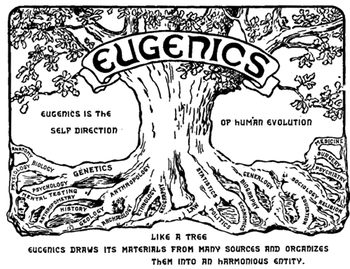
Some reformers used the principles of evolution to justify sexist and racist ideas that undercut their professed belief in equality. For example, the most extreme type of reform Darwinism was eugenics, a term coined by Sir Francis Galton in 1883 from the Greek word eügenáv, meaning well-born. Eugenists claimed that particular racial or social groups–usually wealthy Anglo-Saxons–were "naturally" superior to other groups. They proposed to control human heredity by passing laws that forbid marriage between races or that restrict breeding for various social "misfits" such as criminals or the mentally ill.

VI. Social Darwinism in the 20th Century

Although social Darwinism was highly influential at the beginning of the 20th century, it rapidly lost popularity and support after World War I (1914-1918). During the 1920s and 1930s many political observers blamed it for contributing to German militarism and the rise of Nazism (see  National Socialism). During this same period, advances in anthropology also discredited social Darwinism. German American anthropologist Franz Boas and American anthropologists Margaret Mead and Ruth Benedict showed that human culture sets people apart from animals. By shifting the emphasis away from biology and onto culture, these anthropologists undermined social Darwinism's biological foundations. Eugenics was discredited by a better understanding of genetics and eventually disgraced by Nazi dictator Adolf Hitler's use of eugenic arguments to create a "master race." During World War II (1939-1945), the Nazis killed several million Jews, Roma (Gypsies), and members of other groups, believing them inferior to an idealized Aryan race.

Social theories based on biology gained renewed support after 1953, when American biologist James Watson and British biologist Francis Crick successfully described the structure of the DNA molecule, the building block of all life. During the 1960s anthropologists interested in the influence of DNA on human behavior produced studies of the biological basis of aggression, territoriality, mate selection, and other behavior common to people and animals. Books on this theme, such as Desmond Morris's Naked Ape (1967) and Lionel Tiger's Men in Groups (1969), became best-sellers. In the early 1970s American psychologist Richard J. Herrnstein revived the social Darwinist argument that intelligence is mostly determined by biology rather than by environmental influences.

During the 1960s, British biologist W. D. Hamilton and American biologist Robert L. Trivers produced separate studies showing that the self-sacrificing behavior of some members of a group serves the genetic well-being of the group as a whole. American biologist Edward O. Wilson drew on these theories in Sociobiology: the New Synthesis (1975), where he argued that genetics exerts a greater influence on human behavior than scientists had previously believed. Wilson claimed that human behavior cannot be understood without taking both biology and culture into account. Wilson's views became the foundations of a new science–sociobiology–and were later popularized in such studies as Richard Dawkins' The Selfish Gene (1976). Wilson's critics have alleged that sociobiology is simply another version of social Darwinism. They claim that it downplays the role of culture in human societies and justifies poverty and warfare in the name of natural selection. Such criticism has led to a decline in the influence of sociobiology and other forms of social Darwinism.

Contributed By:

Robert C. Bannister, B.A., M.A., Ph.D.

Professor of History, Swarthmore College. Author of Social Darwinism: Science and Myth and On Liberty, Society, and Politics: The Essential Essays of William Graham Sumner.


Week 9


Thursday, October 22, 2020

Week 8

Image result for charles darwin
The Darwin Economy

Week 8

Image result for adam smith
Adam Smith's Wealth of Nations

Week 8

Jerusalem 
And did those feet in ancient time
Walk upon England's mountain green?
And was the holy Lamb of God
On England's pleasant pastures seen?
And did the countenance divine
Shine forth upon our clouded hills?
And was Jerusalem builded here
Among those dark satanic mills?

Bring me my bow of burning gold!
Bring me my arrows of desire!
Bring me my spear! O clouds, unfold!
Bring me my chariot of fire!
I will not cease from mental fight,
Nor shall my sword sleep in my hand,
Till we have built Jerusalem
In England's green and pleasant land.

Wednesday, October 14, 2020

Week 7

Image result for holy alliance treaty
The Holy Alliance Treaty

This treaty, drawn up by Tsar Alexander, reflects the return to conservative politics in Europe after the long struggle against Revolutionary and Imperial France. It was subsequently acceded to by all the monarchs of Europe except the King of Great Britain, who declined to sign on constitutional grounds, Pope Pius VII, who refused to treat with Protestant monarchs, and the Sultan of Turkey. Both Castlereagh and Metternich dismissed the wording of treaty as largely meaningless, and it had little influence on the policies of the signatories. Liberals and nationalists hated the Alliance as a symbol of the reactionary Restoration.\

The Holy Alliance Treaty
TREATY between Austria, Prussia, and Russia.

Signed at Paris 18 / 26th September 1815.


In the name of the Most Holy and Indivisible Trinity.

Holy Alliance of Sovereigns of Austria, Prussia, and Russia.
THEIR Majesties the Emperor of Austria, the King of Prussia, and the Emperor of Russia, having, in consequence of the great events which have marked the course of the three last years in Europe, and especially of the blessings which it has pleased Divine Providence to shower down upon those States which place their confidence and their hope on it alone, acquired the intimate conviction of the necessity of settling the steps to be observed by the Powers, in their reciprocal relations, upon the sublime truths which the Holy Religion of our Saviour teaches:

Government and Political Relations
They solemnly declare that the present Act has no other object than to publish, in the face of the whole world, their fixed resolution, both in the administration of their respective States, and in their political relations with every other Government, to take for their sole guide the precepts of that Holy Religion, namely, the precepts of Justice, Christian Charity, and Peace, which, far from being applicable only to private concerns, must have an immediate influence on the councils of Princes, and guide all their steps, as being the only means of consolidating human institutions and remedying their imperfections. In consequence, their Majesties have agreed on the following Articles:


Principles of the Christian Religion
ART. I. Conformably to the words of the Holy Scriptures, which command all men to consider each other as brethren, the Three contracting Monarchs will remain united by the bonds of a true and indissoluble fraternity, and considering each other as fellow countrymen, they will, on all occasions and in all places, lend each other aid and assistance; and, regarding themselves towards their subjects and armies as fathers of families, they will lead them, in the same spirit of fraternity with which they are animated, to protect Religion, Peace, and Justice.


Fraternity and Affection
ART. II. In consequence, the sole principle of force, whether between the said Governments or between their Subjects, shall be that of doing each other reciprocal service, and of testifying by unalterable good will the mutual affection with which they ought to be animated, to consider themselves all as members of one and the same Christian nation; the three allied Princes looking on themselves as merely designated by Providence to govern three branches of the One family, namely, Austria, Prussia, and Russia, thus confessing that the Christian world, of which they and their people form a part, has in reality no other Sovereign than Him to whom alone power really belongs, because in Him alone are found all the treasures of love, science, and infinite wisdom, that is to say, God, our Divine Saviour, the Word of the Most High, the Word of Life. Their Majesties consequently recommend to their people, with the most tender solicitude, as the sole means of enjoying that Peace, which arise from a good conscience, and which alone is more durable, to strengthen themselves every day more and more in the principles and exercise of the duties which the Divine Saviour has taught to mankind.


Accession of Foreign Powers
ART. III. All the powers who shall choose solemnly to avow the sacred principles which have dictated the present Act, and shall acknowledge how important it is for the happiness of nations, too long agitated, that these truths should henceforth exercise over the destinies of mankind all the influence which belongs to them, will be received with equal ardour and affection into this Holy Alliance.

Done in triplicate, and signed at Paris, the year of Grace 1815, 14/26th September.

(L.S.) Francis
(L.S.) Frederick William
(L.S.) Alexander

Week 7

"An die Freude""Ode to Joy"
Freude, schöner Götterfunken,
Tochter aus Elysium,
Wir betreten feuertrunken,
Himmlische, dein Heiligtum!
Deine Zauber binden wieder
Was die Mode streng geteilt*;
Alle Menschen werden Brüder*
Wo dein sanfter Flügel weilt.

Wem der große Wurf gelungen
Eines Freundes Freund zu sein;
Wer ein holdes Weib errungen
Mische seinen Jubel ein!
Ja, wer auch nur eine Seele
Sein nennt auf dem Erdenrund!
Und wer's nie gekonnt, der stehle
Weinend sich aus diesem Bund!

Freude trinken alle Wesen
An den Brüsten der Natur;
Alle Guten, alle Bösen
Folgen ihrer Rosenspur.
Küsse gab sie uns und Reben,
Einen Freund, geprüft im Tod;
Wollust ward dem Wurm gegeben
und der Cherub steht vor Gott.

Froh, wie seine Sonnen fliegen
Durch des Himmels prächt'gen Plan
Laufet, Brüder, eure Bahn,
Freudig, wie ein Held zum siegen.

Seid umschlungen, Millionen!
Diesen Kuß der ganzen Welt!
Brüder, über'm Sternenzelt
Muß ein lieber Vater wohnen.
Ihr stürzt nieder, Millionen?
Ahnest du den Schöpfer, Welt?
Such' ihn über'm Sternenzelt!
Über Sternen muß er wohnen.
Joy, beautiful spark of Divinity,
Daughter from Elysium,
We enter, drunk with fire,
Heavenly One, thy sanctuary!
Your magic binds again
What convention strictly divides;*
All people become brothers,*
Where your gentle wing abides.

Who has succeeded in the great attempt,
To be a friend's friend,
Whoever has won a lovely woman,
Add his to the jubilation!
Indeed, who calls even one soul
Theirs upon this world!
And whoever never managed, shall steal himself
Weeping away from this union!

All creatures drink of joy
At nature's breast.
Just and unjust
Follow her trail of roses.
She gave us kisses and the fruit of the vine,
A tried friend to the end.
[Even] the worm has been granted sensuality,
And the cherub stands before God!

Gladly, as His heavenly bodies fly
On their courses through the heavens,
Thus, brothers, you should run your race,
Joyful, like a hero going to conquest.

You millions, be embraced.
This kiss is for all the world!
Brothers, above the starry canopy
There must dwell a loving Father.
Do you fall in worship, you millions?
World, do you know your creator?
Seek him in the heavens
Above the stars must He dwell.

Thursday, October 8, 2020

Week 6


Week 6


Week 6

Image result for edmund burke

Edmund Burke (1729-1797) was not a reactionary. As a member of Parliament, he had supported the American colonists in their initial protests against the British government. He is most famous, however, for his writings on the French Revolution. His Reflections, written in the form of a long letter in 1791, in a sense marks the origin of modern conservative thought.

Kings, in one sense, are undoubtedly the servants of the people: because their power has no other rational end than that of the genera] advantage; but it is not true that they are, in the ordinary sense, (by our constitution at least), anything like servants; the essence of whose situation is to obey the commands oi some other, and to be removable al pleasure. But the king of Great Britain obeys no other person; all other persons are individually, and collectively too, under him, and owe to him a legal obedience. The law which knows neither to Ratter no to insult, calls this high magistrate not our servant, as this humble divine calls him, but "our sovereign Lord the King"; and we, on our parts have learned to speak only the primitive language of the law, and not the confused jargon of their Babylonian pulpits.

As he is not to obey us, but as we are to obey the law in him, Our constitution has made no sort of provision towards rendering him, as a servant, in any degree responsible Our constitution knows nothing of a magistrate like the Justicia of Aragon; nor of any court legally appointed, nor of any process legally settled, for submitting the king to the responsibility belonging to all servants. In this he is not distinguished from the Commons and the Lords; who, in their several public capacities, can never be called to an account of their conduct; although the Revolution Society chooses to assert in direct opposition to one ol the wisest and most beautiful parts of our constitution, that "a king is no more than the first servant of the public, created by it, and responsible to it."
Ill would our ancestors at the Revolution [of 1688-Ed.] have deserved their fame for wisdom, if they had found no security for their freedom, but in rendering their government feeble in its operations and precarious in its tenure; if the had been able to contrive no better remedy against arbitrary power than civil confusion. Let these gentlemen state who that representative public is to whom they will affirm the king, as a servant, to be responsible. It will be then time enough for me to produce to them the positive statute law which affirms that he is not.

The ceremony of cashiering kings of which these gentlemen talk so much at their ease, can rarely, if ever, be performed without force It then becomes a case of war, and not of constitution. Laws are commanded to hold their tongues amongst arms, and tribunals fall to the ground with the peace they are no longer able to uphold. The Revolution of 1688 was obtained by a just war, in the only case in which any war, and much more a civil war, can be just. "Justa bella quibus necessaria. " [Wars are just to those to whom they are necessary."-Ed.] ' The question of dethroning, or, if these gentlemen like the phrase better "cashiering kings," will always be, as it has always been, an extraordinary question of state, and wholly out of the law; a question (like all other questions of state) of dispositions, and of means, and of probable consequences, rather than of positive rights. As it was not made for common abuses, so it is not to be agitated by common minds. The speculative line of demarcation, where obedience ought to end, and resistance must begin, is faint, obscure, and not easily definable. It is not a single act, or a single event, which determines it. Governments must be abused and deranged indeed, before it can be thought of; and the prospect of the future must be as bad as the experience of the past. When things are in that lamentable condition, the nature of the disease is to indicate the remedy to those whom nature has qualified to administer in extremities this critical, ambiguous, bitter | potion to a distempered state. Times, and occasions, and provocations, will teach their own lessons. The wise will determine from the gravity of the case; the irritable, from sensibility to oppression; the high­minded, from disdain and indignation at abusive power in unworthy hands; the brave and bold, from the love of honourable danger in a generous cause; but, with or without right, a revolution will be the very last resource of the thinking and the good.

The third head of right, asserted by the pulpit of the Old Jewry, namely, the "right to form a government for ourselves," has, at least, as little countenance from anything done at the Revolution [of 1688- Ed.], either in precedent or principle, as the two first of their claims. The Revolution was made to preserve our ancient, indisputable laws and liberties, and that ancient constitution of government which is our only security for law and liberty. If you are desirous of knowing the spirit of our constitution, and the policy which predominated in that great period which has secured it to this hour, pray look for both in our histories, in our records, in our acts of parliament, and journals of parliament, and not in the sermons of the Old Jewry, and the after­dinner toasts of the Revolution Society. In the former you will find other ideas and another language. Such a claim is as ill­suited to our temper and wishes as it is unsupported by an appearance of authority. The very idea of the fabrication of a new government is enough to fill us with disgust and horror. We wished at the period of the Revolution, and do now wish, to derive all we possess as an inheritance from our forefathers. Upon that body and stock of inheritance we have taken care not to inoculate any scion alien to the nature of the original plant. All the reformations we have hitherto made have proceeded upon the principle of reverence to antiquity: and I hope, nay I am persuaded, that all those which possibly may be made hereafter, will be carefully formed upon analogical precedent, authority, and example.

Our oldest reformation is that of Magna Charta. You will see that Sir Edward Coke, that great oracle of our law, and indeed all the great men who follow him, to Blackstone, are industrious to prove the pedigree of our liberties. They endeavour to prove, that the ancient charter, the Magna Charta of King John, was connected with another positive charter from Henry I, and that both the one and the other were nothing more than a reaffirmance of the still more ancient standing law of the kingdom. In the matter of fact, for the greater part, these authors appear to be in the right; perhaps not always; but if the lawyers mistake in some particulars, it proves my position still the more strongly; because it demonstrates the powerful prepossession towards antiquity, with which the minds of all our lawyers and legislators, and of all the people whom they wish to influence, have been always filled; and the stationary policy of this kingdom in considering their most sacred rights and franchises as an inheritance.

In the famous law of the 3rd of Charles I, called the Petition of Right, the parliament says to the king, "Your subjects have inherited this freedom," claiming their franchises not on abstract principles "as the rights of men," but as the rights of Englishmen, and as a patrimony derived from their forefathers. Selden, and the other profoundly learned men, who drew this Petition of Right, were as well acquainted, at least, with all the general theories concerning the "rights of men," as any of the discourses in our pulpits, or on your tribune, full as well as Dr. Price, or as the Abbé Siéyès. But, for reasons worthy of that practical wisdom which superseded their theoretic science, they preferred this positive, recorded, hereditary title to all which can be dear to the man and the citizen, to that vague speculative right, which exposed their sure inheritance to be scrambled for and torn to pieces by every wild, litigious spirit.

The same policy pervades all the laws which have since been made for the preservation of our liberties. In the 1st of William and Mary, in the famous statute, called the Declaration of Right, the two Houses utter not a syllable of "a right to frame a government for themselves." You will see, that their whole care was to secure the religion, laws, and liberties that had been long possessed, and had been lately endangered. "Taking into their most serious consideration the best means for making such an establishment, that their religion, laws, and liberties might not be in danger of being again subverted," they auspicate all their proceedings, by stating as some of those best means, "in the first place" to do "as their ancestors in like cases have usually done for vindicating their ancient rights and liberties, to declare";-and then they pray the king and queen, "that it may be declared and enacted, that all and singular the rights and liberties asserted and declared, are the true ancient and indubitable rights and liberties of the people of this kingdom.

You will observe that from Magna Charta to the Declaration of Right, it has been the uniform policy of our constitution to claim and assert our liberties as an entailed inheritance derived to us from our forefathers, and to be transmitted to our posterity; as an estate specially belonging to the people of this kingdom, without any reference whatever to any other more general or prior right. By this means our constitution preserves a unity in so great a diversity of its parts. We have an inheritable crown; an inheritable peerage; and a House of Commons and a people inheriting privileges, franchises, and liberties, from a long line of ancestors.

This policy appears to me to be the result of profound reflection; or rather the happy effect of following nature, which is wisdom without reflection, and above it. A spirit of innovation is generally the result of a selfish temper, and confined views. People will not look forward to posterity, who never look backward to their ancestors. Besides, the people of England well know, that the idea of inheritance furnishes a sure principle of conservation, and a sure principle of transmission; without at all excluding a principle of improvement. It leaves acquisition free; but it secures what it acquires. Whatever advantages are obtained by a state proceeding on these maxims, are locked fast as in a sort of family settlement; grasped as in a kind of mortmain for ever. By a constitutional policy, working after the pattern of nature, we receive, we hold, we transmit our government and our privileges, in the same manner in which we enjoy and transmit our property alad our lives. The institutions of policy, the goods of fortune, the gifts of providence, are handed down to us, and from us, in the same course and order. Our political system is placed in a just correspondence and symmetry with the order of the world, and with the mode of existence decreed to a permanent body composed of transitory parts; wherein, by the disposition of a stupendous wisdom, moulding together the great mysterious incorporation of the human race, the whole, at one time, is never old, or middle-aged, or young, but, in a condition of unchangeable constancy, moves on through the varied tenor of perpetual decay, fall, renovation, and progression. Thus, by preserving the method of nature in the conduct of the state, in what we improve, we are never wholly new; in what we retain, we are never wholly obsolete. By adhering in this manner and on those principles to our forefathers, we are guided not by the superstition of antiquarians, but by the spirit of philosophic analogy. In this choice of inheritance we have given to our frame of polity the image of a relation in blood; binding up the constitution of our country with our dearest domestic ties; adopting our fundamental laws into the bosom of our family affections; keeping inseparable, and cherishing with the warmth of all their combined and mutually reflected charities, our state, our hearts, our sepulchres, and our altars.

Through the same plan of a conformity to nature in our artificial institutions, and by calling in the aid of her unerring and powerful instincts to fortify the fallible and feeble contrivances of our reason, we have derived several others, and those no small benefits, from considering our liberties in the light of an inheritance. Always acting as if in the presence of canonized forefathers, the spirit of freedom, leading in itself to misrule and excess, is tempered with an awful gravity. This idea of a liberal descent inspires us with a sense of habitual native dignity, which prevents that upstart insolence almost inevitably adhering to and disgracing those who are the first acquirers of any distinction. By this means our liberty becomes a noble freedom. It carries an imposing and majestic aspect. It has a pedigree and illustrating ancestors. It has its bearings and its ensigns armorial. It has its gallery of portraits; its monumental inscriptions; its records, evidences, and titles. We procure reverence to our civil institutions on the principle upon which nature teaches us to revere individual men; on account of their age, and on account of those from whom they are descended. All your sophisters cannot produce anything better adapted to preserve a rational and manly freedom than the course that we have pursued, who have chosen our nature, rather than our speculations, our breasts rather than our inventions, for the great conservatories and magazines of our rights and privileges.

You [in France-Ed.] might, if you pleased, have profited of our example, and have given to your recovered freedom a correspondent dignity. Your privileges, though discontinued, were not lost to memory. Your constitution, it is true, whilst you were out of possession, suffered waste and dilapidation; but you possessed in some parts the walls, and, in all, the foundations, of a noble and venerable castle. You might have repaired those walls;

you might have built on those old foundations. Your constitution was suspended before it was perfected; but you had the elements of a constitution very nearly as good as could be wished. In your old states you possessed that variety of parts corresponding with the various descriptions of which your community was happily composed; you had all that combination, and all that opposition of interests, you had that action and counteraction, which, in the natural and in the political world, from the reciprocal struggle of discordant powers, draws out the harmony of the universe. These opposed and conflicting interests, which you considered as so great a blemish in your old and in our present constitution, interpose a salutary check to all precipitate resolutions. They render deliberation a matter not of choice, but of necessity; they make all change a subject of compromise, which naturally begets moderation; they produce temperaments preventing the sore evil of harsh, crude, unqualified reformations; and rendering all the headlong exertions of arbitrary power, in the few or in the many, for ever impracticable. Through that diversity of members and interests, general liberty had as many securities as there were separate views in the several orders; whilst by pressing down the whole by the weight of a real monarchy, the separate parts would have been prevented from warping, and starting from their allotted places.

You had all these advantages in your ancient states; but you chose to act as if you had never been moulded into civil society, and had everything to begin anew. You began ill, because you began by despising everything that belonged to you. You set up your trade without a capital. If the last generations of your country appeared without much lustre in your eyes, you might have passed them by, and derived your claims from a more early race of ancestors. Under a pious predilection for those ancestors your imaginations would have realized in them a standard of virtue and wisdom, beyond the vulgar practice of the hour: and you would have risen with the example to whose imitation you aspired. Respecting your forefathers, you would have been taught to respect yourselves You would not have chosen to consider the French as a people of yesterday, as a nation of low­born servile wretches until the emancipating year of 1789. In order to furnish, at the expense of your honour, an excuse to your apologists here for several enormities of yours, you would not have been content to be represented as a gang of Maroon slaves, suddenly broke loose from the house of bondage, and therefore to be pardoned for your abuse of the liberty to which you were not accustomed, and ill fitted. Would it not, my worthy friend, have been wiser to have you thought, what I, for one, always thought you, a generous and gallant nation, long misled to your disadvantage by your high and romantic sentiments of fidelity, honour, and loyalty; that events had been unfavourable to you, but that you were not enslaved through any illiberal or servile disposition; in your most devoted submission, you were actuated by a principle of public spirit, and that it was your Country you worshipped, in the person of your king? Had you made it to be understood, that in the delusion of this amiable error you had gone further than your wise ancestors; that you were resolved to resume your ancient privileges, whilst you preserved the spirit of your ancient and your recent loyalty and honour; or if, diffident of yourselves, and not clearly discerning the almost obliterated constitution of your ancestors, you had looked to your neighbours in this land, who had kept alive the ancient principles and models of the old common law of Europe meliorated and adapted to its present state-by following wise examples you would have given new examples of wisdom to the world. You would have rendered the cause of liberty venerable in the eyes of every worthy mind in every nation. You would have shamed despotism from the earth, by showing that freedom was not only reconcilable, but, as when well disciplined it is, auxiliary to law. You would have an unoppressive but a productive revenue. You would have had a flourishing commerce to feed it. You would have had a free constitution; a potent monarchy; a disciplined army; a reformed and venerated clergy; a mitigated but spirited nobility, to lead your virtue, not to overlay it; you would have had a liberal order of commons, to emulate and to recruit that nobility; you would have had a protected, satisfied, laborious, and obedient people, taught to seek and to recognise the happiness that is to be found by virtue in all conditions; in which consists the true moral equality of mankind, and not in that monstrous fiction, which, by inspiring false ideas and vain expectations into men destined to travel in the obscure walk of laborious life, serves only to aggravate and embitter that real inequality, which it never can remove; and which the order of civil life establishes as much for the benefit of those whom it must leave in an humble state, as those whom it is able to exalt to a condition more splendid, but not more happy. You had a smooth and easy career of felicity and glory laid open to you beyond anything recorded in the history of the world; but you have shown that difficulty is good for men.

Compute your gains: see what is got by those extravagant and presumptuous speculations which have taught your leaders to despise all their predecessors, and all their contemporaries, and even to despise themselves, until the moment in which they became truly despicable. By following those false lights, France has bought undisguised calamities at a higher price than any nation has purchased the most unequivocal blessings! France has bought poverty by crime! France has not sacrificed her virtue to her interest, but she has abandoned her interest, that she might prostitute her virtue. All other nations have begun the fabric of a new government, or the reformation of an old, by establishing originally, or by enforcing with greater exactness some rites or other of religion. All other people have laid the foundations of civil freedom in severer manners, and a system of a more austere and masculine morality. France, when she let loose the reins of regal authority, doubled the license of a ferocious dissoluteness in manners, and of an insolent irreligion in opinions and practices; and has extended through all ranks of life, as if she were communicating some privilege, or laying open some secluded benefit, all the unhappy corruptions that usually were the disease of wealth and power. This is one of the new principles of equality in France.

France, by the perfidy of her leaders has utterly disgraced the tone of lenient council in the cabinets of princes, and disarmed it of its most potent topics. She has sanctified the dark, suspicious maxims of tyrannous distrust; and taught kings to tremble at (what will hereafter be called) the delusive plausibilities of moral politicians. Sovereigns will consider those, who advise them to place an unlimited confidence in their people, as subverters of their throne; as traitors who aim at their destruction, by leading their easy good nature, under specious pretences, to admit combinations of bold and faithless men into a participation of their power. This alone (if there were nothing else) is an irreparable calamity to you and to mankind. Remember that your parliament of Paris told your king, that, in calling the states together, he had nothing to fear but the prodigal excess of their zeal in providing for the support of the throne. It is right that these men should hide their heads. It is right that they should bear their part in the ruin which their counsel has brought on their sovereign and their country. Such sanguine declarations tend to lull authority asleep; to encourage it rashly to engage in perilous adventures of untried policy; to neglect those provisions, preparations, and precautions, which distinguish benevolence from imbecility; and without which no man can answer for the salutary effect of any abstract plan of government or of freedom. For want of these, they have seen the medicine of the state corrupted into its poison. They have seen the French rebel against a mild and lawful monarch, with more fury, outrage, and insult, than ever any people has been known to rise against the most illegal usurper, or the most sanguinary tyrant. Their I resistance was made to concession; | their revolt was from protection; their blow was aimed at a hand holding out graces, favours, and immunities.

This was unnatural. The rest is in order. They have found their punishment in their success. Laws overturned; tribunals subverted; industry without vigor; commerce expiring, the revenue unpaid, yet the people impoverished; a church pillaged, and a state not relieved; civil and military anarchy made the constitution of the kingdom; everything human and divine sacrificed to the idol of public credit, and national bankruptcy the consequence; and, to crown all, the paper securities or new, precarious, tottering power, the discredited paper securities of impoverished fraud and beggared rapine, held out as a currency for the support of an empire, in lieu of the two great recognised species that represent the lasting, conventional credit of mankind, which disappeared and hid themselves in the earth from whence they came, when the principle of property, whose creatures j and representatives they are, was systematically subverted.

Were all those dreadful things necessary? Were they the inevitable results of the desperate struggle of determined patriots, compelled to wade through blood and tumult, to the quiet shore of a tranquil and prosperous liberty? No! nothing like it. The fresh ruins of France, which shock our feelings wherever we can turn our eyes, are not the devastation of civil war; they are the sad but instructive monuments of rash and ignorant counsel in time of profound peace. They are the display of inconsiderate and presumptuous, because unresisted and irresistible, authority. The persons who have thus squandered away the precious treasure of their crimes, the persons who have made this prodigal and wild waste of public evils, (the last stage reserved for the ultimate ransom of the state), have met in their progress with little, or rather with no opposition at all. Their whole march was more like a triumphal procession, than the progress of a war. Their pioneers have gone before them, and demolished and laid everything level at their feet. Not one drop of their blood have they shed in the cause of the country they have ruined. They have made no sacrifices to their projects of greater consequence than their shoe­buckles, whilst they were imprisoning their king, murdering their fellow citizens, and bathing in tears, and plunging in poverty and distress, thousands of worthy men and worthy families. Their cruelty has not even been the base result of fear. It has been the effect of their sense of perfect safety, in authorizing treasons, robberies, rapes, assassinations, slaughters, and burnings, throughout their harassed land. But the cause of all was plain from the beginning.

This unforced choice, this fond election of evil, would appear perfectly unaccountable, if we did not consider the composition of the National Assembly: I do not mean its formal constitution, which, as it now stands, is exceptional enough, but the materials of which, in a great measure, it is composed, which is of ten thousand times greater consequence than all the formalities in the world. If we were to know nothing of this assembly but by its title and function, no colours could paint to the imagination anything more venerable. In that light the mind of an inquirer, subdued by such an awful image as that of the virtue and wisdom of a whole people collected into a focus, would pause and hesitate in condemning things even of the very worst aspect. Instead of blameable, they would appear only mysterious. But no name, no power, no function, no artificial institution whatsoever, can make the men of whom any system of authority is composed, any other than God, and nature, and education, and their habits of life have made them. Capacities beyond these the people have not to give. Virtue and wisdom may be the objects of their choice; but their choice confers neither the one nor the other on those upon whom they lay their ordaining hands. They have not the engagement of nature, they have not the promise of revelation, for any such powers.

After I have read over the list of the persons and descriptions elected into the Tiers Etat, nothing which they afterwards did could appear astonishing. Among them, indeed, I saw some of known rank; some of shining talents; but of any practical experience in the state, not one man was to be found. The best were only men of theory. But whatever the distinguished few may have been, it is the substance, the mass of the body which constitutes its character, and must finally determine its direction. In all bodies, those who will lead, must also, in a considerable degree, follow. They must conform their propositions to the taste, talent, and disposition, of those whom they wish to conduct: therefore, ii` an assembly is viciously or feebly composed in a very great part of it, nothing but such a supreme degree of virtue as very rarely appears in the world, and for that reason cannot enter into calculation, will prevent the men of talent disseminated through it from becoming only the expert instruments of absurd projects! If, what is the more likely event, instead of that unusual degree of virtue, they should be actuated by sinister ambition, and a lust of meretricious glory, then the feeble part of the assembly, to whom at first they conform, becomes in its turn the dupe and instrument of their designs. In this political traffic, the leaders will be obliged to bow to the ignorance of their followers, and the followers to become subservient to the worst designs of their leaders.

To secure any degree of sobriety in the propositions made by the leaders in any public assembly, they ought to respect, in some degree perhaps to fear, those whom they conduct. To be led any otherwise than blindly, the followers must be qualified, if not for actors, at least for judges; they must also be judges of natural weight and authority. Nothing can secure a steady and moderate conduct in such assemblies, but that the body of them should be respectably composed, in point of condition in life, of permanent property, of education, and of such habits as enlarge and liberalize the understanding.

In the calling of the Estates-General of France, the first thing that struck me, was a great departure from the ancient course. I found the representation for the third estate composed of six hundred persons. They were equal in number to the representatives of both the other orders. If the orders were to act separately, the number would not, beyond the consideration of the expense, be of much moment. But when it became apparent that the three orders were to be melted down into one, the policy and necessary effect of this numerous representation became obvious. A very small desertion from either of the other two orders must throw the power of both into the hands of the third. In fact, the whole power of the state was soon resolved into that body. Its due composition became therefore of infinitely the greater importance.

Judge, Sir, of my surprise, when I found that a very great proportion of the assembly (a majority, I believe, of the members who attended) was composed of practitioners in the law. It was composed, not of distinguished magistrates, who had given pledges to their country of their science, prudence, and integrity; not of leading advocates, the glory of the bar; not of renowned professors in univerSitieS-but for the far greater part, as it must in such a number, of the inferior, unlearned, mechanical, merely instrumental members of the profession. There were distinguished exceptions, but the general composition was of obscure provincial advocates, of stewards of petty local jurisdictions, country attorneys, notaries, and the whole train of the ministers of municipal litigation, the fomenters and conductors of the petty war of village vexation. From the moment I read the list, I saw distinctly, and very nearly as it has happened, all that was to follow.

The degree of estimation in which any profession is held becomes the standard of the estimation in which the professors hold themselves. Whatever the personal merits of many individual lawyers might have been, and in many it was undoubtedly very considerable, in that military kingdom no part of the profession had been much regarded, except the highest of all, who often united to their professional offices great family splendour, and were invested with great power and authority. These certainly were highly respected, and even with no small degree of awe. The next rank was not much esteemed; the mechanical part was in a very low degree of repute.

Whenever the supreme authority is vested in a body so composed, it must evidently produce the consequences of supreme authority placed in the hands of men not taught habitually to respect themselves; who had no previous fortune in character at stake; who could not be expected to bear with moderation, or to conduct with discretion, a power, which they themselves, more than any others, must be surprised to find in their hands. Who could flatter himself that these men, suddenly, and, as it were, by enchantment, snatched from the humblest rank of subordination, would not be intoxicated with their unprepared greatness? Who could conceive that men, who are habitually meddling, daring, subtle, active, of litigious dispositions and unquiet minds would easily fall back into their old condition of obscure contention, and laborious, low, and unprofitable chicane? Who could doubt but that, at any expense to the state, of which they understood nothing, they must pursue their private interests which they understood but too well? It was not an event depending on chance, or contingency. It was inevitable; it was necessary; it was planted in the nature of things. They must join (if their capacity did not permit them to lead) in any project which could procure them those innumerable lucrative jobs, which follow in the train of all great convulsions and revolutions in the state, and particularly in all great and violent permutations of property. Was it to be expected that they would attend to the stability of property, whose existence had always depended upon whatever rendered property questionable, ambiguous, and insecure? Their objects would be enlarged with their elevation, but their disposition and habits, and mode of accomplishing their designs, must remain the same.

Well! but these men were to be tempered and restrained by other descriptions, of more sober and more enlarged understandings Were they then to be awed by the supereminent authority and awful dignity of a handful of country clowns, who have seats in that assembly, some of whom are said not to be able to read and write? and by not a great number of traders who, though somewhat more instructed, and more conspicuous in the order of society, had never known anything beyond their countinghouse. No! both these descriptions were more formed to be overborne and swayed by the intrigues and artifices of lawyers, than to become their counterpoise. With such a dangerous disproportion, the whole must needs be governed by them. To the faculty of law was joined a pretty considerable proportion of the faculty of medicine. This faculty had not, any more than that of the law, possessed in France its just estimation. Its professors, therefore, must have the qualities of men not habituated to sentiments of dignity. But supposing they had ranked as they ought to do, and as with us they do actually, the sides of sickbeds are not the academies for forming statesmen and legislators. Then came the dealers in stock and funds, who must be eager, at any expense, to change their ideal paper wealth for the more solid substance of land. To these were joined men of other descriptions, from whom as little knowledge of, or attention to, the interests of a great state was to be expected, and as little regard to the stability of any institution; men formed to be instruments, not controls. Such in general was the composition of the Tiers Etat in the National Assembly; in which was scarcely to be perceived the slightest traces of what we call the natural landed interest of the country.

We know that the British House of Commons, without shutting its doors to any merit in any class, is, by the sure operation of adequate causes, filled with everything illustrious in rank, in descent, in hereditary and in acquired opulence, in cultivated talents, in military, civil, naval, and political distinction, that the country can afford. But supposing, what hardly can be supposed, as a case, that the House of Commons should be composed in the same manner with the Tiers Etat in France, would this dominion of chicane be borne with patience, or even conceived without horror? God forbid I should insinuate anything derogatory to that profession, which is another priesthood, administering the rights of sacred justice. But whilst I revere men in the functions which belong to them, and would do as much as one man can do to prevent their exclusion from any, I cannot, to flatter them, give the lie to nature. They are good and useful in the composition; they must be mischievous if they preponderate so as virtually to become the whole. Their very excellence in their peculiar functions may be far from a qualification for others. It cannot escape observation, that when men are too much confined to professional and faculty habits, and as it were inveterate in the recurrent employment of that narrow circle, they are rather disabled than qualified for whatever depends on the knowledge of mankind, on experience in mixed affairs, on a comprehensive, connected view of the various complicated, external and internal interests, which go to the formation of that multifarious thing called a state.

After all, if the House of Commons were to have a wholly professional and faculty composition, what is the power of the House of Commons, circumscribed and shut in by the immoveable barriers of laws, usages, positive rules of doctrine and practice, counterpoised by the House of Lords, and every moment of its existence at the discretion of the crown to continue, prorogue, or dissolve us? The power of the House of Commons, direct or indirect, is indeed great; and long may it be able to preserve its greatness, and the spirit belonging to true greatness, at the full; and it will do so, as long as it can keep the breakers of law in India from becoming the makers of law for England. The power, however, of the House of Commons, when least diminished, is as a drop of water in the ocean, compared to that residing in a settled majority of your National Assembly. That assembly, since the destruction of the orders, has no fundamental law, no strict convention, no respected usage to restrain it. Instead of finding themselves obliged to conform to a fixed constitution, they have a power to make a constitution which shall conform to their designs. Nothing in heaven or upon earth can serve as a control on them. What ought to be the heads, the hearts, the dispositions, that are qualified, or that dare, not only to make laws under a fixed constitution, but at one heat to strike out a totally new constitution for a great kingdom, and in every part of it, from the monarch on the throne to the vestry of a parish? But-"fools rush in where angels fear to tread." In such a state of unbounded power for undefined and undefinable purposes, the evil of a moral and almost physical inaptitude of the man to the function must be the greatest we can conceive to happen in the management of human affairs.

Having considered the composition of the Third Estate as it stood in its original frame, I took a view of the representatives of the clergy. There too it appeared, that full as little regard was had to the general security of property, or to the aptitude of the deputies for their public purposes, in the principles of their election. That election was so contrived, as to send a very large proportion of mere country curates to the great and arduous work of new­modelling a state; men who never had seen the state so much as in a picture; men who knew nothing of the world beyond the bounds of an obscure village; who, immersed in hopeless poverty, could regard all property, whether secular or ecclesiastical, with no other eye than that of envy; among whom must be many who, for the smallest hope of the meanest dividend in plunder, would readily join in any attempts upon a body of wealth, in which they could hardly look to have any share, except in a general scramble. Instead of balancing the power of the active chicaners in the other assembly, these curates must necessarily become the active coadjutors, or at best the passive instruments, of those by whom they had been habitually guided in their petty village concerns. They too could hardly be the most conscientious of their kind, who presuming upon their incompetent understanding, could intrigue for a trust which led them from their natural relation to their flocks, and their natural spheres of action, to undertake the regeneration of kingdoms. This preponderating weight, being added to the force of the body of chicane in the Tiers Etat, completed that momentum of ignorance, rashness, presumption, and lust of plunder, which nothing has been able to resist.

To observing men it must have appeared from the beginning, that the majority of the Third Estate, in conjunction with such a deputation from the clergy as I have described whilst it pursued the destruction of the nobility, would inevitably become subservient to the worst designs of individuals in that class. In the spoil and humiliation of their own order these individuals would possess a sure fund for the pay of their new followers. To squander away the objects which made the happiness of their fellows, would be to them no sacrifice at all. Turbulent, discontented men of quality, in proportion as they are puffed up with personal pride and arrogance, generally despise their own order. One of the first symptoms they discover of a selfish and mischievous ambition, is a profligate disregard of a dignity which they partake with others. To be attached to the subdivision, to love the platoon we belong to in society is the first principle (the germ as it were) of public affections. It is the first link in the series by which we proceed towards a love to our country, and to mankind. The interest of that portion of social arrangement is a trust in the hands of all those who compose it; and as none but bad men would justify it in abuse, none but traitors would barter it away for their own personal advantage.

Source: Edmund Burke, Works, (London: 1867)
Thursday, October 1, 2020

Week 5


Week 5

What Is Enlightenment?
Immanuel Kant 


Enlightenment is man's emergence from his self-imposed nonage. Nonage is the inability to use one's own understanding without another's guidance. This nonage is self-imposed if its cause lies not in lack of understanding but in indecision and lack of courage to use one's own mind without another's guidance. Dare to know! (Sapere aude.) "Have the courage to use your own understanding," is therefore the motto of the enlightenment.
Laziness and cowardice are the reasons why such a large part of mankind gladly remain minors all their lives, long after nature has freed them from external guidance. They are the reasons why it is so easy for others to set themselves up as guardians. It is so comfortable to be a minor. If I have a book that thinks for me, a pastor who acts as my conscience, a physician who prescribes my diet, and so on--then I have no need to exert myself. I have no need to think, if only I can pay; others will take care of that disagreeable business for me. Those guardians who have kindly taken supervision upon themselves see to it that the overwhelming majority of mankind--among them the entire fair sex--should consider the step to maturity, not only as hard, but as extremely dangerous. First, these guardians make their domestic cattle stupid and carefully prevent the docile creatures from taking a single step without the leading-strings to which they have fastened them. Then they show them the danger that would threaten them if they should try to walk by themselves. Now this danger is really not very great; after stumbling a few times they would, at last, learn to walk. However, examples of such failures intimidate and generally discourage all further attempts.
Thus it is very difficult for the individual to work himself out of the nonage which has become almost second nature to him. He has even grown to like it, and is at first really incapable of using his own understanding because he has never been permitted to try it. Dogmas and formulas, these mechanical tools designed for reasonable use--or rather abuse--of his natural gifts, are the fetters of an everlasting nonage. The man who casts them off would make an uncertain leap over the narrowest ditch, because he is not used to such free movement. That is why there are only a few men who walk firmly, and who have emerged from nonage by cultivating their own minds.
It is more nearly possible, however, for the public to enlighten itself; indeed, if it is only given freedom, enlightenment is almost inevitable. There will always be a few independent thinkers, even among the self-appointed guardians of the multitude. Once such men have thrown off the yoke of nonage, they will spread about them the spirit of a reasonable appreciation of man's value and of his duty to think for himself. It is especially to be noted that the public which was earlier brought under the yoke by these men afterwards forces these very guardians to remain in submission, if it is so incited by some of its guardians who are themselves incapable of any enlightenment. That shows how pernicious it is to implant prejudices: they will eventually revenge themselves upon their authors or their authors' descendants. Therefore, a public can achieve enlightenment only slowly. A revolution may bring about the end of a personal despotism or of avaricious tyrannical oppression, but never a true reform of modes of thought. New prejudices will serve, in place of the old, as guide lines for the unthinking multitude.
This enlightenment requires nothing but freedom--and the most innocent of all that may be called "freedom": freedom to make public use of one's reason in all matters. Now I hear the cry from all sides: "Do not argue!" The officer says: "Do not argue--drill!" The tax collector: "Do not argue--pay!" The pastor: "Do not argue--believe!" Only one ruler in the world says: "Argue as much as you please, but obey!" We find restrictions on freedom everywhere. But which restriction is harmful to enlightenment? Which restriction is innocent, and which advances enlightenment? I reply: the public use of one's reason must be free at all times, and this alone can bring enlightenment to mankind.
On the other hand, the private use of reason may frequently be narrowly restricted without especially hindering the progress of enlightenment. By "public use of one's reason" I mean that use which a man, as scholar, makes of it before the reading public. I call "private use" that use which a man makes of his reason in a civic post that has been entrusted to him. In some affairs affecting the interest of the community a certain [governmental] mechanism is necessary in which some members of the community remain passive. This creates an artificial unanimity which will serve the fulfillment of public objectives, or at least keep these objectives from being destroyed. Here arguing is not permitted: one must obey. Insofar as a part of this machine considers himself at the same time a member of a universal community--a world society of citizens--(let us say that he thinks of himself as a scholar rationally addressing his public through his writings) he may indeed argue, and the affairs with which he is associated in part as a passive member will not suffer. Thus it would be very unfortunate if an officer on duty and under orders from his superiors should want to criticize the appropriateness or utility of his orders. He must obey. But as a scholar he could not rightfully be prevented from taking notice of the mistakes in the military service and from submitting his views to his public for its judgment. The citizen cannot refuse to pay the taxes levied upon him; indeed, impertinent censure of such taxes could be punished as a scandal that might cause general disobedience. Nevertheless, this man does not violate the duties of a citizen if, as a scholar, he publicly expresses his objections to the impropriety or possible injustice of such levies. A pastor, too, is bound to preach to his congregation in accord with the doctrines of the church which he serves, for he was ordained on that condition. But as a scholar he has full freedom, indeed the obligation, to communicate to his public all his carefully examined and constructive thoughts concerning errors in that doctrine and his proposals concerning improvement of religious dogma and church institutions. This is nothing that could burden his conscience. For what he teaches in pursuance of his office as representative of the church, he represents as something which he is not free to teach as he sees it. He speaks as one who is employed to speak in the name and under the orders of another. He will say: "Our church teaches this or that; these are the proofs which it employs." Thus he will benefit his congregation as much as possible by presenting doctrines to which he may not subscribe with full conviction. He can commit himself to teach them because it is not completely impossible that they may contain hidden truth. In any event, he has found nothing in the doctrines that contradicts the heart of religion. For if he believed that such contradictions existed he would not be able to administer his office with a clear conscience. He would have to resign it. Therefore the use which a scholar makes of his reason before the congregation that employs him is only a private use, for no matter how sizable, this is only a domestic audience. In view of this he, as preacher, is not free and ought not to be free, since he is carrying out the orders of others. On the other hand, as the scholar who speaks to his own public (the world) through his writings, the minister in the public use of his reason enjoys unlimited freedom to use his own reason and to speak for himself. That the spiritual guardians of the people should themselves be treated as minors is an absurdity which would result in perpetuating absurdities.
But should a society of ministers, say a Church Council, . . . have the right to commit itself by oath to a certain unalterable doctrine, in order to secure perpetual guardianship over all its members and through them over the people? I say that this is quite impossible. Such a contract, concluded to keep all further enlightenment from humanity, is simply null and void even if it should be confirmed by the sovereign power, by parliaments, and the most solemn treaties. An epoch cannot conclude a pact that will commit succeeding ages, prevent them from increasing their significant insights, purging themselves of errors, and generally progressing in enlightenment. That would be a crime against human nature whose proper destiny lies precisely in such progress. Therefore, succeeding ages are fully entitled to repudiate such decisions as unauthorized and outrageous. The touchstone of all those decisions that may be made into law for a people lies in this question: Could a people impose such a law upon itself? Now it might be possible to introduce a certain order for a definite short period of time in expectation of better order. But, while this provisional order continues, each citizen (above all, each pastor acting as a scholar) should be left free to publish his criticisms of the faults of existing institutions. This should continue until public understanding of these matters has gone so far that, by uniting the voices of many (although not necessarily all) scholars, reform proposals could be brought before the sovereign to protect those congregations which had decided according to their best lights upon an altered religious order, without, however, hindering those who want to remain true to the old institutions. But to agree to a perpetual religious constitution which is not publicly questioned by anyone would be, as it were, to annihilate a period of time in the progress of man's improvement. This must be absolutely forbidden.
A man may postpone his own enlightenment, but only for a limited period of time. And to give up enlightenment altogether, either for oneself or one's descendants, is to violate and to trample upon the sacred rights of man. What a people may not decide for itself may even less be decided for it by a monarch, for his reputation as a ruler consists precisely in the way in which he unites the will of the whole people within his own. If he only sees to it that all true or supposed [religious] improvement remains in step with the civic order, he can for the rest leave his subjects alone to do what they find necessary for the salvation of their souls. Salvation is none of his business; it is his business to prevent one man from forcibly keeping another from determining and promoting his salvation to the best of his ability. Indeed, it would be prejudicial to his majesty if he meddled in these matters and supervised the writings in which his subjects seek to bring their [religious] views into the open, even when he does this from his own highest insight, because then he exposes himself to the reproach: Caesar non est supra grammaticos. 2    It is worse when he debases his sovereign power so far as to support the spiritual despotism of a few tyrants in his state over the rest of his subjects.
When we ask, Are we now living in an enlightened age? the answer is, No, but we live in an age of enlightenment. As matters now stand it is still far from true that men are already capable of using their own reason in religious matters confidently and correctly without external guidance. Still, we have some obvious indications that the field of working toward the goal [of religious truth] is now opened. What is more, the hindrances against general enlightenment or the emergence from self-imposed nonage are gradually diminishing. In this respect this is the age of the enlightenment and the century of Frederick [the Great].
A prince ought not to deem it beneath his dignity to state that he considers it his duty not to dictate anything to his subjects in religious matters, but to leave them complete freedom. If he repudiates the arrogant word "tolerant", he is himself enlightened; he deserves to be praised by a grateful world and posterity as that man who was the first to liberate mankind from dependence, at least on the government, and let everybody use his own reason in matters of conscience. Under his reign, honorable pastors, acting as scholars and regardless of the duties of their office, can freely and openly publish their ideas to the world for inspection, although they deviate here and there from accepted doctrine. This is even more true of every person not restrained by any oath of office. This spirit of freedom is spreading beyond the boundaries [of Prussia] even where it has to struggle against the external hindrances established by a government that fails to grasp its true interest. [Frederick's Prussia] is a shining example that freedom need not cause the least worry concerning public order or the unity of the community. When one does not deliberately attempt to keep men in barbarism, they will gradually work out of that condition by themselves.
I have emphasized the main point of the enlightenment--man's emergence from his self-imposed nonage--primarily in religious matters, because our rulers have no interest in playing the guardian to their subjects in the arts and sciences. Above all, nonage in religion is not only the most harmful but the most dishonorable. But the disposition of a sovereign ruler who favors freedom in the arts and sciences goes even further: he knows that there is no danger in permitting his subjects to make public use of their reason and to publish their ideas concerning a better constitution, as well as candid criticism of existing basic laws. We already have a striking example [of such freedom], and no monarch can match the one whom we venerate.
But only the man who is himself enlightened, who is not afraid of shadows, and who commands at the same time a well disciplined and numerous army as guarantor of public peace--only he can say what [the sovereign of] a free state cannot dare to say: "Argue as much as you like, and about what you like, but obey!" Thus we observe here as elsewhere in human affairs, in which almost everything is paradoxical, a surprising and unexpected course of events: a large degree of civic freedom appears to be of advantage to the intellectual freedom of the people, yet at the same time it establishes insurmountable barriers. A lesser degree of civic freedom, however, creates room to let that free spirit expand to the limits of its capacity. Nature, then, has carefully cultivated the seed within the hard core--namely the urge for and the vocation of free thought. And this free thought gradually reacts back on the modes of thought of the people, and men become more and more capable of acting in freedom. At last free thought acts even on the fundamentals of government and the state finds it agreeable to treat man, who is now more than a machine, in accord with his dignity.