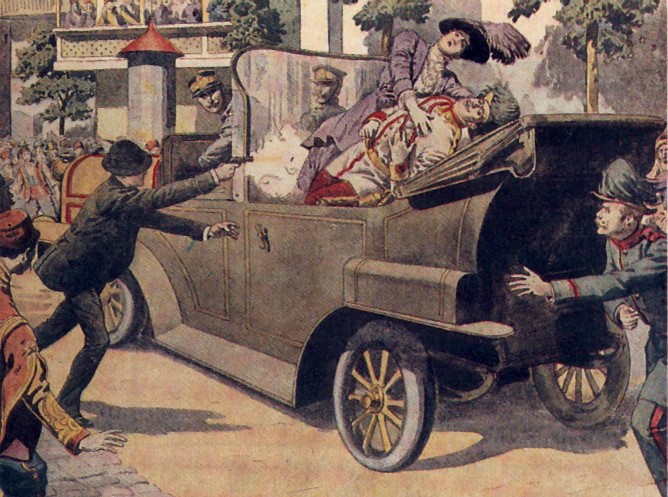
In June 1914, Austro-Hungarian Archduke Franz Ferdinand was shot by Serbian nationalists in Sarajevo. As a result of the escalation of threats and mobilization orders following the assassination, in mid-August of that same year World War I began. A war which pitted Germany, Austria-Hungary and the Ottoman Empire (the Central Powers) against Great Britain, France, Russia, and Italy (the Allied Powers). The Allies were joined in 1917 by the United States of America. The Great War brought about unprecedented levels of carnage, due to its use of trench warfare and modern weaponry such as machine guns, tanks and mustard gas. By the time World War I ground to a halt in November 1918, approximately nine million soldiers had been killed and 21 million more wounded. The Treaty of Versailles, signed the following year, set post-war borders from Europe to the Middle East, established the League of Nations as an international peace organization, and forced Germany to pay for the war via reparations and the loss of territory.
1. We are now about to accept…battle with [Germany] and shall, if necessary, spend the whole force of the nation to check and nullify its pretensions and its power. We are glad, now that we see the facts with no veil of false pretense about them, to fight thus for the ultimate peace of the world and for the liberation of its peoples, the German peoples included: for the rights of nations great and small and the privilege of men everywhere to choose their way of life and of obedience. The world must be made safe for democracy. Its peace must be planted upon the tested foundations of political liberty. We have no selfish ends to serve. We desire no conquest, no dominion. We seek no indemnities for ourselves, no material compensation for the sacrifices we shall freely make. We are but one of the champions of the rights of mankind. We shall be satisfied when those rights have been made as secure as the faith and the freedom of nations can make them.
2. We [Germans] are a nation that wishes to lead a quiet and industrious life. This need hardly be stated to you Americans. You, of all others, know the temper of the German who lives within your gates. Our love of peace is so strong that it is not regarded by us in the light of a virtue; we simply know it to be an inborn and integral portion of ourselves. Since the foundation of the German Empire in the year 1871, we, living in the center of Europe, have given an example of tranquility and peace, never once seeking to profit by any momentary difficulties of our neighbors. Everyone is aware that we have produced great philosophers and poets; we have preached the gospel of humanity with impassioned zeal. America fully appreciates Goethe and Kant, looks upon them as corner-stones of elevated culture. Do you really believe that we have changed our natures, that our souls can be satisfied with military drill and servile obedience? We and all our soldiers have remained, however, the same lovers of music and lovers of exalted thought. We have retained our old devotion to peace. Firmly believing in the justice of our cause, all parties, the conservatives and Christians; liberals and the socialists, have joined hands. All disputes are forgotten, one duty exists for all, the duty of defending our country. The war has severed us from the rest of the world; all our cable communications are destroyed. But the winds will carry the mighty voice of justice even across the ocean. We trust in God, and have confidence in the judgment of right-minded men.

