Friday, March 31, 2017

Friday, March 24, 2017
Week 24: Kurdish-Iraqi War

The First Kurdish–Iraqi War lasted from 1961 until 1970. Kurdish forces, led by Mustafa Barzani, attempted to establish an independent Kurdish state in northern Iraq. The war failed to resolve the issue of a Kurdish homeland despite the fact that the war inflicted over 100,000 casualties. In 1958, a military coup d’état against the Hashemite Monarchy, led to the seizure of power by Abdul Karim Qasim. Qasim invited Barzani to return from exile in the USSR, hoping to gain the support of Kurdish militias. As part of the new arrangement, Qasim promised Barzani complete regional autonomy in Kurdistan in return for Kurdish support for his government. Barzani, who was the head of the Kurdistan Democratic Party (KDP), agreed to the deal. By early 1960, it became apparent that Qasim would not follow through with his promise of regional autonomy. As a result, the KDP began to agitate for regional autonomy. In the face of growing Kurdish dissent, as well as Barzani's personal influence, Qasim’s government shifted its support to the Barzani clan’s historical rivals, the Baradost and Zebari tribes. The result of this pivot was a period of intense inter-tribal warfare between 1960 and 1961. By February 1961, Barzani had defeated the pro-government forces Kurdish tribes and consolidated his position as leader of all the Kurdish tribes. At this point, Barzani ordered his forces to occupy and expel Iraqi Arab officials from Kurdish territory. This was not received well in Baghdad, and as a result, Qasim began to prepare for a military offensive against the Kurdish region. Meanwhile, in June 1961, the KDP issued a detailed ultimatum to Qasim outlining Kurdish grievances and demanded rectification. Qasim ignored the Kurdish demands and continued planning for war. It was not until September 10, 1961 when an Iraqi army column was ambushed by a group of Kurds, that the Kurdish revolt truly began. In response to the attack, Qasim lashed out and ordered the Iraqi Air Force to indiscriminately bomb Kurdish villages, which ultimately rallied the entire Kurdish population to Barzani's standard. Due to Qasim's profound distrust of the Iraqi Army, which he purposely failed to adequately arm, Qasim's government was not able to subdue the insurrection. Of the sixteen members of Qasim's cabinet, twelve were Ba'ath Party members; however, the party turned against Qasim due to his refusal to join Gamel Abdel Nasser's United Arab Republic. To strengthen his own position within the government, Qasim created an alliance with the Iraqi Communist Party, which was opposed to any notion of pan-Arabism. The war’s stalemate irritated powerful factions within the military and is said to be one of the main reasons behind the Ba'athist coup against Qasim in February 1963. The Ba’athists had made earlier attempts, however, in 1959. The assassins, which included Saddam Hussein, planned to ambush Qasim on October 7, 1959: one man was to kill those sitting at the back of the car, the rest killing those in front. During the ambush it is claimed that Saddam Hussein began shooting prematurely, which disorganized the whole operation. Qasim's chauffeur was killed, and Qasim was hit in the arm and shoulder. The assassins believed they had killed him and quickly retreated to their headquarters, but Qasim survived. At the time of the attack the Ba'ath Party had less than 1,000 members. After the failed coup d’état, many Ba’athist fled to Syria, the ideological home of Ba’athism. After the failure of Syrian unification with Egypt in 1961, Syria was declared an Arab Republic in the interim constitution. On 23 August 1962, around 120,000 Kurds in Jazira were arbitrarily categorized as aliens, forcing them to either leave the country or register as foreigners in their own country. In addition, a policy of violent discrimination was launched against the Kurds. These policies coincided with the beginning of Barzani's uprising in Iraqi Kurdistan and the discovery of oilfields in the Kurdish inhabited areas of Syria. These events led to a period of increasing violence, including an attack in which Syrian troops crossed the Iraqi border in pursuit of Barzani's fighters. These tensions and the failure of the Iraqi government to halt the war, led the Ba’athist elements within the government to stage a coup d’état. The coup d’état itself occurred on February 8, 1963, the fourteenth day of Ramadan, and as a result is remembered as the 14 Ramadan Coup. The coup had been in its planning stages since 1962, and several attempts had been planned, only to be abandoned for fear of discovery. The coup began in the early hours of February 8, 1963, when the communist air force chief, Jalal al-Awqati was assassinated and tank units occupied the Abu Ghrayb radio station. Over the following two day a violent struggle unfolded with fierce fighting between the Ba’athist conspirators and pro-Qasim forces. Qasim took refuge in the Ministry of Defence, where fighting became particularly heavy. Communist sympathizers were widely mobilized to fight against the coup. The following day, Qasim offered to surrender in return for safe passage out of the country. His request was refused, and that afternoon he was captured and executed. His dead body was displayed on television by leaders of the coup soon after his death. Around 5,000 Iraqis were killed in the fighting and an unknown number of communist sympathizers were rounded up during a CIA sponsored hunt for communists. The Ba’athist forces lost 80 men during the fight.
Writing in his memoirs of the 1963 coup, long time CIA analyst Harry Rositzke presented it as an example of one on which they had good intelligence in contrast to others that caught the agency by surprise. According to Rositzke, the Ba’athists had kept CIA informed of every step in the process of the coup d’état. "Agents in the Ba’ath Party headquarters in Baghdad had for years kept Washington au courant on the party’s personnel and organization, its secret communications and sources of funds, and its penetrations of military and civilian hierarchies in several countries. CIA sources were in a perfect position to follow each step of Ba’athist preparations for the Iraqi coup, which focused on making contacts with military and civilian leaders in Baghdad. The CIA’s major source, in an ideal catbird seat, reported the exact time of the coup and provided a list of the new cabinet members. To call an upcoming coup requires the CIA to have sources within the group of plotters. Yet, from a diplomatic point of view, having secret contacts with plotters implies at least unofficial complicity in the plot." The best evidence that the U.S. was complicit is the memo from NSC staff member Bob Komer to President John F. Kennedy on the night of the coup, February 8, 1963. The last paragraph of the memo reads: "We will make informal friendly noises as soon as we can find out whom to talk with, and ought to recognize as soon as we’re sure these guys are firmly in the saddle. CIA had excellent reports on the plotting, but I doubt either they or UK should claim much credit for it. The new government used lists, provided by the CIA, to systematically arrest several thousand suspected communists. According to former CIA Near East Division Chief James Chritchfield, the CIA took interest in the Ba'ath Party around 1961-2, and "was better informed on the 1963 coup in Baghdad than on any other major event or change of government that took place in the whole region in those years;" however, it did not "actively support" the coup.
In November 1963, after considerable infighting amongst the civilian and military wings of the Ba'athists, they were ousted by Abdul Salam Arif in a coup. Then, after another failed offensive on Kurds, Arif declared a ceasefire in February 1964, which provoked a split among Kurdish urban radicals on one hand In 1966, the Iraqi government launched a last-ditch effort to defeat the Kurds. This campaign failed when Barzani forces thoroughly defeated the Iraqi Army at the Battle of Mount Handrin, near Rawanduz. At this battle alone, Kurdish peshmerga reportedly killed over 5,000 Iraqi infantrymen. Recognizing the futility of continuing this campaign, Rahamn Arif announced a 12-point peace program in June 1966, which was not implemented due to the overthrow of Abdul Rahman Arif in a 1968 coup by the Ba’ath Party, which included key figures from the 1963 coup, Ahmed al-Bakr and his cousin Saddam Hussein. The Ba'ath government restarted a campaign to end the Kurdish insurrection, which again stalled in 1969. The Soviet Union pressured the Iraqis to come to terms with Barzani and a peace plan was announced in March 1970 which provided for some Kurdish autonomy. Despite this, the Iraqi government embarked on an ethnic cleansing program, which included the usage of chemical and biological warfare, especially in the oil rich regions of Kirkuk. Saddam Hussein remained in control of Iraq until 2003.
Friday, March 10, 2017
Week 23: The Munich Olympics Attack

It was 4:30 in the morning on Sept. 5, 1972, when five Palestinians wearing track sweat suits climbed the six-foot six-inch fence surrounding the Olympic Village. Although they were seen by several people, no one thought anything was unusual since athletes routinely hopped the fence; moreover, the their weapons were hidden in athletic bags.
These five were met by three more men who are presumed to have obtained credentials to enter the village. The Palestinians then used stolen keys to enter two apartments being used by the Israeli team at 31 Connollystraße.
Israeli wrestling referee Yossef Gutfreund heard a faint scratching noise at the door of the first apartment. When he investigated, he saw the door begin to open and masked men with guns on the other side. He shouted “Hevre tistalku!” (Hebrew: "Guys, get out of here!") and threw his nearly 300-lb. weight against the door to try to stop the Palestinians from forcing their way in. In the confusion, coach Tuvia Sokolovsky and race-walker Dr. Shaul Ladany escaped and another four athletes, plus the two team doctors and delegation head Shmuel Lalkin, managed to hide.
Wrestling coach Moshe Weinberg, attacked the kidnappers as the hostages were being moved from one apartment to another, allowing one of his wrestlers, Gad Tsobari, to escape. The burly Weinberg knocked one of the intruders unconscious and stabbed another with a fruit knife before being shot to death. Weightlifter and father of three Yossef Romano, 31, also attacked and wounded one of the intruders before being killed. The Palestinians then succeeded in rounding up nine Israelis to hold as hostages.
At 9:30, the terrorists announced that they were Palestinians and demanded that Israel release 200 Arab prisoners and that the terrorists be given safe passage out of Germany. The Palestinians were led by Luttif Afif, his deputy Yusuf Nazzal, and junior members Afif Ahmed Hamid, Khalid Jawad, Ahmed Chic Thaa, Mohammed Safady, Adnan Al-Gashey, and his cousin Jamal Al-Gashey.
After hours of tense negotiations, the Palestinians, who it was later learned belonged to a PLO faction called Black September, agreed to a plan whereby they were to be taken by helicopter to the NATO air base at Firstenfeldbruck where they would be given an airplane to fly them and their hostages to Cairo. The Israelis were then taken by bus to the helicopters and flown to the airfield. In the course of the transfer, the Germans discovered that there were eight terrorists instead of the five they expected and realized that they had not assigned enough marksmen to carry out the plan to kill the terrorists at the airport.
After the helicopters landed at the air base around 10:30 p.m., the German sharpshooters attempted to kill the terrorists and a bloody firefight ensued. At 11, the media was mistakenly informed that the hostages had been saved and the news was announced to a relieved Israeli public. Almost an hour later, however, new fighting broke out and one of the helicopters holding the Israelis was blown up by a terrorist grenade. The remaining nine hostages in the second helicopter were shot to death by one of the surviving terrorists.
At 3 a.m., a drawn and teary-eyed Jim McKay, who had been reporting the drama throughout the day as part of ABC's Olympic coverage, announced: “They're all gone.”
In July 2012, German magazine Der Spiegel reported that Germany had in fact been warned about the possibility of a Palestinian terrorist attack at the Games but took no actions to secure the Olympic Village.
Five of the terrorists were killed along with one policeman, and three were captured. A little over a month later, on Oct. 29, a Lufthansa jet was hijacked by terrorists demanding that the Munich killers be released.
The Germans capitulated and the terrorists were let go, but an Israeli squad was assigned to track them down along with those responsible for planning the massacre. According to George Jonas in Vengeance: The True Story of an Israeli Counter-Terrorist Team, eight of the 11 men targeted for death were killed. Of the remaining three, one died of natural causes and the other two were assassinated, but it is not known if they were killed by Israeli agents.
The massacre of 11 Israeli athletes was not considered sufficiently serious to merit canceling or postponing the Olympics. “Incredibly, they're going on with it,” Jim Murray of the Los Angeles Times wrote at the time. “It's almost like having a dance at Dachau.”
On December 1, 2015, new information about the Munich massacre was released to the public for the first time via an article in the New York Times. The article shed light on long-hidden details from that day, and included interviews with Ilana Romano and Ankie Spitzer, who were both widowed following the attack. Among the most horrific new details revealed was that Yossef Romano, Ilana Romano's husband, was beaten and brutally castrated by the terrorists while the Israelis were being held hostage. Most of these specific and gory details about the tragedy were not revealed to the victims families until September 1992, when the German government released hundreds of pages of reports on the attack and photographs of the crime scenes that they had previously claimed did not exist.
New York Times article about the attack
Ilana Romano and Ankie Spitzer attended a memorial ceremony in their husband's honor on August 3, 2016, in Rio de Janiero, Brazil, the host city of the 2016 Olympic Games. The ceremony, led by the president of the International Olympic Committee (IOC), Thomas Bach, was followed by one minute of silence in the Olympic village to honor the murdered Israeli athletes. In addition to the remembrance ceremony, the IOC inaugurated a new tradition in honor of the athletes; a place of mourning to be established at every future olympics in the olympic village. Ankie Spitzer told reporters that, “This is closure for us. This is incredibly important. We waited 44 years to have this remembrance.”
Wednesday, March 1, 2017
Week 22: Overview
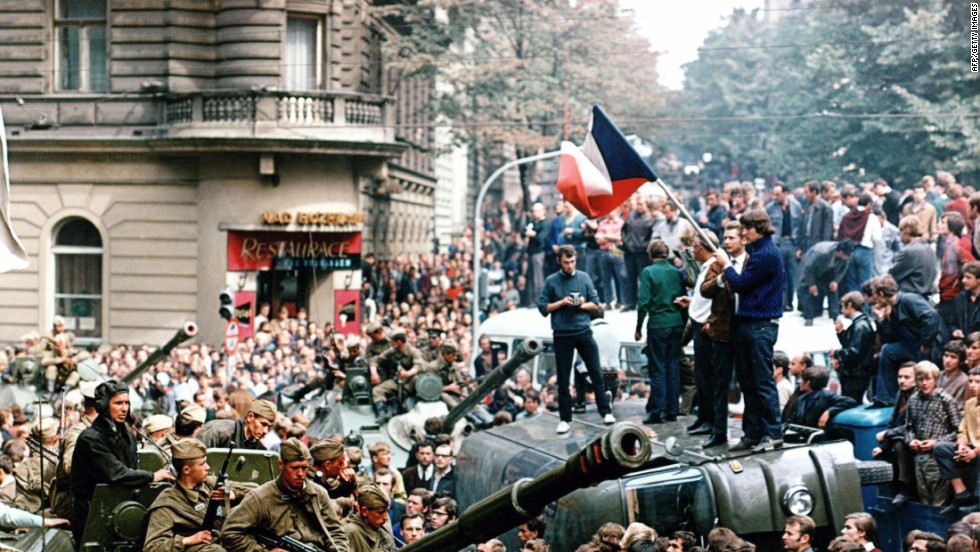
Prague Spring
Before the Second World War, the nation of Czechoslovakia had been a strong democracy in Central Europe, but beginning in the mid-1930s it faced challenges from both the West and the East. In 1948, Czech attempts to join the U.S.-sponsored Marshall Plan to aid postwar rebuilding were thwarted by a Soviet takeover and the installation of a new communist government in Prague. For the next twenty years, Czechoslovakia remained a stable state within the Soviet sphere of influence; unlike in Hungary or Poland, even the rise of de-Stalinization after 1953 did not lead to liberalization by the Czech government.
In the 1960s, however, changes in the leadership in Prague led to a series of reforms to soften or humanize the application of communist doctrines within Czech borders. The Czech economy had been slowing since the early 1960s, and cracks were emerging in the communist consensus as workers struggled against new challenges. The government responded with reforms designed to improve the economy. In early 1968, hardline communist Antonin Novotny was ousted as the head of the Communist Party of Czechoslovakia, and he was replaced by Alexander Dubcek. The Dubcek government ended censorship in early 1968, and the acquisition of this freedom resulted in a public expression of broad-based support for reform and a public sphere in which government and party policies could be debated openly. In April, the Czech Government issued a formal plan for further reforms, although it tried to liberalize within the existing framework of the Marxist-Leninist State and did not propose a revolutionary overhaul of the political and economic systems. As conflicts emerged between those calling for further reforms and conservatives alarmed by how far the liberalization process had gone, Dubcek struggled to maintain control. Soviet leaders were concerned over these recent developments in Czechoslovakia. Recalling the 1956 uprising in Hungary, leaders in Moscow worried that if Czechoslovakia carried reforms too far, other satellite states in Eastern Europe might follow, leading to a widespread rebellion against Moscow’s leadership of the Eastern Bloc. There was also a danger that the Soviet Republics in the East, such as the Ukraine, Lithuania, Latvia, and Estonia might make their own demands for more liberal policies. After much debate, the Communist Party leadership in Moscow decided to intervene to establish a more pro-Soviet government in Prague.
The Warsaw Pact invasion of August 20-21 caught Czechoslovakia and much of the Western world by surprise. In anticipation of the invasion, the Soviet Union had moved troops from Russia, along with limited numbers of troops from Hungary, Poland, East Germany and Bulgaria into place by announcing Warsaw Pact military exercises. When these forces did invade, they swiftly took control of Prague, other major cities, and communication and transportation links. Given the escalating U.S. involvement in the conflict in Vietnam as well as past U.S. pronouncements on non-intervention in the Eastern Bloc, the Soviets guessed correctly that the United States would condemn the invasion but refrain from intervening. Although the Soviet crackdown on Czechoslovakia was swift and successful, small-scale resistance continued throughout early 1969 while the Soviets struggled to install a stable government. Finally, in April of 1969, the Soviets forced Dubcek from power in favor of a hardline communist administrator. In the years that followed, the new leadership reestablished government censorship and controls preventing freedom of movement, but it also improved economic conditions, eliminating one of the sources for revolutionary fervor. Czechoslovakia once again became a cooperative member of the Warsaw Pact.
The Soviet invasion of Czechoslovakia was significant in the sense that it delayed the splintering of Eastern European Communism and was concluded without provoking any direct intervention from the West. Repeated efforts in the UN Security Council to pass a resolution condemning the attacks met with opposition from the Soviet Union, and the effort finally died away. The invasion did, however, temporarily derail progress toward détente between the Soviet Union and the United States. The NATO allies valued the idea of a lessening of tensions, and as a result they were determined not to intervene. Still, the invasion forced U.S. President Lyndon B. Johnson to cancel a summit meeting with Soviet leader Leonid Brezhnev. Although Brezhnev knew this was the most likely outcome of the invasion, he considered maintaining Soviet control in the East Bloc a higher priority in the short-term than pursuing détente with the West. As it turned out, the progress on arms control agreements were only delayed by a few years in the aftermath of the Prague Spring.
There were also long-term consequences. After the invasion, the Soviet leadership justified the use of force in Prague under what would become known as the Brezhnev Doctrine, which stated that Moscow had the right to intervene in any country where a communist government had been threatened. This doctrine, established to justify Soviet action in Czechoslovakia, also became the primary justification for the Soviet invasion of Afghanistan in 1979, and even before that it helped to finalize the Sino-Soviet split, as Beijing feared that the Soviet Union would use the doctrine as a justification to invade or interfere with Chinese communism. Because the United States interpreted the Brezhnev Doctrine and the history of Soviet interventions in Europe as defending established territory, not expanding Soviet power, the aftermath of the Czech crisis also lent support to voices in the U.S. Congress calling for a reduction in U.S. military forces in Europe.
Timeline:
5 January 1968
Alexandr Dubcek - a reformer - took over as leader of the Communist Party (KSC).
April 1968
Dubcek's government announced an Action Plan for what it called a new model of socialism - it removed state controls over industry and allowed freedom of speech.
For four months (the Prague Spring), there was freedom in Czechoslovakia. But then the revolution began to run out of control. Dubcek announced that he was still committed to democratic communism, but other political parties were set up.
Also, Dubcek stressed that Czechoslovakia would stay in the Warsaw Pact, but in August, President Tito of Yugoslavia, a country not in the Warsaw Pact, visited Prague.
3 August 1968
Brezhnev read out a letter from some Czechoslovakian Communists asking for help. He announced the Brezhnev Doctrine - the USSR would not allow any Eastern European country to reject Communism.
20 August 1968
500,000 Warsaw Pact troops invaded Czechoslovakia. Dubcek and three other leaders were arrested and sent to Moscow.
The Czechoslovakians did not fight the Russians. Instead, they stood in front of the tanks, and put flowers in the soldiers' hair. Jan Palach burned himself to death in protest. Over one hundred Czechs and Slovaks are killed in the invasion.
Subscribe to:
Posts (Atom)