Friday, November 20, 2020

Schedule Update

Hello Seniors,

Based on the vote, we will be studying Oscar Wilde instead of having our social history presentations via zoom the week after Thanksgiving. Please complete the Oscar Wilde homework, and prepare any social history presentation questions before our next session. Thanks and Happy Thanksgiving!

Kind regards,

Dr. Parker


Phrases and Philosophies for the Use of the Young

Image result for oscar wilde
Phrases and Philosophies for the Use of the Young (1894) 
by Oscar Wilde

The first duty in life is to be as artificial as possible. What the second duty is no one has as yet discovered.
Wickedness is a myth invented by good people to account for the curious attractiveness of others.
If the poor only had profiles there would be no difficulty in solving the problem of poverty.
Those who see any difference between soul and body have neither.
A really well-made buttonhole is the only link between Art and Nature.
Religions die when they are proved to be true. Science is the record of dead religions.
The well-bred contradict other people. The wise contradict themselves.
Nothing that actually occurs is of the smallest importance.
Dullness is the coming of age of seriousness.
In all unimportant matters, style, not sincerity, is the essential. In all important matters, style, not sincerity, is the essential.
If one tells the truth, one is sure, sooner or later, to be found out.
Pleasure is the only thing one should live for. Nothing ages like happiness.
It is only by not paying one's bills that one can hope to live in the memory of the commercial classes.
No crime is vulgar, but all vulgarity is crime. Vulgarity is the conduct of others.
Only the shallow know themselves.
Time is a waste of money.
One should always be a little improbable.
There is a fatality about all good resolutions. They are invariably made too soon.
The only way to atone for being occasionally a little over-dressed is by being always absolutely over-educated.
To be premature is to be perfect.
Any preoccupation with ideas of what is right and wrong in conduct shows an arrested intellectual development.
Ambition is the last refuge of the failure.
A truth ceases to be true when more than one person believes in it.
In examinations the foolish ask questions that the wise cannot answer.
Greek dress was in its essence inartistic. Nothing should reveal the body but the body.
One should either be a work of art, or wear a work of art.
It is only the superficial qualities that last. Man's deeper nature is soon found out.
Industry is the root of all ugliness.
The ages live in history through their anachronisms.
It is only the gods who taste of death. Apollo has passed away, but Hyacinth, whom men say he slew, lives on. Nero and Narcissus are always with us.
The old believe everything: the middle-aged suspect everything: the young know everything.
The condition of perfection is idleness: the aim of perfection is youth.
Only the great masters of style ever succeed in being obscure.
There is something tragic about the enormous number of young men there are in England at the present moment who start life with perfect profiles, and end by adopting some useful profession.
To love oneself is the beginning of a life-long romance.

Debussy Arabesque 1


Dogmas for the use of the Ages


Oscar Wilde Essays (optional)

Image result for oscar wilde

LECTURE TO ART STUDENTS
Delivered to the Art students of the Royal Academy at their Club in Golden Square, Westminster, on June 30, 1883.  The text is taken from the original manuscript.

In the lecture which it is my privilege to deliver before you to-night I do not desire to give you any abstract definition of beauty at all.  For we who are working in art cannot accept any theory of beauty in exchange for beauty itself, and, so far from desiring to isolate it in a formula appealing to the intellect, we, on the contrary, seek to materialise it in a form that gives joy to the soul through the senses.  We want to create it, not to define it.  The definition should follow the work: the work should not adapt itself to the definition.

Nothing, indeed, is more dangerous to the young artist than any conception of ideal beauty: he is constantly led by it either into weak prettiness or lifeless abstraction: whereas to touch the ideal at all you must not strip it of vitality.  You must find it in life and re-create it in art.

While, then, on the one hand I do not desire to give you any philosophy of beauty—for, what I want to-night is to investigate how we can create art, not how we can talk of it—on the other hand, I do not wish to deal with anything like a history of English art.

To begin with, such an expression as English art is a meaningless expression.  One might just as well talk of English mathematics.  Art is the science of beauty, and Mathematics the science of truth: there is no national school of either.  Indeed, a national school is a provincial school, merely.  Nor is there any such thing as a school of art even.  There are merely artists, that is all.

And as regards histories of art, they are quite valueless to you unless you are seeking the ostentatious oblivion of an art professorship.  It is of no use to you to know the date of Perugino or the birthplace of Salvator Rosa: all that you should learn about art is to know a good picture when you see it, and a bad picture when you see it.  As regards the date of the artist, all good work looks perfectly modern: a piece of Greek sculpture, a portrait of Velasquez—they are always modern, always of our time.  And as regards the nationality of the artist, art is not national but universal.  As regards archæology, then, avoid it altogether: archæology is merely the science of making excuses for bad art; it is the rock on which many a young artist founders and shipwrecks; it is the abyss from which no artist, old or young, ever returns.  Or, if he does return, he is so covered with the dust of ages and the mildew of time, that he is quite unrecognisable as an artist, and has to conceal himself for the rest of his days under the cap of a professor, or as a mere illustrator of ancient history.  How worthless archæology is in art you can estimate by the fact of its being so popular.  Popularity is the crown of laurel which the world puts on bad art.  Whatever is popular is wrong.

As I am not going to talk to you, then, about the philosophy of the beautiful, or the history of art, you will ask me what I am going to talk about.  The subject of my lecture to-night is what makes an artist and what does the artist make; what are the relations of the artist to his surroundings, what is the education the artist should get, and what is the quality of a good work of art.

Now, as regards the relations of the artist to his surroundings, by which I mean the age and country in which he is born.  All good art, as I said before, has nothing to do with any particular century; but this universality is the quality of the work of art; the conditions that produce that quality are different.  And what, I think, you should do is to realise completely your age in order completely to abstract yourself from it; remembering that if you are an artist at all, you will be not the mouthpiece of a century, but the master of eternity, that all art rests on a principle, and that mere temporal considerations are no principle at all; and that those who advise you to make your art representative of the nineteenth century are advising you to produce an art which your children, when you have them, will think old-fashioned.  But you will tell me this is an inartistic age, and we are an inartistic people, and the artist suffers much in this nineteenth century of ours.

Of course he does.  I, of all men, am not going to deny that.  But remember that there never has been an artistic age, or an artistic people, since the beginning of the world.  The artist has always been, and will always be, an exquisite exception.  There is no golden age of art; only artists who have produced what is more golden than gold.

What, you will say to me, the Greeks? were not they an artistic people?

Well, the Greeks certainly not, but, perhaps, you mean the Athenians, the citizens of one out of a thousand cities.

Do you think that they were an artistic people?  Take them even at the time of their highest artistic development, the latter part of the fifth century before Christ, when they had the greatest poets and the greatest artists of the antique world, when the Parthenon rose in loveliness at the bidding of a Phidias, and the philosopher spake of wisdom in the shadow of the painted portico, and tragedy swept in the perfection of pageant and pathos across the marble of the stage.  Were they an artistic people then?  Not a bit of it.  What is an artistic people but a people who love their artists and understand their art?  The Athenians could do neither.

How did they treat Phidias?  To Phidias we owe the great era, not merely in Greek, but in all art—I mean of the introduction of the use of the living model.

And what would you say if all the English bishops, backed by the English people, came down from Exeter Hall to the Royal Academy one day and took off Sir Frederick Leighton in a prison van to Newgate on the charge of having allowed you to make use of the living model in your designs for sacred pictures?

Would you not cry out against the barbarism and the Puritanism of such an idea?  Would you not explain to them that the worst way to honour God is to dishonour man who is made in His image, and is the work of His hands; and, that if one wants to paint Christ one must take the most Christlike person one can find, and if one wants to paint the Madonna, the purest girl one knows?

Would you not rush off and burn down Newgate, if necessary, and say that such a thing was without parallel in history?

Without parallel?  Well, that is exactly what the Athenians did.

In the room of the Parthenon marbles, in the British Museum, you will see a marble shield on the wall.  On it there are two figures; one of a man whose face is half hidden, the other of a man with the godlike lineaments of Pericles.  For having done this, for having introduced into a bas relief, taken from Greek sacred history, the image of the great statesman who was ruling Athens at the time, Phidias was flung into prison and there, in the common gaol of Athens, died, the supreme artist of the old world.

And do you think that this was an exceptional case?  The sign of a Philistine age is the cry of immorality against art, and this cry was raised by the Athenian people against every great poet and thinker of their day—Æschylus, Euripides, Socrates.  It was the same with Florence in the thirteenth century.  Good handicrafts are due to guilds, not to the people.  The moment the guilds lost their power and the people rushed in, beauty and honesty of work died.

And so, never talk of an artistic people; there never has been such a thing.

But, perhaps, you will tell me that the external beauty of the world has almost entirely passed away from us, that the artist dwells no longer in the midst of the lovely surroundings which, in ages past, were the natural inheritance of every one, and that art is very difficult in this unlovely town of ours, where, as you go to your work in the morning, or return from it at eventide, you have to pass through street after street of the most foolish and stupid architecture that the world has ever seen; architecture, where every lovely Greek form is desecrated and defiled, and every lovely Gothic form defiled and desecrated, reducing three-fourths of the London houses to being, merely, like square boxes of the vilest proportions, as gaunt as they are grimy, and as poor as they are pretentious—the hall door always of the wrong colour, and the windows of the wrong size, and where, even when wearied of the houses you turn to contemplate the street itself, you have nothing to look at but chimney-pot hats, men with sandwich boards, vermilion letter-boxes, and do that even at the risk of being run over by an emerald-green omnibus.

Is not art difficult, you will say to me, in such surroundings as these?  Of course it is difficult, but then art was never easy; you yourselves would not wish it to be easy; and, besides, nothing is worth doing except what the world says is impossible.

Still, you do not care to be answered merely by a paradox.  What are the relations of the artist to the external world, and what is the result of the loss of beautiful surroundings to you, is one of the most important questions of modern art; and there is no point on which Mr. Ruskin so insists as that the decadence of art has come from the decadence of beautiful things; and that when the artist cannot feed his eye on beauty, beauty goes from his work.

I remember in one of his lectures, after describing the sordid aspect of a great English city, he draws for us a picture of what were the artistic surroundings long ago.

Think, he says, in words of perfect and picturesque imagery, whose beauty I can but feebly echo, think of what was the scene which presented itself, in his afternoon walk, to a designer of the Gothic school of Pisa—Nino Pisano or any of his men: [206]

On each side of a bright river he saw rise a line of brighter palaces, arched and pillared, and inlaid with deep red porphyry, and with serpentine; along the quays before their gates were riding troops of knights, noble in face and form, dazzling in crest and shield; horse and man one labyrinth of quaint colour and gleaming light—the purple, and silver, and scarlet fringes flowing over the strong limbs and clashing mall, like sea-waves over rocks at sunset.  Opening on each side from the river were gardens, courts, and cloisters; long successions of white pillars among wreaths of vine; leaping of fountains through buds of pomegranate and orange: and still along the garden-paths, and under and through the crimson of the pomegranate shadows, moving slowly, groups of the fairest women that Italy ever saw—fairest, because purest and thoughtfullest; trained in all high knowledge, as in all courteous art—in dance, in song, in sweet wit, in lofty learning, in loftier courage, in loftiest love—able alike to cheer, to enchant, or save, the souls of men.  Above all this scenery of perfect human life, rose dome and bell-tower, burning with white alabaster and gold: beyond dome and bell-tower the slopes of mighty hills hoary with olive; far in the north, above a purple sea of peaks of solemn Apennine, the clear, sharp-cloven Carrara mountains sent up their steadfast flames of marble summit into amber sky; the great sea itself, scorching with expanse of light, stretching from their feet to the Gorgonian isles; and over all these, ever present, near or far—seen through the leaves of vine, or imaged with all its march of clouds in the Arno’s stream, or set with its depth of blue close against the golden hair and burning cheek of lady and knight,—that untroubled and sacred sky, which was to all men, in those days of innocent faith, indeed the unquestioned abode of spirits, as the earth was of men; and which opened straight through its gates of cloud and veils of dew into the awfulness of the eternal world;—a heaven in which every cloud that passed was literally the chariot of an angel, and every ray of its Evening and Morning streamed from the throne of God.

What think you of that for a school of design?

And then look at the depressing, monotonous appearance of any modern city, the sombre dress of men and women, the meaningless and barren architecture, the colourless and dreadful surroundings.  Without a beautiful national life, not sculpture merely, but all the arts will die.

Well, as regards the religious feeling of the close of the passage, I do not think I need speak about that.  Religion springs from religious feeling, art from artistic feeling: you never get one from the other; unless you have the right root you will not get the right flower; and, if a man sees in a cloud the chariot of an angel, he will probably paint it very unlike a cloud.

But, as regards the general idea of the early part of that lovely bit of prose, is it really true that beautiful surroundings are necessary for the artist?  I think not; I am sure not.  Indeed, to me the most inartistic thing in this age of ours is not the indifference of the public to beautiful things, but the indifference of the artist to the things that are called ugly.  For, to the real artist, nothing is beautiful or ugly in itself at all.  With the facts of the object he has nothing to do, but with its appearance only, and appearance is a matter of light and shade, of masses, of position, and of value.

Appearance is, in fact, a matter of effect merely, and it is with the effects of nature that you have to deal, not with the real condition of the object.  What you, as painters, have to paint is not things as they are but things as they seem to be, not things as they are but things as they are not.

No object is so ugly that, under certain conditions of light and shade, or proximity to other things, it will not look beautiful; no object is so beautiful that, under certain conditions, it will not look ugly.  I believe that in every twenty-four hours what is beautiful looks ugly, and what is ugly looks beautiful, once.

And, the commonplace character of so much of our English painting seems to me due to the fact that so many of our young artists look merely at what we may call ‘ready-made beauty,’ whereas you exist as artists not to copy beauty but to create it in your art, to wait and watch for it in nature.

What would you say of a dramatist who would take nobody but virtuous people as characters in his play?  Would you not say he was missing half of life?  Well, of the young artist who paints nothing but beautiful things, I say he misses one half of the world.

Do not wait for life to be picturesque, but try and see life under picturesque conditions.  These conditions you can create for yourself in your studio, for they are merely conditions of light.  In nature, you must wait for them, watch for them, choose them; and, if you wait and watch, come they will.

In Gower Street at night you may see a letter-box that is picturesque: on the Thames Embankment you may see picturesque policemen.  Even Venice is not always beautiful, nor France.

To paint what you see is a good rule in art, but to see what is worth painting is better.  See life under pictorial conditions.  It is better to live in a city of changeable weather than in a city of lovely surroundings.

Now, having seen what makes the artist, and what the artist makes, who is the artist?  There is a man living amongst us who unites in himself all the qualities of the noblest art, whose work is a joy for all time, who is, himself, a master of all time.  That man is Mr. Whistler.

* * * * *

But, you will say, modern dress, that is bad.  If you cannot paint black cloth you could not have painted silken doublet.  Ugly dress is better for art—facts of vision, not of the object.

What is a picture?  Primarily, a picture is a beautifully coloured surface, merely, with no more spiritual message or meaning for you than an exquisite fragment of Venetian glass or a blue tile from the wall of Damascus.  It is, primarily, a purely decorative thing, a delight to look at.

All archæological pictures that make you say ‘How curious!’ all sentimental pictures that make you say, ‘How sad!’ all historical pictures that make you say ‘How interesting!’ all pictures that do not immediately give you such artistic joy as to make you say ‘How beautiful!’ are bad pictures.

* * * * *

We never know what an artist is going to do.  Of course not.  The artist is not a specialist.  All such divisions as animal painters, landscape painters, painters of Scotch cattle in an English mist, painters of English cattle in a Scotch mist, racehorse painters, bull-terrier painters, all are shallow.  If a man is an artist he can paint everything.

The object of art is to stir the most divine and remote of the chords which make music in our soul; and colour is indeed, of itself a mystical presence on things, and tone a kind of sentinel.

Am I pleading, then, for mere technique?  No.  As long as there are any signs of technique at all, the picture is unfinished.  What is finish?  A picture is finished when all traces of work, and of the means employed to bring about the result, have disappeared.

In the case of handicraftsmen—the weaver, the potter, the smith—on their work are the traces of their hand.  But it is not so with the painter; it is not so with the artist.

Art should have no sentiment about it but its beauty, no technique except what you cannot observe.  One should be able to say of a picture not that it is ‘well painted,’ but that it is ‘not painted.’

What is the difference between absolutely decorative art and a painting?  Decorative art emphasises its material: imaginative art annihilates it.  Tapestry shows its threads as part of its beauty: a picture annihilates its canvas: it shows nothing of it.  Porcelain emphasises its glaze: water-colours reject the paper.

A picture has no meaning but its beauty, no message but its joy.  That is the first truth about art that you must never lose sight of.  A picture is a purely decorative thing.

Monday, November 16, 2020

Swann's Way

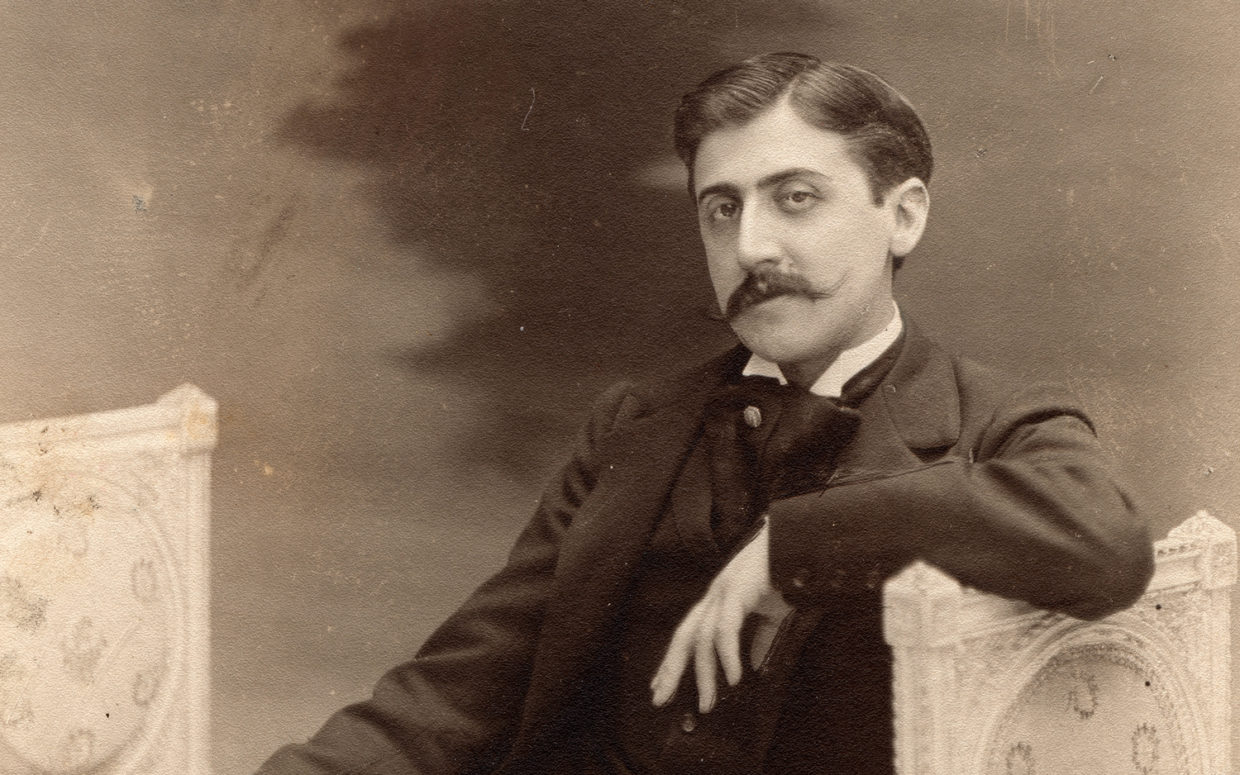
Image result for proust
Excerpt from Remembrance of Things Past 
by Marcel Proust

And so it was that, for a long time afterwards, when I lay awake at night and revived old memories of Combray, I saw no more of it than this sort of luminous panel, sharply defined against a vague and shadowy background, like the panels which a Bengal fire or some electric sign will illuminate and dissect from the front of a building the other parts of which remain plunged in darkness: broad enough at its base, the little parlour, the dining-room, the alluring shadows of the path along which would come M. Swann, the unconscious author of my sufferings, the hall through which I would journey to the first step of that staircase, so hard to climb, which constituted, all by itself, the tapering ‘elevation’ of an irregular pyramid; and, at the summit, my bedroom, with the little passage through whose glazed door Mamma would enter; in a word, seen always at the same evening hour, isolated from all its possible surroundings, detached and solitary against its shadowy background, the bare minimum of scenery necessary (like the setting one sees printed at the head of an old play, for its performance in the provinces) to the drama of my undressing, as though all Combray had consisted of but two floors joined by a slender staircase, and as though there had been no time there but seven o’clock at night. I must own that I could have assured any questioner that Combray did include other scenes and did exist at other hours than these. But since the facts which I should then have recalled would have been prompted only by an exercise of the will, by my intellectual memory, and since the pictures which that kind of memory shews us of the past preserve nothing of the past itself, I should never have had any wish to ponder over this residue of Combray. To me it was in reality all dead.

Permanently dead? Very possibly.

There is a large element of hazard in these matters, and a second hazard, that of our own death, often prevents us from awaiting for any length of time the favours of the first.

I feel that there is much to be said for the Celtic belief that the souls of those whom we have lost are held captive in some inferior being, in an animal, in a plant, in some inanimate object, and so effectively lost to us until the day (which to many never comes) when we happen to pass by the tree or to obtain possession of the object which forms their prison. Then they start and tremble, they call us by our name, and as soon as we have recognised their voice the spell is broken. We have delivered them: they have overcome death and return to share our life.

And so it is with our own past. It is a labour in vain to attempt to recapture it: all the efforts of our intellect must prove futile. The past is hidden somewhere outside the realm, beyond the reach of intellect, in some material object (in the sensation which that material object will give us) which we do not suspect. And as for that object, it depends on chance whether we come upon it or not before we ourselves must die.

Many years had elapsed during which nothing of Combray, save what was comprised in the theatre and the drama of my going to bed there, had any existence for me, when one day in winter, as I came home, my mother, seeing that I was cold, offered me some tea, a thing I did not ordinarily take. I declined at first, and then, for no particular reason, changed my mind. She sent out for one of those short, plump little cakes called ‘petites madeleines,’ which look as though they had been moulded in the fluted scallop of a pilgrim’s shell. And soon, mechanically, weary after a dull day with the prospect of a depressing morrow, I raised to my lips a spoonful of the tea in which I had soaked a morsel of the cake. No sooner had the warm liquid, and the crumbs with it, touched my palate than a shudder ran through my whole body, and I stopped, intent upon the extraordinary changes that were taking place. An exquisite pleasure had invaded my senses, but individual, detached, with no suggestion of its origin. And at once the vicissitudes of life had become indifferent to me, its disasters innocuous, its brevity illusory—this new sensation having had on me the effect which love has of filling me with a precious essence; or rather this essence was not in me, it was myself. I had ceased now to feel mediocre, accidental, mortal. Whence could it have come to me, this all-powerful joy? I was conscious that it was connected with the taste of tea and cake, but that it infinitely transcended those savours, could not, indeed, be of the same nature as theirs. Whence did it come? What did it signify? How could I seize upon and define it?

I drink a second mouthful, in which I find nothing more than in the first, a third, which gives me rather less than the second. It is time to stop; the potion is losing its magic. It is plain that the object of my quest, the truth, lies not in the cup but in myself. The tea has called up in me, but does not itself understand, and can only repeat indefinitely with a gradual loss of strength, the same testimony; which I, too, cannot interpret, though I hope at least to be able to call upon the tea for it again and to find it there presently, intact and at my disposal, for my final enlightenment. I put down my cup and examine my own mind. It is for it to discover the truth. But how? What an abyss of uncertainty whenever the mind feels that some part of it has strayed beyond its own borders; when it, the seeker, is at once the dark region through which it must go seeking, where all its equipment will avail it nothing. Seek? More than that: create. It is face to face with something which does not so far exist, to which it alone can give reality and substance, which it alone can bring into the light of day.

And I begin again to ask myself what it could have been, this unremembered state which brought with it no logical proof of its existence, but only the sense that it was a happy, that it was a real state in whose presence other states of consciousness melted and vanished. I decide to attempt to make it reappear. I retrace my thoughts to the moment at which I drank the first spoonful of tea. I find again the same state, illumined by no fresh light. I compel my mind to make one further effort, to follow and recapture once again the fleeting sensation. And that nothing may interrupt it in its course I shut out every obstacle, every extraneous idea, I stop my ears and inhibit all attention to the sounds which come from the next room. And then, feeling that my mind is growing fatigued without having any success to report, I compel it for a change to enjoy that distraction which I have just denied it, to think of other things, to rest and refresh itself before the supreme attempt. And then for the second time I clear an empty space in front of it. I place in position before my mind’s eye the still recent taste of that first mouthful, and I feel something start within me, something that leaves its resting-place and attempts to rise, something that has been embedded like an anchor at a great depth; I do not know yet what it is, but I can feel it mounting slowly; I can measure the resistance, I can hear the echo of great spaces traversed.

Undoubtedly what is thus palpitating in the depths of my being must be the image, the visual memory which, being linked to that taste, has tried to follow it into my conscious mind. But its struggles are too far off, too much confused; scarcely can I perceive the colourless reflection in which are blended the uncapturable whirling medley of radiant hues, and I cannot distinguish its form, cannot invite it, as the one possible interpreter, to translate to me the evidence of its contemporary, its inseparable paramour, the taste of cake soaked in tea; cannot ask it to inform me what special circumstance is in question, of what period in my past life.

Will it ultimately reach the clear surface of my consciousness, this memory, this old, dead moment which the magnetism of an identical moment has travelled so far to importune, to disturb, to raise up out of the very depths of my being? I cannot tell. Now that I feel nothing, it has stopped, has perhaps gone down again into its darkness, from which who can say whether it will ever rise? Ten times over I must essay the task, must lean down over the abyss. And each time the natural laziness which deters us from every difficult enterprise, every work of importance, has urged me to leave the thing alone, to drink my tea and to think merely of the worries of to-day and of my hopes for to-morrow, which let themselves be pondered over without effort or distress of mind.

And suddenly the memory returns. The taste was that of the little crumb of madeleine which on Sunday mornings at Combray (because on those mornings I did not go out before church-time), when I went to say good day to her in her bedroom, my aunt Léonie used to give me, dipping it first in her own cup of real or of lime-flower tea. The sight of the little madeleine had recalled nothing to my mind before I tasted it; perhaps because I had so often seen such things in the interval, without tasting them, on the trays in pastry-cooks’ windows, that their image had dissociated itself from those Combray days to take its place among others more recent; perhaps because of those memories, so long abandoned and put out of mind, nothing now survived, everything was scattered; the forms of things, including that of the little scallop-shell of pastry, so richly sensual under its severe, religious folds, were either obliterated or had been so long dormant as to have lost the power of expansion which would have allowed them to resume their place in my consciousness. But when from a long-distant past nothing subsists, after the people are dead, after the things are broken and scattered, still, alone, more fragile, but with more vitality, more unsubstantial, more persistent, more faithful, the smell and taste of things remain poised a long time, like souls, ready to remind us, waiting and hoping for their moment, amid the ruins of all the rest; and bear unfaltering, in the tiny and almost impalpable drop of their essence, the vast structure of recollection.

And once I had recognized the taste of the crumb of madeleine soaked in her decoction of lime-flowers which my aunt used to give me (although I did not yet know and must long postpone the discovery of why this memory made me so happy) immediately the old grey house upon the street, where her room was, rose up like the scenery of a theatre to attach itself to the little pavilion, opening on to the garden, which had been built out behind it for my parents (the isolated panel which until that moment had been all that I could see); and with the house the town, from morning to night and in all weathers, the Square where I was sent before luncheon, the streets along which I used to run errands, the country roads we took when it was fine. And just as the Japanese amuse themselves by filling a porcelain bowl with water and steeping in it little crumbs of paper which until then are without character or form, but, the moment they become wet, stretch themselves and bend, take on colour and distinctive shape, become flowers or houses or people, permanent and recognisable, so in that moment all the flowers in our garden and in M. Swann’s park, and the water-lilies on the Vivonne and the good folk of the village and their little dwellings and the parish church and the whole of Combray and of its surroundings, taking their proper shapes and growing solid, sprang into being, town and gardens alike, from my cup of tea.

Excerpt curated by K. Thomas Kahn. Excerpted from Remembrance Of Things Past, Volume One, Swann’s Way by Marcel Proust, translated by C. K. Scott Moncrieff, 1922.

The Interpretation of Dreams

Image result for freud's couch
Excerpt from The Interpretation of Dreams
by Sigmund Freud

Another of the great creations of tragic poetry, Shakespeare's Hamlet, has its roots in the same soil as Oedipus Rex. But the changed treatment of same material reveals the whole difference in the mental life of these two widely separated epochs of civilization: the secular advance of repression in the emotional life of mankind. In the Oedipus the child's wishful fantasy that underlies it is brought into the open and realized as it would be in a dream. In Hamlet it remains repressed; and—just as in the case of a neurosis—we only learn of its existence from its inhibiting consequences. Strangely enough, the overwhelming effect produced by the more modern tragedy has turned out to be compatible with the fact that people have remained completely in the dark as to the hero's character. The play is built up on Hamlet's hesitations over fulfilling the task of revenge that is assigned to him; but its text offers no reasons or motives for these hesitations and an immense variety of attempts at interpretating them have failed to produce a result. According to the view which was originated by Goethe and is still the prevailing one today, Hamlet represents the type of man whose power of direct action is paralyzed by an excessive development of his intellect. (He is "sicklied o'er with the pale cast of thought.") According to another view, the dramatist has tried to portray a pathologically irresolute character which might be classed as neurasthenic. The plot of the drama shows us, however, that Hamlet is far from being represented as a person incapable of taking any action. We see him doing so on two occasions: first in as outburst of temper, when he runs his sword through the eavesdropper behind the arras, and secondly in a premeditated and even crafty fashion, when, with all the callousness of a Renaissance prince, he sends the two courtiers to the death that had been planned for himself.

What is it, then, that inhibits him in fulfilling the task set him by his father's ghost? The answer, once again, it that it is the peculiar nature of the task. Hamlet is able to do anything—except take vengeance on the man who did away with his father and took that father's place with his mother, the man who shows him the repressed wishes of childhood realized. Thus the loathing which should drive him on to revenge is replaced in him by self-reproaches, by scruples of conscience, which remind him that he himself is literally no better than the sinner whom he is to punish. Here I have translated into conscious terms what was bound to remain unconscious in Hamlet's mind; and if anyone is inclined to call him a hysteric, I can only accept the fact as one that is implied by my interpretation. The distaste for sexuality expressed by Hamlet in his conversation with Ophelia fits in very well with this: the same distaste which was destined to take possession of the poet's mind more and more during the years that followed, and which reached its extreme expression in Timon of Athens. For it can of course only be the poet's own mind which confronts us in Hamlet. I observe in a book on Shakespeare by Georg Brandes (1896) a statement that Hamlet was written immediately after the death of Shakespeare's father (in 1601), that is, under the immediate impact of his bereavement and, as we may well assume, while his childhood feelings about his father had been freshly revived. It is known, too, that Shakespeare's own son who died at an early age bore the name of "Hamnet," which is identical with "Hamlet." Just as Hamlet deals with the relation of a son to his parents, so Macbeth (written at approximately the same period) is concerned with the subject of childlessness. But just as all neurotic symptoms, and, for that matter, dreams, are capable of being "overinterpreted" and indeed need to be, if they are to be fully understood, so all genuinely creative writings are the product of more than a single motive and more than a single impulse in the poet's mind, and are open to more than a single interpretation. In what I have written I have only attempted to interpret the deepest layer of impulses in the mind of the creative writer.

Civilization and Its Discontents

Image result for freud
Civilization and its Discontents
by Sigmund Freud

Men are not gentle creatures, who want to be loved, who at the most can defend themselves if they are attacked; they are, on the contrary, creatures among whose instinctual endowments is to be reckoned a powerful share of aggressiveness. As a result, their neighbor is for them not only a potential helper or object, but also someone who tempts them to satisfy their aggressiveness on him, to exploit his capacity for work without compensation, to use him without his consent, to seize his possessions, to humiliate him, to cause him pain, to torture and to kill him. Homo homini lupus [man is wolf to man]. Who in the face of all his experience of life and of history, will have the courage to dispute this assertion? As a rule this cruel aggressiveness waits for some provocation or puts itself at the service of some other purpose, whose goal might also have been reached by milder measures. In circumstances that are favorable to it, when the mental counter-forces which ordinarily inhibit it are out of action, it also manifests itself spontaneously and reveals man as a savage beast to whom consideration towards his own kind is something alien. Anyone who calls to mind the atrocities committed during the racial migrations or the invasions of the Huns, or by the people known as Mongols under Jenghiz Khan and Tamerlane, or at the capture of Jerusalem by the pious Crusaders, or even, indeed, the horrors of the recent World War -- anyone who calls these things to mind will have to bow humbly before the truth of this view.

The existence of this inclination to aggression, which we can detect in ourselves and justly assume to be present in others, is the factor which disturbs our relations with our neighbor and which forces civilization into such a high expenditure [of energy]. In consequence of this primary mutual hostility of human beings, civilized society is perpetually threatened with disintegration. The interest of work in common would not hold it together; instinctual passions are stronger than reasonable interests. Civilization has to use its utmost efforts in order to set limits to man's aggressive instincts and to hold the manifestations of hem in check by psychical reaction-formations. Hence, therefore, the use of methods intended to incite people into identifications and aim-inhibited relations of love, hence the restriction upon romantic life, and hence too the ideal's commandment to love one's neighbor as oneself -- a commandment which is really justified by the fact that nothing else runs so strongly counter to the original nature of man. In spite of every effort, these endeavors of civilization have not so far achieved very much. It hopes to prevent the crudest excesses of brutal violence by itself assuming the right to use violence against criminals, but the law is not able to lay hold of the more cautious and refined manifestations of human aggressiveness. The time comes when each one of us has to give up illusions the expectations which, in his youth. he pinned upon his fellow men, and when he may learn how much difficulty and pain has been added to his life by their ill-will. At the same time, it would be unfair to reproach civilization with trying to eliminate strife and competition from human activity. These things are undoubtedly indispensable. But opposition is not necessarily enmity; it is merely misused and made occasion for enmity.

The communists believe they have found the path to deliverance from our evils. According to them, man is wholly good and as well-disposed to his neighbor; but the institution of private property has corrupted his nature. The ownership of private wealth gives the individual power, and waited the temptation to ill-treat his neighbor; while the man who is excluded from possession is bound to rebel in hostility against his oppressor.  If private property were abolished, all wealth held in common, and everyone allowed to share in the enjoyment of it, ill-will and hostility would disappear among men.  Since everyone's needs would be satisfied, no one would have any reason to regard another as his enemy; all would willingly undertake the work that was necessary.  I have no concern with any economic criticisms of the communist system; I cannot inquire into whether the abolition of private property is expedient or advantageous.  But I am able to recognize that the psychological premises on which the systems based are an untenable illusion.  In abolishing private property we deprive the human love of aggression of one of its instruments, certainly a strong one, though certainly not the strongest; but we have in no way altered the differences in power and influence which are misused by aggressiveness, nor have we altered anything in its nature. Aggressiveness was not created by property.  It reigned almost before property had given up its primal form; it forms the basis of every relation of affection and love among people (with the single exception, perhaps, of the mother's relation to her male child).  If we do away with personal rights over material wealth, there still remains prerogative in the field of romantic relationships, which is bound to become the source of the strongest dislike in the most violent hostility among men who in other respects are on an equal footing.  If we were to remove this factor, too, by allowing complete freedom of romantic life and thus abolishing the family, the germ-cell of civilization, we cannot, it is true, easily foresee what new paths the development of civilization could take; but one thing we can expect, and that is that this indestructible feature of human nature will follow at there.

It is clearly not easy for man to give up the satisfaction of this inclination to aggression.  They do not feel comfortable without it.  The advantage which a comparatively small cultural group offers of allowing this instinct an outlet in the form of hostility against intruders is not to be despised. It is always possible to bind together a considerable number of people in love, so long as there are other people left over to receive the manifestations of their aggressiveness.  I once discussed the phenomenon that is precisely communities with adjoining territories, and related to each other in other ways as well, who are engaged in constant feuds and in ridiculing each other -- like the Spaniards and Portuguese, for instance, the North Germans and South Germans, the English and Scotch, and so on.  I gave this phenomenon the name of "the narcissism of minor differences", a name which does not do much to explain it.  We can now see that it is a convenient and relatively harmless satisfaction of the inclination to aggression, by means of which cohesion between the members of the community is made easier. In this respect the Jewish people, scattered everywhere, have rendered most useful services to the civilizations of the countries that have been their hosts; but unfortunately, all the massacres of the Jews in the Middle Ages did not suffice to make that period more peaceful and secure for their Christian fellows. When once the Apostle Paul had posited universal love between men as the foundation of his Christian community, extreme intolerance, part of Christendom towards those who remained outside its became the inevitable consequence.  To the Romans, who had not founded their communal life as a State upon love, religious intolerance was something foreign, although with them religion was a concern of the State and the State was permeated by religion.  Neither was it an unaccountable chance that the dream of a Germanic world-dominion called for anti-Semitism as its complement; and it is intelligible that the attempts to establish a new, communist civilization in Russia should find its psychological support in the persecution of the bourgeois. One only wonders, with concern, what the Soviets will do after they have wiped out their bourgeois.

If Civilization imposes such great sacrifices not only on human sexuality but on his aggressivity, we can understand better why it is hard for him to be happy in that civilization. In fact, primitive man was better off in knowing no restrictions of instinct.  To counterbalance this, his prospects of enjoying this happiness for any length of time were very slender.  Civilized man has exchanged a portion of his possibilities of happiness for a portion of security.  We must not forget, however, that in the primal family only the head of it enjoyed this instinctual freedom; the rest lived in slavish suppression. In that primal period of civilization, the contrast between a minority who enjoyed the advantages of civilization and a majority who were robbed of those advantages was, therefore, carried to extremes. As regards the primitive peoples who exists to-day, careful researches have shown that their instinctual life is by no means to be envied for its freedom.  It is subject to restrictions of a different kind but perhaps of greater severity than those attaching to modern civilized man.

When we justly find fault with the present state of our civilization for so inadequately fulfilling our demands for plan of life that shall make us happy, and for allowing the existence of so much suffering which could probably be avoided -- when, with unsparing criticism, we try to uncover the roots of its imperfection, we are undoubtedly exercising a proper right and are not showing ourselves, enemies of civilization,.  We may expect gradually to carry through such alterations in our civilization as will better satisfy our needs and will escape our criticisms. But perhaps we may also familiarize ourselves with the idea that there are difficulties attaching to the nature of civilization which will not yield to any attempt at reform.  Over and above the tasks of restricting the instincts, which we are prepared for, there forces itself on our notice the danger of a state of things which might be termed "the psychological poverty of groups".  This danger is most threatening where the bonds of a society are chiefly constituted by the identification of its members with one another, while individuals of the leader type do not acquire the importance that should fall to them in the formation of a group. The present cultural state of America would give us a good opportunity for studying the damage to civilization which is us to be feared.  But I shall avoid the temptation of entering upon a critique of American civilization; I do not wish to give an impression of wanting myself to employ American methods.

[Source: Sigmund Freud, Civilization and its Discontents, trans. and ed., James Strachey (New York: W. W. Norton, 1961), pp. 58-63.]

Je Te Veux


Wednesday, November 4, 2020

The Man Who Was Thursday Discussion Questions

 1. Discuss the Council’s role as a secret society. What is important about their ability to function as a group and their determination to keep their activities secret? What is the point of their conspiracy?

2. What is the meaning of the book’s title? How does the title’s ambiguity and mystery characterize the book as a whole? Is personal identity less important than collective identity, in Chesterton’s view? Does Syme, in effect, lose his identity? What does he gain?

3. What is the significance of the book’s subtitle, “A Nightmare”? What does Chesterton mean by this? Discuss the dedicatory poem that follows. What kind of tone is Chesterton trying to establish? Does he succeed?

4. Discuss the idea of anarchy as presented in the book. What kinds of activities does Gabriel Syme find himself engaged in? Are they dangerous to society, in your opinion? How do you reconcile the council members being revealed as policemen?

5. Critics have discussed the book as an allegorical work, particularly in Christian terms. Do you agree with this assessment? Who or what, in your opinion, does Sunday represent?