At an NSC meeting in early 1953,
President Dwight Eisenhower said "it was a matter of great distress to him that we seemed unable to get some of these down-trodden countries to like us instead of hating us." The problem has likewise distressed all administrations since, and is the core conundrum of American policy today. The explanation may lie next door in Iran, where the CIA carried out its first successful regime-change operation over half a century ago. The target was not an oppressive Soviet puppet but a democratically elected government whose populist ideology and nationalist fervor threatened Western economic and geopolitical interests. The CIA's covert intervention—codenamed TPAJAX—preserved the Shah's power and protected Western control of a hugely lucrative oil infrastructure. It also
transformed a turbulent constitutional monarchy into an absolutist kingship and
induced a succession of unintended consequences at least as far ahead as the
Islamic revolution of 1979—and perhaps to today.
British colonialism faced its last stand in 1951 when the Iranian
parliament nationalized the sprawling Anglo-Iranian Oil Company (AIOC)
after London refused to modify the firm's concession. "[B]y a series of
insensate actions," the British replied with concern, "the Iranian
Government is causing a great enterprise, the proper functioning of which is of
immense benefit not only to the United Kingdom and Iran but to the whole free
world, to grind to a stop. Unless this is promptly checked, the whole of the
free world will be much poorer and weaker, including the deluded Iranian people
themselves." Of that attitude, Dean Acheson, the secretary of state at the
time, later wrote: "Never had so few lost so much so stupidly and so
fast." But the two sides were talking past each other. The Iranian Prime
Minister, Mohammed Mossadegh, was "a visionary, a utopian, [and] a
millenarian" who hated the British. "You do not know how crafty they
are," Mossadegh told an American envoy sent to broker the impasse.
"You do not know how evil they are. You do not know how they sully everything
they touch."
The
Truman administration resisted the efforts of some British diplomats to use
gunboat diplomacy, but elections in the United Kingdom and the United States in
1951 and 1952 tipped the scales decisively toward intervention. After the loss
of India, Britain's new prime minster, Winston Churchill, was committed to
stopping his country's empire from unraveling further. Eisenhower and his
secretary of state, John Foster Dulles, were dedicated to rolling back
communism and defending democratic governments threatened by Moscow's
machinations. In Iran's case, with diplomacy having failed and a military
incursion infeasible (the Korean War was underway), they decided to take care
of "that madman Mossadegh" through a covert action under the
supervision of the secretary of state's brother, Director of Central
Intelligence (DCI) Allen Dulles. Directing the operation was the CIA's charming
and resourceful man in Tehran, Kermit Roosevelt, an OSS veteran,
Arabist, chief of Middle East operations, and inheritor of some of his
grandfather Theodore's love of adventure. The CIA's immediate target was
Mossadegh, whom the Shah had picked to run the government just before the
parliament voted to nationalize the AIOC. A royal-blooded eccentric given to
melodrama and hypochondria, Mossadegh often wept during speeches, had fits and
swoons, and conducted affairs of state from bed wearing wool pajamas. During
his visit to the United States in October 1951, Newsweek labeled him the
"Fainting Fanatic" but also observed that, although most Westerners
at first dismissed him as "feeble, senile, and probably a lunatic,"
many came to regard him as "an immensely shrewd old man with an iron will
and a flair for self-dramatization."
Mossadegh's ideology blinded him to opportunities to benefit both
himself and the Iranian people: "The single-mindedness with which he
pursued his campaign against [the AIOC] made it impossible for him to
compromise when he could and should have." In addition, Mossadegh failed
at a basic test of statecraft—trying to understand other leaders' perspectives
on the world. By ignoring the anticommunist basis of US policy, he wrenched the
dispute with the AIOC out of its Cold War context and saw it only from his
parochial nationalist viewpoint. Lastly, Mossadegh's naïvete about communist
tactics led him to ignore the Tudeh Party's efforts to penetrate and control
Iranian institutions. He seemed almost blithely unaware that pro-Soviet
communists had taken advantage of democratic systems to seize power in parts of
Eastern Europe. By not reining in Iran's communists, he fell on Washington's
enemies list.
The plan, that Washington hatched to oust Mossadegh made up of
propaganda, provocations, demonstrations, and bribery, and employed agents of
influence, "false flag" operatives, dissident military leaders, and
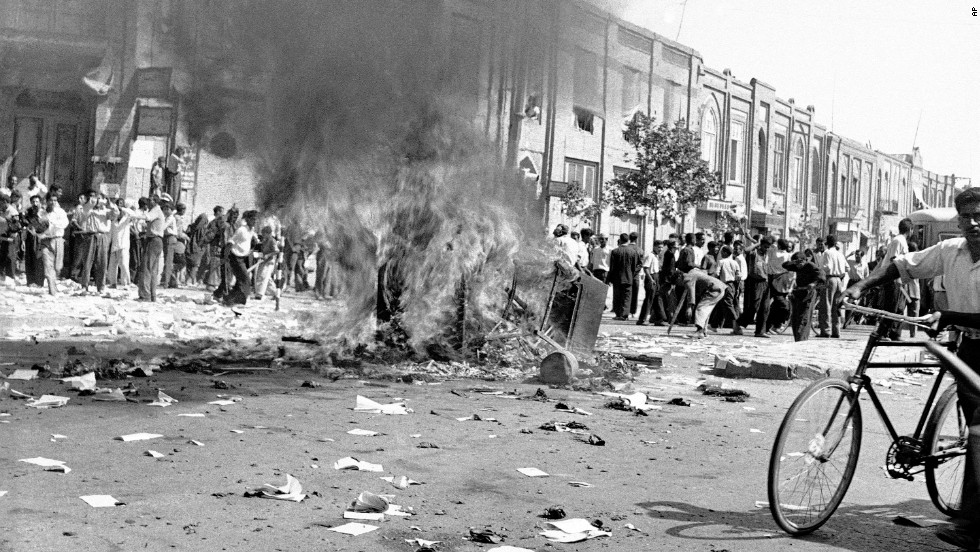
paid protestors. The measure of success seemed easy enough to gauge—"[a]ll
that really mattered was that Tehran be in turmoil.” The design, which looked
good on paper, failed on its first try, however, and succeeded largely through
happenstance and Roosevelt's nimble improvisations. No matter how meticulously
scripted a covert action may be, the "fog of war" affects it as
readily as military forces on a battlefield. Roosevelt may have known that
already—he and his confreres chose as the project's unofficial anthem a song
from the musical Guys and Dolls: "Luck Be a Lady Tonight."
TPAJAX had its surreal and offbeat moments. Examples include,
Roosevelt calmly lunching at a colleague's house in the embassy compound while
"[o]utside, Tehran was in upheaval. Cheers and rhythmic chants echoed
through the air, punctuated by the sound of gunfire and exploding mortar
shells. Squads of soldiers and police surged past the embassy gate every few
minutes. Yet Roosevelt's host and his wife were paragons of discretion, asking
not a single question about what was happening." To set the right mood
just before Washington's chosen coup leader, a senior army general named
Fazlollah Zahedi, spoke to the nation on the radio, US officials decided to
broadcast some military music. Someone found an appropriate-looking record in
the embassy library and put on the first song; to everyone's embarrassment, it
was "The Star-Spangled Banner." A less politically discordant tune
was quickly played, and then Zahedi took the microphone to declare himself
"the lawful prime minister by the Shah's order." Mossadegh was
sentenced to prison and then lifetime internal exile.
The Shah—who reluctantly signed the decrees removing Mossadegh
from office and installing Zahedi—had fled Iran during the crucial latter days
of the operation. When he heard of the successful outcome from his refuge in
Rome, he leapt to his feet and cried out, "I knew it! They love me!"
That serious misreading of his subjects' feeling toward him showed that he was
out of touch already. Seated again on the Peacock Throne, the insecure and vain
Shah missed the opportunity to introduce constitutional reforms that had been
on the Iranian people's minds for decades. Instead, he became a staunch
pro-Western satrap with grandiose pretensions. He forced the country into the
20th century economically and socially but ruled like a pre-modern despot,
leaving the mosques as the only outlet for dissent. Although the next 25 years
of stability that he imposed brought the United States an intelligence payoff
the price was dependence on local liaison for information about internal
developments. The intelligence gap steadily widened, and Washington was caught
by surprise when the Khomeini-inspired Islamist revolution occurred in February
1979. That takeover links the 51-year-old coup with recent and current
terrorism. With their devotion to radical Islam and their eagerness to embrace
even the most horrific kinds of violence, Iran's revolutionary leaders became
heroes to fanatics in many countries. Among those who were inspired by their
example were Afghans who founded the Taliban, led it to power in Kabul, and
gave Osama bin-Laden the base from which he launched devastating terror
attacks. It is not far-fetched to draw a line from Operation Ajax through the
Shah's repressive regime and the Islamic Revolution to the fireballs that
engulfed the World Trade Center in New York.
This conclusion, however, requires too many historical jumps,
exculpates several presidents who might have pressured the Shah to institute
reforms, and overlooks conflicts between the Shia theocracy in Tehran and Sunni
extremists in Saudi Arabia, Afghanistan, and elsewhere.
In the end, Operation Ajax got the CIA into the regime-change
business for good—similar efforts would soon follow in Guatemala, Indonesia,
and Cuba.
Source: CIA.gov