Some of you have contacted me about the Coup d'Etat text. Please be aware that there is a new edition now available. Feel free to use this edition instead.
Coup d'Etat: A Practical Handbook, 2016 Edition
Monday, December 12, 2016

Friday, December 9, 2016
Week 13 Class Overview

ZERO HOUR
The zero hour for post-war Germany rang
out with the capitulation of the country on
May 9, 1945. The members of the last
government of the German Reich, headed by
Admiral of the Fleet Dönitz were arrested
and together with other National Socialist
leaders brought before the International
Military Tribunal in Nuremberg and tried for
crimes against peace and humanity. The four
victorious powers, the United States, the
United Kingdom, the Soviet Union and
France assumed supreme authority and
divided up the capital city into four sectors
and the territory of the Reich into four
occupation zones.

Red Army in Berlin
On 2 May 1945,
after one of the bloodiest battles in
history,
two victorious Soviet soldiers:
Meliton
Kantaria and Mikhail Yegorov,
raised the Soviet flag
over the German Reichstag.
The Eastern territories
were placed under Polish or Russian
administration. At the Potsdam Conference
in the summer of 1945 the four victorious
powers were in agreement on the questions
of denazification, demilitarization, economic
decentralization and re-education of the
German people along democratic lines.
Admittedly not all those involved agreed on
what these concepts actually entailed. In
Potsdam the Western powers gave their
consent to the expulsion of Germans from
the German eastern territories, from
Hungary and from Czechoslovakia. The West
had insisted that the transfer be carried out
in a “humane” fashion, but this demand was
not observed and in the following years some
12 million Germans were brutally expelled by
the new rulers.
A minimum consensus was at least reached
in the form of an agreement to treat
Germany as an economic entity and in the
medium term to establish centralized
administrations for Germany as a whole. This
resolution had no effect as the different
developments in the zones occupied by the
Soviet Union and the Western Allies
respectively, as well as the handling of the
reparations issue, which was of particular
importance for the Soviet Union, excluded
any uniform arrangement for Germany from
the very beginning. Moscow demanded that
Germany be forced to make overall
reparations of USD 20 billion to the
victorious powers, above all by dismantling
plant and by contributions from ongoing
production, and claimed that USD 10 billion
should go to the USSR. The solution that was
finally devised entailed each of the victorious
powers drawing the reparations due to it
from the zone it respectively occupied, a
process that contributed to the economic
division of Germany.
 John Birch: The First Casualty of the Cold War
In the spring of 1942, a group of stranded
U.S. servicemen huddled inside a Chinese
riverboat, hiding from Japanese soldiers in
the invaded country. Suddenly, they heard
what seemed to be an American voice:
"Anyone in there?" The hidden men feared
trickery and capture until they heard the
voice again; it was a full-blown Southern
accent.
That voice belonged to missionary John
Morrison Birch, and the men he rescued
from the boat were Col. Jimmy Doolittle and
his famed "Tokyo Raiders." Birch brought the
group down the Chienteng River to the town
of Lanchi, from where they were able to
move on to safety.
Doolittle was much taken with the young
missionary, whose native garb and near fluent
grasp of Mandarin Chinese allowed
him to continue his goal of bringing the
Gospel to the Chinese mainland despite its
occupying force. Birch had sought a position
as a chaplain, but when Doolittle told Gen.
Claire Chennault about his rescuer,
Chennault recognized Birch's potential as an
intelligence resource. Commissioned a first
lieutenant on July 4, 1942, Birch became "the
eyes of the 14th Air Force (the Flying Tigers)"
with the stipulation that he be allowed to
preach the Gospel whenever possible.
Both in Chungking proper and in the interior,
Birch used his language skills and analytical
talents to draw up a network for the China
Air Task Force, which replaced the American
Volunteer Group. By all accounts, Birch was a
man of great skill and even greater modesty;
when he was awarded the Legion of Merit in
1944, he wrote to his mother, "they ought
not to cheapen the decoration by giving it
when a man merely does his duty." By war's
end, Birch had achieved the rank of captain
and his duties had come under the spreading
auspices of the Office of Strategic Services.
Shortly after the war ended, Birch and a
party of 11 Chinese soldiers were sent by the
OSS to accept the surrender of a Japanese
base. On Aug. 25, 1945, they met a group of
Chinese communists who disarmed Birch,
and shot his aide Lt. Tung when he tried to
intervene (Tung lived to tell the tale of Birch's
treatment). Birch's ankles were bound and he
was made to kneel for execution, then shot in
the back of his head.
Birch, who had spent the war working
behind enemy lines to serve both God and
Country, is considered by many to be the first
casualty of the Cold War.

The Dumbarton Oaks Conference
U.S., British, Soviet, and Chinese representatives met at Dumbarton Oaks in Washington in August and September 1944 to draft the charter of a postwar international organization based on the principle of collective security. They recommended a General Assembly of all member states and a Security Council consisting of the Big Four plus six members chosen by the Assembly. Voting procedures and the veto power of permanent members of the Security Council were finalized at the Yalta Conference in 1945 when Roosevelt and Stalin agreed that the veto would not prevent discussions by the Security Council. Roosevelt agreed to General Assembly membership for Ukraine and Byelorussia while reserving the right, which was never exercised, to seek two more votes for the United States. Representatives of 50 nations met in San Francisco April-June 1945 to complete the Charter of the United Nations. In addition to the General Assembly of all member states and a Security Council of 5 permanent and 6 non-permanent members, the Charter provided for an 18-member Economic and Social Council, an International Court of Justice, a Trusteeship Council to oversee certain colonial territories, and a Secretariat under a Secretary General. The Roosevelt administration strove to avoid Woodrow Wilson's mistakes in selling the League of Nations to the Senate. It sought bipartisan support and in September 1943 the Republican Party endorsed U.S. participation in a postwar international organization, after which both houses of Congress overwhelmingly endorsed participation. Roosevelt also sought to convince the public that an international organization was the best means to prevent future wars. The Senate approved the UN Charter on July 28, 1945, by a vote of 89 to 2. The United Nations came into existence on October 24, 1945, after 29 nations had ratified the Charter.

The Stated Goals of the Dumbarton Oaks Conference were:
Dumbarton Oaks
Located in the Georgetown neighborhood of
Washington, DC
the site of the Dumbarton Oaks
Conference was the residence
of Robert Woods Bliss
and his wife Mildred Barnes Bliss .
The Dumbarton Oaks Conference
U.S., British, Soviet, and Chinese representatives met at Dumbarton Oaks in Washington in August and September 1944 to draft the charter of a postwar international organization based on the principle of collective security. They recommended a General Assembly of all member states and a Security Council consisting of the Big Four plus six members chosen by the Assembly. Voting procedures and the veto power of permanent members of the Security Council were finalized at the Yalta Conference in 1945 when Roosevelt and Stalin agreed that the veto would not prevent discussions by the Security Council. Roosevelt agreed to General Assembly membership for Ukraine and Byelorussia while reserving the right, which was never exercised, to seek two more votes for the United States. Representatives of 50 nations met in San Francisco April-June 1945 to complete the Charter of the United Nations. In addition to the General Assembly of all member states and a Security Council of 5 permanent and 6 non-permanent members, the Charter provided for an 18-member Economic and Social Council, an International Court of Justice, a Trusteeship Council to oversee certain colonial territories, and a Secretariat under a Secretary General. The Roosevelt administration strove to avoid Woodrow Wilson's mistakes in selling the League of Nations to the Senate. It sought bipartisan support and in September 1943 the Republican Party endorsed U.S. participation in a postwar international organization, after which both houses of Congress overwhelmingly endorsed participation. Roosevelt also sought to convince the public that an international organization was the best means to prevent future wars. The Senate approved the UN Charter on July 28, 1945, by a vote of 89 to 2. The United Nations came into existence on October 24, 1945, after 29 nations had ratified the Charter.
The Stated Goals of the Dumbarton Oaks Conference were:
- To maintain international peace and security; and to that end to take effective collective measures for the prevention and removal of threats to the peace and the suppression of acts of aggression or other breaches of the peace, and to bring about by peaceful means adjustment or settlement of international disputes which may lead to a breach of the peace
- To develop friendly relations among nations and to take other appropriate measures to strengthen universal peace
- To achieve international co-operation in the solution of international economic, social and other humanitarian problems
- To afford a center for harmonizing the actions of nations in the achievement of these common ends.
Wednesday, November 30, 2016

Friday, November 18, 2016
Thursday, November 10, 2016
Week 10
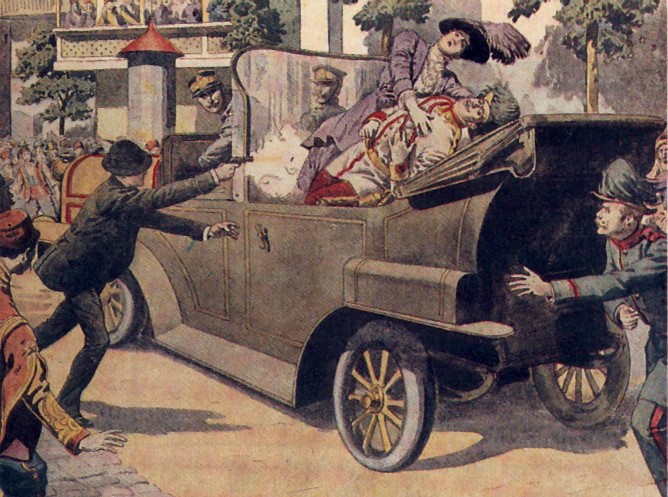
In June 1914, Austro-Hungarian Archduke Franz Ferdinand was shot by Serbian nationalists in Sarajevo. As a result of the escalation of threats and mobilization orders following the assassination, in mid-August of that same year World War I began. A war which pitted Germany, Austria-Hungary and the Ottoman Empire (the Central Powers) against Great Britain, France, Russia, and Italy (the Allied Powers). The Allies were joined in 1917 by the United States of America. The Great War brought about unprecedented levels of carnage, due to its use of trench warfare and modern weaponry such as machine guns, tanks and mustard gas. By the time World War I ground to a halt in November 1918, approximately nine million soldiers had been killed and 21 million more wounded. The Treaty of Versailles, signed the following year, set post-war borders from Europe to the Middle East, established the League of Nations as an international peace organization, and forced Germany to pay for the war via reparations and the loss of territory.
1. We are now about to accept…battle with [Germany] and shall, if necessary, spend the whole force of the nation to check and nullify its pretensions and its power. We are glad, now that we see the facts with no veil of false pretense about them, to fight thus for the ultimate peace of the world and for the liberation of its peoples, the German peoples included: for the rights of nations great and small and the privilege of men everywhere to choose their way of life and of obedience. The world must be made safe for democracy. Its peace must be planted upon the tested foundations of political liberty. We have no selfish ends to serve. We desire no conquest, no dominion. We seek no indemnities for ourselves, no material compensation for the sacrifices we shall freely make. We are but one of the champions of the rights of mankind. We shall be satisfied when those rights have been made as secure as the faith and the freedom of nations can make them.
2. We [Germans] are a nation that wishes to lead a quiet and industrious life. This need hardly be stated to you Americans. You, of all others, know the temper of the German who lives within your gates. Our love of peace is so strong that it is not regarded by us in the light of a virtue; we simply know it to be an inborn and integral portion of ourselves. Since the foundation of the German Empire in the year 1871, we, living in the center of Europe, have given an example of tranquility and peace, never once seeking to profit by any momentary difficulties of our neighbors. Everyone is aware that we have produced great philosophers and poets; we have preached the gospel of humanity with impassioned zeal. America fully appreciates Goethe and Kant, looks upon them as corner-stones of elevated culture. Do you really believe that we have changed our natures, that our souls can be satisfied with military drill and servile obedience? We and all our soldiers have remained, however, the same lovers of music and lovers of exalted thought. We have retained our old devotion to peace. Firmly believing in the justice of our cause, all parties, the conservatives and Christians; liberals and the socialists, have joined hands. All disputes are forgotten, one duty exists for all, the duty of defending our country. The war has severed us from the rest of the world; all our cable communications are destroyed. But the winds will carry the mighty voice of justice even across the ocean. We trust in God, and have confidence in the judgment of right-minded men.
Monday, November 7, 2016
Barzun Study Questions (Week 9)
Barzun Study Questions:
Please answer these questions in complete sentences and provide page references for your answers.
1. Barzun describes the 1890s as the 'starting point of modern American higher education'. What major trends in education emerged from the particular cultural context of American life in the late-nineteenth century? How do you think these trends continue to influence modern secondary education? (p. 606)
Thursday, November 3, 2016
Week 9
Note: The first performance of this piece caused the audience to riot. Check out this discussion of dissonance which delves into that riot.
Sound as Touch
Friday, October 28, 2016
Barzun Study Questions (Week 8)
Barzun Study Questions:
Please answer these questions in complete sentences and provide page references for your answers.
- Barzun argues that ‘there are moments in history when political evolution is for one reason or another impossible, the dam bursts and the land is submerged in the flood until a new legitimacy builds up’. (p. 521) Does political change happen gradually or can it occur in sudden events like Barzun argues? Please provide evidence.
- Barzun argues that efforts at mimicking the success of the British parliament have largely met with failure, why? (pp. 528-29, 35-36)
- In what ways did the railroad system change European culture?
- Barzun writes: ‘wanting tranquility after long unrest…Europeans obtained it in good measure by what might be called home remedies’. (p. 554) What historical trends is he describing in this sentence?
- What makes Macaulay’s historical writings problematic to modern scholars? (pp. 568-69)
Friday, October 21, 2016
Week 7
Joy, beautiful spark of divinity,
Daughter from Heaven,
We enter, drunk with fire,
Heavenly, thy sanctuary!
Your magics join again
What custom strictly divided;
All people become brothers,
Where your gentle wing abides.
Who has succeeded in the great attempt,
To be a friend's friend,
Whoever has won a lovely woman,
Add his to the jubilation!
Indeed, who calls at least one soul
Theirs upon this world!
And whoever never managed, shall steal himself
Weeping away from this union.
All creatures drink of joy
At nature's breast.
Just and unjust
Alike taste of her gift;
She gave us kisses and the fruit of the vine,
A tried friend to the end.
[Even] the worm has been granted sensuality,
And the cherub stands before God!
Gladly, as His heavenly bodies fly
On their courses through the heavens,
Thus, brothers, you should run your race,
As a hero going to conquest.
You millions, I embrace you.
This kiss is for all the world!
Brothers, above the starry canopy
There must dwell a loving Father.
Do you fall in worship, you millions?
World, do you know your creator?
Seek him in the heavens;
Above the stars must He dwell.
Daughter from Heaven,
We enter, drunk with fire,
Heavenly, thy sanctuary!
Your magics join again
What custom strictly divided;
All people become brothers,
Where your gentle wing abides.
Who has succeeded in the great attempt,
To be a friend's friend,
Whoever has won a lovely woman,
Add his to the jubilation!
Indeed, who calls at least one soul
Theirs upon this world!
And whoever never managed, shall steal himself
Weeping away from this union.
All creatures drink of joy
At nature's breast.
Just and unjust
Alike taste of her gift;
She gave us kisses and the fruit of the vine,
A tried friend to the end.
[Even] the worm has been granted sensuality,
And the cherub stands before God!
Gladly, as His heavenly bodies fly
On their courses through the heavens,
Thus, brothers, you should run your race,
As a hero going to conquest.
You millions, I embrace you.
This kiss is for all the world!
Brothers, above the starry canopy
There must dwell a loving Father.
Do you fall in worship, you millions?
World, do you know your creator?
Seek him in the heavens;
Above the stars must He dwell.
Edit: Sorry, my textbook went missing, so there will be no study question this week.
Thursday, October 13, 2016
Barzun Study Questions (Week 6)
Barzun Study Questions:
Please answer these questions in complete sentences and provide page references for your answers.
Week 6:
1. Why doesn't Barzun see the American War of Independence as a revolution?
1. Why doesn't Barzun see the American War of Independence as a revolution?
J. J. Rousseau's Daphnis et Chloè
Jean-Jacques Rousseau, who composed the piece above, was one of the most influential thinkers during the Enlightenment in eighteenth century Europe. His first major philosophical work, A Discourse on the Sciences and Arts, was the winning response to an essay contest conducted by the Academy of Dijon in 1750. In this work, Rousseau argues that the progression of the sciences and arts has caused the corruption of virtue and morality. This discourse won Rousseau fame and recognition, and it laid much of the philosophical groundwork for a second, longer work, The Discourse on the Origin of Inequality. The second discourse did not win the Academy’s prize, but like the first, it was widely read and further solidified Rousseau’s place as a significant intellectual figure. The central claim of the work is that human beings are basically good by nature, but were corrupted by the complex historical events that resulted in present day civil society.Rousseau’s praise of nature is a theme that continues throughout his later works as well, the most significant of which include his comprehensive work on the philosophy of education, the Emile, and his major work on political philosophy, The Social Contract: both published in 1762. These works caused great controversy in France and were immediately banned by Paris authorities. Rousseau fled France and settled in Switzerland, but he continued to find difficulties with authorities and quarrel with friends. The end of Rousseau’s life was marked in large part by his growing paranoia and his continued attempts to justify his life and his work. This is especially evident in his later books, The Confessions, The Reveries of the Solitary Walker, and Rousseau: Judge of Jean-Jacques.
Rousseau greatly influenced Immanuel Kant’s work on ethics. His novel Julie or the New Heloiseimpacted the late eighteenth century’s Romantic Naturalism movement, and his political ideals were championed by leaders of the French Revolution.
Source: http://www.iep.utm.edu/rousseau/
Thursday, October 6, 2016
Barzun Study Questions (Week 5)
Barzun Study Questions:
Please answer these questions in complete sentences and provide page references for your answers.
Week 5:
1. In what ways did Cartouche symbolize the culture of regency France? (pp. 307-309)
2. How did John Law impact history? (pp. 320-322)
3. Compare and contrast the writing styles of Swift and Defoe:
4. According to Barzun, in what ways has Rousseau been misunderstood? (pp. 382-387)
1. In what ways did Cartouche symbolize the culture of regency France? (pp. 307-309)
2. How did John Law impact history? (pp. 320-322)
3. Compare and contrast the writing styles of Swift and Defoe:
4. According to Barzun, in what ways has Rousseau been misunderstood? (pp. 382-387)
Wednesday, October 5, 2016
Handel's See the Conquering Hero Come
Georg Frideric Handel was born on February 23, 1685, to Georg and Dorothea Handel of Halle, Saxony, Germany. From an early age, Handel longed to study music, but his father objected, doubting that music would be a realistic source of income. In fact, his father would not even permit him to own a musical instrument. His mother, however, was supportive, and she encouraged him to develop his musical talent. With her cooperation, Handel took to practicing on the sly.
When Handel was still a young boy, he had the opportunity to play the organ for the duke’s court in Weissenfels. It was there that Handel met composer and organist Frideric Wilhelm Zachow. Zachow was impressed with Handel’s potential and invited Handel to become his pupil. Under Zachow's tutelage, Handel mastered composing for the organ, the oboe and the violin alike by the time he was 10 years old. From the age of 11 to the time he was 16 or 17, Handel composed church cantatas and chamber music that, being written for a small audience, failed to garner much attention and have since been lost to time.
Despite his dedication to his music, at his father’s insistence, Handel initially agreed to study law at the University of Halle. Not surprisingly, he did not remain enrolled for long. His passion for music would not be suppressed.
In 1703, when Handel was 18 years old, he decided to commit himself completely to music, accepting a violinist’s position at the Hamburg Opera’s Goose Market Theater. During this time, he supplemented his income by teaching private music lessons in his free time, passing on what he had learned from Zachow.
Though working as a violinist, it was Handel's skill on the organ and harpsichord that began to earn him attention and landed him more opportunities to perform in operas.
Handel also began to compose operas, making his debut in early 1705 with Almira. The opera was instantly successful and achieved a 20-performance run. After composing several more popular operas, in 1706 Handel decided to try his luck in Italy. While in there, Handel composed the operas Rodrigo and Agrippina, which were produced in 1707 and 1709 respectively. He also managed to write more than a few dramatic chamber works during this period.
Touring the major Italian cities over three opera seasons, Handel introduced himself to most of Italy’s major musicians. Unexpectedly, while in Venice, he met multiple people who expressed an interest in London’s music scene. Enticed to experiment with a freelance music career there, in 1710 Handel left Venice and set out for London. In London, Handel met with the manager of the King’s Theatre, who commissioned Handel to write an opera. Within just two weeks, Handel composed Rinaldo. Released during the 1710–11 London opera season, Rinaldo was Handel’s breakthrough. His most critically acclaimed work up to that date, it gained him the widespread recognition that he would maintain throughout the rest of his musical career.
After the debut of Rinaldo, Handel spent the next few years writing and performing for English royalty, including Queen Anne and King George I. Then, in 1719, Handel was invited to become the Master of the Orchestra at the Royal Academy of Music, the first Italian opera company in London. Handel eagerly accepted. He produced several operas with the Royal Academy of Music that, while well liked, were not especially lucrative for the struggling academy.
In 1726 Handel decided to make London his home permanently, and became a British citizen. (He also Anglicized his name at this time, to George Frideric.) In 1727, when Handel’s latest opera, Alessandro, was being performed, Italian opera in London took a hard hit as the result of a hostile rivalry between two female lead singers. Frustrated, Handel broke away from the Royal Academy and formed his own new company, calling it the New Royal Academy of Music. Under the New Royal Academy of Music, Handel produced two operas a year for the next decade, but Italian opera fell increasingly out of style in London. Handel composed two more Italian operas before finally deciding to abandon the failing genre.
In place of operas, oratorios became Handel’s new format of choice. Oratorios, large-scale concert pieces, immediately caught on with audiences and proved quite lucrative. The fact that oratorios didn’t require elaborate costumes and sets, as operas did, also meant that they cost far less to produce. Handel revised a number of Italian operas to fit this new format, translating them into English for the London audience. His oratorios became the latest craze in London and were soon made a regular feature of the opera season.
In 1735, during Lent alone, Handel produced more than 14 concerts made up primarily of oratorios. In 1741 Dublin’s Lord Lieutenant commissioned Handel to write a new oratorio based on a biblical libretto assembled by art patron Charles Jennens. As a result, Handel’s most famous oratorio, Messiah, made its debut at the New Music Hall in Dublin in April 1742.
Back in London, Handel organized a subscription season for 1743 that consisted exclusively of oratorios. The series opened with Handel’s composition Samson, to great audience acclaim. Samson was eventually followed by a run of Handel’s beloved Messiah.
The piece you are listening to today is 'See the conquering hero come' from the oratorio Judas Maccabaeus composed in 1746. The oratorio was devised as a compliment to the victorious Prince William Augustus, Duke of Cumberland upon his return from the Battle of Culloden in April 1746.
If you are interested in finding out more about the context of the composition of this piece, check out this Battlefield Britain documentary about the Battle of Culloden:
Thursday, September 29, 2016
Barzun Study Questions (Week 4)
Barzun Study Questions:
Please answer these questions in complete sentences and provide page references for your answers.
Week 4:
1. What was the impact of Britain's foreign monarchs post-1066?
2. Compare/contrast the Protestant and Monarchy Revolutions:
3. In what ways did Machiavelli's The Prince help to establish the foundations of the Monarchy Revolution?
4. How did theology influence the political goals of the Puritans in England?
1. What was the impact of Britain's foreign monarchs post-1066?
2. Compare/contrast the Protestant and Monarchy Revolutions:
3. In what ways did Machiavelli's The Prince help to establish the foundations of the Monarchy Revolution?
4. How did theology influence the political goals of the Puritans in England?
Wednesday, September 28, 2016
All People that on Earth do Dwell or Old Hundredth
Old Hundredth is a hymn tune from Pseaumes Octante Trois de David (1551) and is one of the best known melodies in all Christian musical traditions. The tune is usually attributed to the French composer Loys Bourgeois (c. 1510 – c.1560).
Although the tune was first associated with Psalm 134 in the Genevan Psalter, the melody receives its current name from an association with the 100th Psalm, in a translation by William Kethe entitled All People that on Earth do Dwell.
The Genevan Psalter was compiled over a number of years in the Swiss city of Geneva, a center of Protestant activity during the Reformation, in response to the teaching of John Calvin that communal singing of psalms in the vernacular language is a foundational aspect of church life. This contrasted with the prevailing Catholic practice at the time in which sacred texts were chanted in Latin by the clergy only. Calvinist musicians including Loys Bourgeois supplied many new melodies and adapted others from sources both sacred and secular. The final version of the psalter was completed in 1562. Calvin intended the melodies to be sung in plainsong during church services, but harmonized versions were provided for singing at home.
Thursday, September 22, 2016
Barzun Study Questions (Week 3)
Barzun Study Questions:
Please answer these questions in complete sentences and provide page references for your answers.
Week 3:
What does Barzun mean when he says that "the sequence of dominant genres during our half-millennium has paralleled the march of the individual towards equality"? (pg. 153)
How did protestant reforms of church music reflect the growth of individualism? (pg. 157)
In what ways did 16th century music express Europeans' interest in emancipation? (pg. 160)
What does Barzun mean when he says that "the sequence of dominant genres during our half-millennium has paralleled the march of the individual towards equality"? (pg. 153)
How did protestant reforms of church music reflect the growth of individualism? (pg. 157)
In what ways did 16th century music express Europeans' interest in emancipation? (pg. 160)
Wednesday, September 21, 2016
Friday, September 16, 2016
Barzun Study Questions (Weeks 1 & 2)
Barzun
Study Questions:
Please
answer these questions in complete sentences and provide page references for
your answers.
Weeks 1 & 2:
- Was Martin Luther a reformer or a revolutionary?
- What historical trends made Luther’s efforts succeed where others had failed?
- Compare and contrast the personalities and beliefs of Luther and Erasmus:
- What was Weber’s perspective on the Protestant Reformation?
- Explain how the themes of primitivism, individualism, and emancipation play out in Reformation theology?
- How did secularism emerge from the humanist tradition?
- How did the humanist tradition help to kindle the ‘idea’ of history in a way that hadn’t existed during the medieval era?
- How did the Renaissance change the status of the artist?
- Although their ideas differed on some issues what themes linked the Eutopians?
- In what ways did the Renaissance vision impact European exploration and its interaction with the New World?
- How did Montaigne impact the development of self-consciousness?
Thursday, September 15, 2016
Saturday, September 10, 2016
Week 1 Listening
A mighty fortress is our God, A bulwark never failing;
Our shelter He, amid the flood Of mortal ills prevailing.
For still our ancient foe Doth seek to work us woe;
His craft and pow'r are great, And, armed with cruel hate,
On earth is not his equal.
Did we in our own strength confide, Our striving would be losing;
Were not the right Man on our side, The Man of God's own choosing.
Dost ask who that may be? Christ Jesus, it is He;
Lord Sabaoth is His name, From age to age the same,
And He must win the battle.
And tho' this world, with devils filled, Should threaten to undo us;
We will not fear, for God hath willed His truth to triumph through us.
The prince of darkness grim -- We tremble not for him;
His rage we can endure, For lo! his doom is sure,
One little word shall fell him.
That word above all earthly pow'rs -- No thanks to them -- abideth:
The Spirit and the gifts are ours Thro' Him who with us sideth.
Let goods and kindred go, This mortal life also;
The body they may kill: God's truth abideth still,
His kingdom is forever.
Monday, May 9, 2016
Monday, May 2, 2016
Debate Night
Greetings
Debaters,
I hope that your
preparations are going very smoothly! This message is to remind you of tomorrow
evening's debate, and a few additional matters.
Please remember to dress
appropriately in dark gray, navy blue, or black. Gentlemen speakers, please
remember that a white/light blue dress shirt, suit or sports coat, and tie are
required. If you need help with this, please let me know as soon as possible. Non-speakers should dress as they would for a presentation.
For those of you who
will be attending, but not debating, please let me know if you are available for
the jobs previously discussed (tellers, timekeepers, or food service) at some point before the debate.
Lastly, I ask that if at
all possible you bring something to share. For those of you planning on
bringing sweets, please be sure to follow the Greenhouse food regulations.
Additionally, for those of you that volunteered to bring a drink instead, if
you could let me know what you are bringing in the comments, I would appreciate it very much. Thank you!
I hope
that the remainder of your work goes smoothly!
Kind Regards,
Dr. Parker
Tuesday, April 26, 2016
Symphony of Sorrowful Songs
Please listen to: The Symphony of Sorrowful Songs by Henryk Gorecki
The 20th century was one of the darkest periods in human history. Henryk Gorecki, a polish composer, experienced much of the worst that the century had to offer. In 1992 a recording of his third symphony was released which became one of the most important recordings of contemporary classical music to ever be released. This term we have discussed the many wars, coups, and other tragedies that marked the last half of the 20th century. Please take this time to reflect, read through the symphony's texts, and listen.
If at all possible, please listen to this piece in one sitting (ideally in the dark, with headphones on!)
First Movement:
My son, my chosen and beloved
Share your wounds with your mother
And because, dear son, I have always carried you in my heart,
And always served you faithfully
Speak to your mother, to make her happy,
Although you are already leaving me, my cherished hope.
Lamentation of the Holy Cross Monastery from the "Lysagóra Songs" collection. Second half of the 15th century
Second Movement:
No, Mother, do not weep,
Most chaste Queen of Heaven
Support me always.
"Zdrowas Mario." *
Prayer inscribed on wall 3 of cell no. 3 in the basement of "the Palace," the Gestapo's headquarters in Zadopane; beneath is the signature of Helena Wanda Blazusiakówna, and the words "18 years old, imprisoned since 26 September 1944."
* "Zdrowas Mario" (Ave Maria)—the opening of the Polish prayer to the Holy Mother
Third Movement:
Where has he gone
My dearest son?
Perhaps during the uprising
The cruel enemy killed him
Ah, you bad people
In the name of God, the most Holy,
Tell me, why did you kill
My son?
Never again
Will I have his support
Even if I cry
My old eyes out
Were my bitter tears
to create another River Oder
They would not restore to life
My son
He lies in his grave
and I know not where
Though I keep asking people
Everywhere
Perhaps the poor child
Lies in a rough ditch
and instead he could have been
lying in his warm bed
Oh, sing for him
God's little song-birds
Since his mother
Cannot find him
And you, God's little flowers
May you blossom all around
So that my son
May sleep happily
Folk song in the dialect of the Opole region of Poland
Tuesday, April 19, 2016
Oxford Union Debate Information
Please review the Oxford Union Rules
Additionally, please note the following:
1. If at all possible, please bring a plate of treats to share.
2. Suits, white or light blue shirts, dark solid ties for gentlemen. Dresses for ladies; black or navy blue
3. Speakers, please arrive by six; non-speakers by six-thirty.
4. We will need several volunteers: we need a timekeeper, two to four tellers (who will take votes at the division), and a handful of non-speakers willing to set up the refreshments table.
Notes on the debate itself:
1. Members for the proposition will sit on the Chairman's right and the opposition on his left.
2. Speakers should remain on their side of the table at all times and should not move away from the table.
3. The audience will vote by exiting on the side they favor. (Ayes on their own right, Nays on their own left). The tellers will stand outside their door and count voters as they leave.
Additionally, please note the following:
1. If at all possible, please bring a plate of treats to share.
2. Suits, white or light blue shirts, dark solid ties for gentlemen. Dresses for ladies; black or navy blue
3. Speakers, please arrive by six; non-speakers by six-thirty.
4. We will need several volunteers: we need a timekeeper, two to four tellers (who will take votes at the division), and a handful of non-speakers willing to set up the refreshments table.
Notes on the debate itself:
1. Members for the proposition will sit on the Chairman's right and the opposition on his left.
2. Speakers should remain on their side of the table at all times and should not move away from the table.
3. The audience will vote by exiting on the side they favor. (Ayes on their own right, Nays on their own left). The tellers will stand outside their door and count voters as they leave.
The Wall Comes Down
The August 1991 Coup in Moscow, 20 Years Later
Document 2. Rodric Braithwaite, “Moscow, August 19: The First Day of the Coup,” Telegram of 20 August 1991.
Document 3. George Bush-Felipe Gonzalez Memorandum of Telephone Conversation, August 19, 1991.
Document 4. George Bush-Vaclav Havel Memorandum of Telephone Conversation, August 19, 1991.
Document 5. George Bush-Jozsef Antall Memorandum of Telephone Conversation, August 19, 1991.
Document 6. George Bush-Boris Yeltsin Memorandum of Telephone Conversation, August 20, 1991.
Document 7. George Bush-Boris Yeltsin Memorandum of Telephone Conversation, August 21, 1991.
Document 8. George Bush-Mikhail Gorbachev Memorandum of Telephone Conversation, August 21, 1991.
Document 9. Transcript of the First Extraordinary Session of the Supreme Soviet of the Russian Federation, August 21, 1991
Presentation Guidelines:
1. Summarize the document.
2. Find one interesting quotation from the selection, share the quote, and explain it.
3. Explain the importance of your document and its relationship to the fall of communism.
4. Sum up your findings and describe what you learned from reading the document.
5. If you share a dialogue document, your quote should include portions of the dialogue read together with your partner.
Note: Your presentation should use note cards. These will not be handed in.
Presentation Guidelines:
1. Summarize the document.
2. Find one interesting quotation from the selection, share the quote, and explain it.
3. Explain the importance of your document and its relationship to the fall of communism.
4. Sum up your findings and describe what you learned from reading the document.
5. If you share a dialogue document, your quote should include portions of the dialogue read together with your partner.
Note: Your presentation should use note cards. These will not be handed in.
Monday, April 18, 2016
Essay Final Questions
Essay Final Prompts
Please answer the question: 1-2 pages
Compare and contrast Huntington's, Fukayama's, and Bobbitt's perspectives on the post-Cold War world.
Please also answer one of the following five: 1-2 pages each
1. Please trace the long term impact of Operation Ajax from 1953 to today.
2. In what ways did Joseph Alsop’s life experiences shape his impact on history.
3. In what ways did the eccentricities of the USSR’s leadership impact world order?
4. What historical and political developments led to a rise in the number of coup d’états after World War II?
5. In what ways did the Suez Crisis transform post-World War II politics?
Please answer the question: 1-2 pages
Compare and contrast Huntington's, Fukayama's, and Bobbitt's perspectives on the post-Cold War world.
Please also answer one of the following five: 1-2 pages each
1. Please trace the long term impact of Operation Ajax from 1953 to today.
2. In what ways did Joseph Alsop’s life experiences shape his impact on history.
3. In what ways did the eccentricities of the USSR’s leadership impact world order?
4. What historical and political developments led to a rise in the number of coup d’états after World War II?
5. In what ways did the Suez Crisis transform post-World War II politics?
Wednesday, April 13, 2016
Wednesday, April 6, 2016
Afghanistan

Osama
bin Laden with family, ObL
second from right
Today, Afghanistan appears to be a very primitive
society, with few of the resources available to modern states. However,
between the late 1950s through the late 1970s many of Afghanistan’s urban areas
were highly developed and western-style. This was in large part a result of the
generous aid package that Afghanistan’s government received from the Soviet
government. This involvement had a long history and dated back to Tsarist
efforts in the 19th century, during the expansion of the British Empire into
the region. Increasing
Soviet influence in Afghanistan eventually led to the Saur Revolution, which
took place on April 27, 1978. The new, revolutionary government had close
relations with the Soviet Union. On December 5, 1978, a treaty was signed
between the Soviet Union and Afghanistan.
In February of that year, the Islamic Revolution
ousted the American-backed Shah from Afghanistan's neighbor Iran. The United
States Ambassador to Afghanistan, Adolph Dubs, was abducted and killed by
Islamists associated with the Iranian Revolution. The death of the U.S.
Ambassador led to a major degradation in Afghanistan–United States relations.
In response, President Jimmy Carter signed the first directive for covert
financial aid to the opponents of the pro-Soviet regime in Kabul on July 3,
1979.
On Christmas Day 1979, Russian paratroopers
landed in Kabul, the capital city of Afghanistan. Already in the grip of a
civil war, Afghanistan was on the verge of collapse. Soviet troops had been
brought in, at the request of Communist sympathizer Hafizullah Amin, the
enormously unpopular Prime Minister. Amin, in keeping with his Marxist beliefs
was seeking eliminate Muslim tradition within Afghanistan. This outraged many,
more traditional, rural Afghans. Thousands of Islamic leaders had been arrested
and many more fled to the mountains, in order to escape Amin's police.
Thousands of Afghan and foreign Muslims joined the Mujahedeen - a guerilla
force dedicated to regaining Islam’s preeminence in Afghanistan. These soldiers
included a young Saudi named Osama bin Laden. As part of this effort, the
Mujahedeen declared a jihad - a holy war - on the supporters of Amin. This was
then extended to the Russian army which was now supporting him. The Russians
claimed that they had been invited in by the Amin government and that, as such,
they were not an invading army.
On December 27th, 1979, Amin was shot by the
Russians and he was replaced by Babrak Kamal. His position as head of the
Afghan government depended entirely on Russian military support. Many Afghan
soldiers began to desert to the Mujahedeen. As a result the Kamal government
requested a semi-permanent force of 85,000 Soviet troops.
The Mujahedeen proved to be a formidable
opponent. They were equipped with very old weaponry but had knowledge of
terrain and the weather conditions gave them the upper hand. The Russians
resorted to using napalm, poison gas and helicopter gunships against the
Mujahedeen - but this proved to be of limited utility. By 1982, the Mujahedeen
controlled roughly seventy-five percent of Afghanistan despite the best efforts
of the world's second most powerful military power. Young Russian soldiers,
drafted into service, were no match against men fuelled by a belief in
fundamentalist Islam. The war in Afghanistan showed the world just how badly
the Soviet Army had declined. Soviet Army boots often lasted no more than ten
days before falling to bits in the harsh environment of the Afghan mountains.
The United Nations condemned the invasion as early as January 1980 but a
Security Council motion calling for the withdrawal of Russian forces was vetoed
by the Soviet Union.
America put a ban on the export of grain to Russia,
ended the important treaty talks then taking place, and boycotted the Olympic
Games due to be held in Moscow in 1980. Other than that, Mujahedeen fighters
were given access to American surface-to-air missiles. Mikhail Gorbachev took
Russia out of the Afghanistan fiasco when he realized that Russia could not win
the war and the cost of maintaining such a vast force in Afghanistan was
crippling Russia's already weak economy. By the end of the 1980s, the
Mujahedeen was at war with itself in Afghanistan with hard line Taliban
fighters taking a stronger grip over the whole nation and imposing very strict
Muslim law on the Afghanistan population. Taliban leadership, established with
the help of neighboring Pakistan helped Afghanistan to become a major center of
Islamism. As a result of these changes, Islamic radicals were provided a safe
haven from Western and Israeli efforts to capture terrorists protected by the
Taliban leadership. After 9/11 Afghanistan was targeted, after it was
discovered that Al Quaeda attacks had been organized in Afghanistan by figures
such as Osama bin Laden.
Subscribe to:
Posts (Atom)