Wednesday, March 23, 2016

The First Kurdish-Iraqi War

The First Kurdish–Iraqi War lasted from 1961 until 1970. Kurdish forces, led by Mustafa Barzani, attempted to establish an independent Kurdish state in northern Iraq. The war failed to resolve the issue of a Kurdish homeland despite the fact that the war inflicted over 100,000 casualties.  In 1958, a military coup d’état against the Hashemite Monarchy, led to the seizure of power by Abdul Karim Qasim. Qasim invited Barzani to return from exile in the USSR, hoping to gain the support of Kurdish militias.  As part of the new arrangement, Qasim promised Barzani complete regional autonomy in Kurdistan in return for Kurdish support for his government. Barzani, who was the head of the Kurdistan Democratic Party (KDP), agreed to the deal. By early 1960, it became apparent that Qasim would not follow through with his promise of regional autonomy. As a result, the KDP began to agitate for regional autonomy. In the face of growing Kurdish dissent, as well as Barzani's personal influence, Qasim’s government shifted its support to the Barzani clan’s historical rivals, the Baradost and Zebari tribes. The result of this pivot was a period of intense inter-tribal warfare between 1960 and 1961. By February 1961, Barzani had defeated the pro-government forces Kurdish tribes and consolidated his position as leader of all the Kurdish tribes. At this point, Barzani ordered his forces to occupy and expel Iraqi Arab officials from Kurdish territory. This was not received well in Baghdad, and as a result, Qasim began to prepare for a military offensive against the Kurdish region. Meanwhile, in June 1961, the KDP issued a detailed ultimatum to Qasim outlining Kurdish grievances and demanded rectification. Qasim ignored the Kurdish demands and continued planning for war. It was not until September 10, 1961 when an Iraqi army column was ambushed by a group of Kurds, that the Kurdish revolt truly began. In response to the attack, Qasim lashed out and ordered the Iraqi Air Force to indiscriminately bomb Kurdish villages, which ultimately rallied the entire Kurdish population to Barzani's standard. Due to Qasim's profound distrust of the Iraqi Army, which he purposely failed to adequately arm, Qasim's government was not able to subdue the insurrection. Of the sixteen members of Qasim's cabinet, twelve were Ba'ath Party members; however, the party turned against Qasim due to his refusal to join Gamel Abdel Nasser's United Arab Republic. To strengthen his own position within the government, Qasim created an alliance with the Iraqi Communist Party, which was opposed to any notion of pan-Arabism. The war’s stalemate irritated powerful factions within the military and is said to be one of the main reasons behind the Ba'athist coup against Qasim in February 1963. The Ba’athists had made earlier attempts, however, in 1959. The assassins, which included Saddam Hussein, planned to ambush Qasim on October 7, 1959: one man was to kill those sitting at the back of the car, the rest killing those in front. During the ambush it is claimed that Saddam Hussein began shooting prematurely, which disorganized the whole operation. Qasim's chauffeur was killed, and Qasim was hit in the arm and shoulder. The assassins believed they had killed him and quickly retreated to their headquarters, but Qasim survived. At the time of the attack the Ba'ath Party had less than 1,000 members. After the failed coup d’état, many Ba’athist fled to Syria, the ideological home of Ba’athism. After the failure of Syrian unification with Egypt in 1961, Syria was declared an Arab Republic in the interim constitution. On 23 August 1962, around 120,000 Kurds in Jazira were arbitrarily categorized as aliens, forcing them to either leave the country or register as foreigners in their own country. In addition, a policy of violent discrimination was launched against the Kurds. These policies coincided with the beginning of Barzani's uprising in Iraqi Kurdistan and the discovery of oilfields in the Kurdish inhabited areas of Syria.  These events led to a period of increasing violence, including an attack in which Syrian troops crossed the Iraqi border in pursuit of Barzani's fighters. These tensions and the failure of the Iraqi government to halt the war, led the Ba’athist elements within the government to stage a coup d’état.  The coup d’état itself occurred on February 8, 1963, the fourteenth day of Ramadan, and as a result is remembered as the 14 Ramadan Coup. The coup had been in its planning stages since 1962, and several attempts had been planned, only to be abandoned for fear of discovery. The coup began in the early hours of February 8, 1963, when the communist air force chief, Jalal al-Awqati was assassinated and tank units occupied the Abu Ghrayb radio station. Over the following two day a violent struggle unfolded with fierce fighting between the Ba’athist conspirators and pro-Qasim forces. Qasim took refuge in the Ministry of Defence, where fighting became particularly heavy. Communist sympathizers were widely mobilized to fight against the coup. The following day, Qasim offered to surrender in return for safe passage out of the country. His request was refused, and that afternoon he was captured and executed. His dead body was displayed on television by leaders of the coup soon after his death. Around 5,000 Iraqis were killed in the fighting and an unknown number of communist sympathizers were rounded up during a CIA sponsored hunt for communists. The Ba’athist forces lost 80 men during the fight.


Writing in his memoirs of the 1963 coup, long time CIA analyst Harry Rositzke presented it as an example of one on which they had good intelligence in contrast to others that caught the agency by surprise. According to Rositzke, the Ba’athists had kept CIA informed of every step in the process of the coup d’état.  "Agents in the Ba’ath Party headquarters in Baghdad had for years kept Washington au courant on the party’s personnel and organization, its secret communications and sources of funds, and its penetrations of military and civilian hierarchies in several countries. CIA sources were in a perfect position to follow each step of Ba’athist preparations for the Iraqi coup, which focused on making contacts with military and civilian leaders in Baghdad. The CIA’s major source, in an ideal catbird seat, reported the exact time of the coup and provided a list of the new cabinet members. To call an upcoming coup requires the CIA to have sources within the group of plotters. Yet, from a diplomatic point of view, having secret contacts with plotters implies at least unofficial complicity in the plot." The best evidence that the U.S. was complicit is the memo from NSC staff member Bob Komer to President John F. Kennedy on the night of the coup, February 8, 1963. The last paragraph of the memo reads: "We will make informal friendly noises as soon as we can find out whom to talk with, and ought to recognize as soon as we’re sure these guys are firmly in the saddle. CIA had excellent reports on the plotting, but I doubt either they or UK should claim much credit for it. The new government used lists, provided by the CIA, to systematically arrest several thousand suspected communists.  According to former CIA Near East Division Chief James Chritchfield, the CIA took interest in the Ba'ath Party around 1961-2, and "was better informed on the 1963 coup in Baghdad than on any other major event or change of government that took place in the whole region in those years;" however, it did not "actively support" the coup.


In November 1963, after considerable infighting amongst the civilian and military wings of the Ba'athists, they were ousted by Abdul Salam Arif in a coup. Then, after another failed offensive on Kurds, Arif declared a ceasefire in February 1964, which provoked a split among Kurdish urban radicals on one hand In 1966, the Iraqi government launched a last-ditch effort to defeat the Kurds. This campaign failed when Barzani forces thoroughly defeated the Iraqi Army at the Battle of Mount Handrin, near Rawanduz. At this battle alone, Kurdish peshmerga reportedly killed over 5,000 Iraqi infantrymen. Recognizing the futility of continuing this campaign, Rahamn Arif announced a 12-point peace program in June 1966, which was not implemented due to the overthrow of Abdul Rahman Arif in a 1968 coup by the Ba’ath Party, which included key figures from the 1963 coup, Ahmed al-Bakr and his cousin Saddam Hussein. The Ba'ath government restarted a campaign to end the Kurdish insurrection, which again stalled in 1969. The Soviet Union pressured the Iraqis to come to terms with Barzani and a peace plan was announced in March 1970 which provided for some Kurdish autonomy. Despite this, the Iraqi government embarked on an ethnic cleansing program, which included the usage of chemical and biological warfare, especially in the oil rich regions of Kirkuk. Saddam Hussein remained in control of Iraq until 2003.


Kurdish Documentary (optional)


Wednesday, March 16, 2016

Leftist Youth Violence


The Baader-Meinhof Gang

On September 5, 1977, a woman with a stroller stepped out in front of a car on a street in Cologne. The driver, who was chauffeuring one of West Germany's most powerful industrialists, was forced to brake. The woman pulled out two machine guns, and her accomplices, following behind, bundled Hanns Martin Schleyer out of the car. His bodyguards were killed at the scene and one month later, his body was found in the boot of a car. Schleyer is one name on a list of more than 30 people killed by the Baader-Meinhof gang - or Red Army Faction as it later became known - during a campaign against members of the German elite and US military personnel which started in the late 1960s. Born from the radical student movement of that period, the RAF comprised mainly middle-class youngsters who saw themselves as fighting a West German capitalist establishment which they apparently believed was little more than a reincarnation of the Third Reich. Many condemned their tactics but understood their disgust with the new order, particularly one where former Nazis enjoyed prominent roles. Their critics meanwhile denounced them as murderous nihilists - desperate for a cause but with no real political goals.

It was the 1967 killing by police of a young activist during a demonstration in Berlin against a visit by the Shah of Iran that apparently persuaded Andreas Baader that the post-war authorities were little better than that which they had replaced. Baader began his campaign with the bombing of a Frankfurt store. Vowing to mount a violent campaign, he started off in 1968 by detonating home-made bombs in two Frankfurt department stores. Arrested and imprisoned, he escaped in 1970 during a library visit with the help of a left-wing campaigning journalist - Ulrike Meinhof - and the Baader-Meinhof gang was firmly established in the public mind. Horst Mahler - a socialist lawyer who is now a key figure within the German neo-Nazi movement - was by this stage also heavily involved with the fledgling organization.


 In 1970, the group headed off to Jordan where they were taught how to use a Kalashnikov at a camp run by the Palestinian Liberation Organization. They spent the next two years robbing banks and bombing buildings back in Germany. Baader was then captured with accomplices Jan-Carl Raspe and Holger Meins in a Frankfurt shootout on 1 June, 1972. Baader's girlfriend Gudrun Ensslin was arrested a week later, and Meinhof was caught in mid-June.

A second generation of militants then took up the fight, carrying out some of the bloodiest and most high-profile attacks in order to secure the release of their heroes, whose trial - the longest and most expensive in West German history - opened in 1975. That same year the German Embassy in Sweden was seized; two of the hostages, both attachés, were shot dead during the 11-hour siege after Chancellor Helmut Schmidt refused to give in to demands that all the suspects be released. In the course of the trial, Meinhof was found hanging from a rope made of towels in her cell - her death sparking a stream of conspiracy theories from her followers. The trial concluded a year later, with the three remaining defendants sentenced to life imprisonment for murder and attempted murder. A new series of assassinations had already begun. On 7 April 1977, chief public prosecutor Siegfried Buback was killed in Karlsruhe by a motorcycle hit squad. Three months later, the chief executive of Dresdner Bank, Juergen Ponto, was killed at his home in Frankfurt. But it was the September abduction of Schleyer, head of the German Association of Employers and a former member of the Nazi party, which kicked off a series of events known as the German Autumn. Schleyer's captors offered his release in exchange for Baader, Ensslin and nine others. Baader and Ensslin committed suicide in 1977. But even as the negotiations were being carried out, Arab sympathizers were finalizing a plan to hijack a plane full of German tourists bound to Frankfurt from Majorca to increase the pressure on the authorities. The aircraft, seized on 13 October, went first to Italy, then Cyprus, Bahrain and Dubai, before finally landing in Mogadishu, where the captain was shot dead by the hijackers. Shortly afterwards, German elite commandos stormed the plane, killing three of the hijackers and freeing the hostages. The success of the mission provided a ray of hope for a country where many felt under siege. But it was the final blow for the group's leaders in prison. As news broke, Baader, Ensslin and Raspe committed suicide. The next day, Schleyer's kidnappers announced he had been killed.

Some analysts believe the RAF had hoped to push the state to breaking point, goading it into introducing a series of illiberal measures that would whip up anger within the left and spark some form of civil war. While the RAF enjoyed sympathy from the left, the RAF found itself increasingly isolated as the years went by, although it did find assistance from the Soviet Union, where a number of their members were given refuge. Attacks continued throughout the 1980s, but the group never achieved the kind of prominence it had enjoyed in the 1970s. Arms industry executive Ernst Zimmermann was killed in 1985, the same year a bombing at a US airbase killed two people, and in 1986, Siemens executive Karl-Heinz Beckurts was killed. The fall of the Berlin Wall in 1989 weakened the group permanently. It eventually dissolved in 1998 after a long period of silence

Source: www.bbc.co.uk


Timelines:

June 5, 1970: A Berlin publication calls for the establishment of the Red Army Faction with the words "Let the armed resistance begin."

May 11, 1972: Bomb attack on US barracks in Frankfurt leaves one person dead and 13 injured.

May 12, 1972: Bomb attack on police station in Augsburg injures five police officers.

May 15, 1972: Bomb attack on the car of Federal Judge Wolfgang Buddenberg. His wife, who was driving the car, is injured.

May 19, 1972: Bomb attack on Axel Springer Publishing in Hamburg. Seventeen are wounded.

May 24, 1972: One bomb attack outside an officer’s club in Heidelberg followed moments later by a second blast in front of the Army Security Agency, US Army in Europe at Campbell Barracks. Three people are killed, five injured.

April 24, 1975: Occupation of the West German embassy in Stockholm. Four people are killed, two of them RAF members.

January 4, 1977: Attack against US 42nd Field Artillery Brigade at Giessen. Several RAF members are killed.

April 7, 1977: Assassination of Federal Prosecutor General Siegfried Buback. The driver and another passenger are also killed.

July 30, 1977: The director of Dresdner Bank, Jürgen Ponto, is shot in his home during an attempted kidnapping.

September 5, 1977: Chairman of the German Employers' Federation, Hanns Martin Schleyer, is kidnapped. Three police officers and the driver are killed during the kidnapping.

October 13, 1977: A Lufthansa aircraft is hijacked and 87 people taken hostage. The hijacking is ended by German commandos on October 18. 86 hostages are freed alive. The captain of the aircraft had already been killed. Three hijackers are killed.

October 18, 1977: Three RAF leaders, Baader, Ensslin and Raspe commit suicide in prison. Hanns Martin Schleyer is shot in response to the news of the suicides.

June 25, 1979: NATO's commander, Alexander Haig, escapes an assassination attempt in Mons, Belgium.

August 31, 1981: Large car bomb explodes in the parking lot of Ramstein air base in Germany.

September 15, 1981: Unsuccessful rocket attack against the car carrying US Army's West German Commander, Frederick Kroesen.

December 18, 1984: Unsuccessful attempt to bomb a school for NATO officers.

August 8, 1985: Car bomb in the parking lot across from the base commander's building at the Rhein-Main air base near Frankfurt. Two people are killed in the blast.


Operation Wrath of God


Watch: Operation Wrath of God

Note: "21 Hours at Munich" is cancelled. 

Thursday, March 10, 2016

Prague Spring


Prague Spring

Before the Second World War, the nation of Czechoslovakia had been a strong democracy in Central Europe, but beginning in the mid-1930s it faced challenges from both the West and the East. In 1948, Czech attempts to join the U.S.-sponsored Marshall Plan to aid postwar rebuilding were thwarted by a Soviet takeover and the installation of a new communist government in Prague. For the next twenty years, Czechoslovakia remained a stable state within the Soviet sphere of influence; unlike in Hungary or Poland, even the rise of de-Stalinization after 1953 did not lead to liberalization by the Czech government.

In the 1960s, however, changes in the leadership in Prague led to a series of reforms to soften or humanize the application of communist doctrines within Czech borders. The Czech economy had been slowing since the early 1960s, and cracks were emerging in the communist consensus as workers struggled against new challenges. The government responded with reforms designed to improve the economy. In early 1968, hardline communist Antonin Novotny was ousted as the head of the Communist Party of Czechoslovakia, and he was replaced by Alexander Dubcek. The Dubcek government ended censorship in early 1968, and the acquisition of this freedom resulted in a public expression of broad-based support for reform and a public sphere in which government and party policies could be debated openly. In April, the Czech Government issued a formal plan for further reforms, although it tried to liberalize within the existing framework of the Marxist-Leninist State and did not propose a revolutionary overhaul of the political and economic systems. As conflicts emerged between those calling for further reforms and conservatives alarmed by how far the liberalization process had gone, Dubcek struggled to maintain control. Soviet leaders were concerned over these recent developments in Czechoslovakia. Recalling the 1956 uprising in Hungary, leaders in Moscow worried that if Czechoslovakia carried reforms too far, other satellite states in Eastern Europe might follow, leading to a widespread rebellion against Moscow’s leadership of the Eastern Bloc. There was also a danger that the Soviet Republics in the East, such as the Ukraine, Lithuania, Latvia, and Estonia might make their own demands for more liberal policies. After much debate, the Communist Party leadership in Moscow decided to intervene to establish a more pro-Soviet government in Prague.

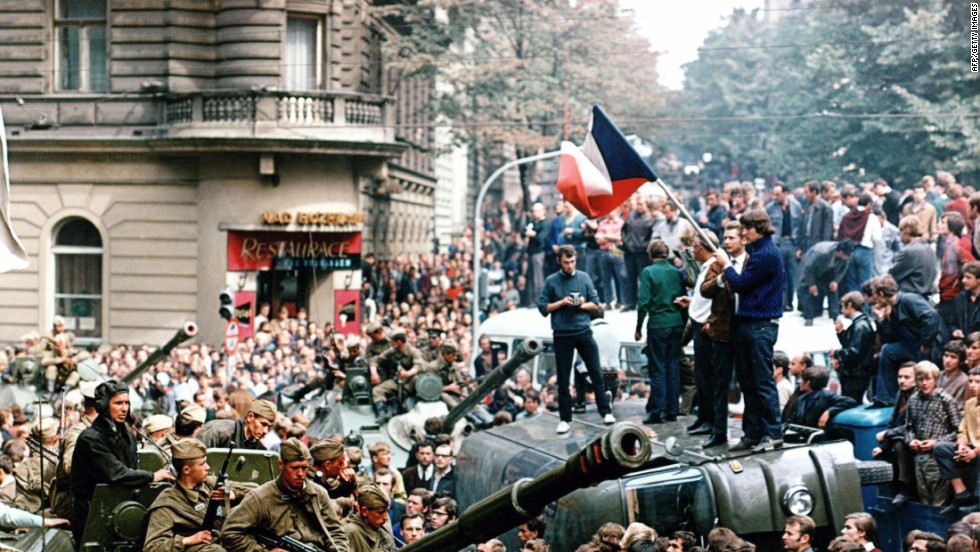
The Warsaw Pact invasion of August 20-21 caught Czechoslovakia and much of the Western world by surprise. In anticipation of the invasion, the Soviet Union had moved troops from Russia, along with limited numbers of troops from Hungary, Poland, East Germany and Bulgaria into place by announcing Warsaw Pact military exercises. When these forces did invade, they swiftly took control of Prague, other major cities, and communication and transportation links. Given the escalating U.S. involvement in the conflict in Vietnam as well as past U.S. pronouncements on non-intervention in the Eastern Bloc, the Soviets guessed correctly that the United States would condemn the invasion but refrain from intervening. Although the Soviet crackdown on Czechoslovakia was swift and successful, small-scale resistance continued throughout early 1969 while the Soviets struggled to install a stable government. Finally, in April of 1969, the Soviets forced Dubcek from power in favor of a hardline communist administrator. In the years that followed, the new leadership reestablished government censorship and controls preventing freedom of movement, but it also improved economic conditions, eliminating one of the sources for revolutionary fervor. Czechoslovakia once again became a cooperative member of the Warsaw Pact.

The Soviet invasion of Czechoslovakia was significant in the sense that it delayed the splintering of Eastern European Communism and was concluded without provoking any direct intervention from the West. Repeated efforts in the UN Security Council to pass a resolution condemning the attacks met with opposition from the Soviet Union, and the effort finally died away. The invasion did, however, temporarily derail progress toward détente between the Soviet Union and the United States. The NATO allies valued the idea of a lessening of tensions, and as a result they were determined not to intervene. Still, the invasion forced U.S. President Lyndon B. Johnson to cancel a summit meeting with Soviet leader Leonid Brezhnev. Although Brezhnev knew this was the most likely outcome of the invasion, he considered maintaining Soviet control in the East Bloc a higher priority in the short-term than pursuing détente with the West. As it turned out, the progress on arms control agreements were only delayed by a few years in the aftermath of the Prague Spring.

There were also long-term consequences. After the invasion, the Soviet leadership justified the use of force in Prague under what would become known as the Brezhnev Doctrine, which stated that Moscow had the right to intervene in any country where a communist government had been threatened. This doctrine, established to justify Soviet action in Czechoslovakia, also became the primary justification for the Soviet invasion of Afghanistan in 1979, and even before that it helped to finalize the Sino-Soviet split, as Beijing feared that the Soviet Union would use the doctrine as a justification to invade or interfere with Chinese communism. Because the United States interpreted the Brezhnev Doctrine and the history of Soviet interventions in Europe as defending established territory, not expanding Soviet power, the aftermath of the Czech crisis also lent support to voices in the U.S. Congress calling for a reduction in U.S. military forces in Europe.


Timeline: 

5 January 1968
Alexandr Dubcek - a reformer - took over as leader of the Communist Party (KSC).
April 1968
Dubcek's government announced an Action Plan for what it called a new model of socialism - it removed state controls over industry and allowed freedom of speech.
For four months (the Prague Spring), there was freedom in Czechoslovakia. But then the revolution began to run out of control. Dubcek announced that he was still committed to democratic communism, but other political parties were set up.
Also, Dubcek stressed that Czechoslovakia would stay in the Warsaw Pact, but in August, President Tito of Yugoslavia, a country not in the Warsaw Pact, visited Prague.
 3 August 1968
Brezhnev read out a letter from some Czechoslovakian Communists asking for help. He announced the Brezhnev Doctrine - the USSR would not allow any Eastern European country to reject Communism.
20 August 1968
500,000 Warsaw Pact troops invaded Czechoslovakia. Dubcek and three other leaders were arrested and sent to Moscow.
The Czechoslovakians did not fight the Russians. Instead, they stood in front of the tanks, and put flowers in the soldiers' hair. Jan Palach burned himself to death in protest. Over one hundred Czechs and Slovaks are killed in the invasion.


Red Spring


Tuesday, March 1, 2016

Six Days in June


Israel Under Siege


In 1963, the Arab League decided to introduce a new weapon in its war against Israel — the Palestine Liberation Organization (PLO). The PLO formally came into being during a 1964 meeting of the first Palestinian Congress. Shortly thereafter, the group began to splinter into various factions. Ultimately, the largest faction, Fatah, would come to dominate the organization, and its leader, Yasser Arafat, would become the PLO chairman and most visible symbol. All the groups adhered to a set of principles laid out in the Palestine National Charter, which called for Israel's destruction. The PLO’s belligerent rhetoric was matched by deeds. Terrorist attacks by the group grew more frequent. In 1965, 35 raids were conducted against Israel. In 1966, the number increased to 41. In just the first four months of 1967, 37 attacks were launched. The targets were always civilians.
Most of the attacks involved Palestinian guerillas infiltrating Israel from Jordan, the Gaza Strip, and Lebanon. The orders and logistical support for the attacks were coming, however, from Cairo and Damascus. Egyptian President Nasser’s main objective was to harass the Israelis, but a secondary one was to undermine King Hussein’s regime in Jordan. King Hussein viewed the PLO as both a direct and indirect threat to his power. Hussein feared that the PLO might try to depose him with Nasser’s help or that the PLO’s attacks on Israel would provoke retaliatory strikes by Israeli forces that could weaken his authority. By the beginning of 1967, Hussein had closed the PLO’s offices in Jerusalem, arrested many of the group’s members, and withdrew recognition of the organization. Nasser and his friends in the region unleashed a torrent of criticism on Hussein for betraying the Arab cause.

Hussein would soon have the chance to redeem himself. The breakup of the U.A.R. and the resulting political instability only made Syria more hostile toward Israel. Another major cause of conflict was Syria’s resistance to Israel’s creation of a National Water Carrier to take water from the Jordan River to supply the country. The Syrian army used the Golan Heights, which tower 3,000 feet above the Galilee, to shell Israeli farms and villages. Syria’s attacks grew more frequent in 1965 and 1966, forcing children living on kibbutzim in the Huleh Valley to sleep in bomb shelters. Israel repeatedly protested the Syrian bombardments to the UN Mixed Armistice Commission, which was charged with policing the cease‐fire, but the UN did nothing to stop Syria’s aggression — even a mild Security Council resolution expressing “regret” for such incidents was vetoed by the Soviet Union. Meanwhile, Israel was condemned by the United Nations when it retaliated. While the Syrian military bombardment and terrorist attacks intensified, Nasser’s rhetoric became increasingly bellicose. In 1965, he announced, “We shall not enter Palestine with its soil covered in sand; we shall enter it with its soil saturated in blood.” Again, a few months later, Nasser expressed the Arabs’ aspiration: “the full restoration of the rights of the Palestinian people. In other words, we aim at the destruction of the state of Israel. The immediate aim: perfection of Arab military might. The national aim: the eradication of Israel.” Syria’s attacks on Israeli kibbutzim from the Golan Heights finally provoked a retaliatory strike on April 7, 1967. During the attack, Israeli planes shot down six Syrian fighter planes — MiGs supplied by the Soviet Union. Shortly thereafter, the Soviets — who had been providing military and economic assistance to both Syria and Egypt — gave Damascus false information alleging a massive Israeli military buildup in preparation for an attack. Despite Israeli denials, Syria decided to invoke its defense treaty with Egypt and asked Nasser to come to its aid. On May 15, Israel's Independence Day, Egyptian troops began moving into the Sinai and massing near the Israeli border. By May 18, Syrian troops were prepared for battle along the Golan Heights. Nasser ordered the UN Emergency Force (UNEF), stationed in the Sinai since 1956 as a buffer between Israeli and Egyptian forces after Israel’s withdrawal following the Sinai Campaign, to withdraw on May 16. Without bringing the matter to the attention of the General Assembly (as his predecessor had promised), Secretary‐General U Thant complied with the demand. After the withdrawal of the UNEF, the Voice of the Arabs radio station proclaimed on May 18, 1967:”As of today, there no longer exists an international emergency force to protect Israel. We shall exercise patience no more. We shall not complain any more to the UN about Israel. The sole method we shall apply against Israel is total war, which willresult in the extermination of Zionist existence.” An enthusiastic echo was heard May 20 from Syrian Defense Minister Hafez Assad: “Our forces are now entirely ready not only to repulse the aggression, but to initiate the act of liberation itself, and to explode the Zionist presence in the Arab homeland. The Syrian army, with its finger on the trigger, is united....I, as a military man, believe that the time has come to enter into a battle of annihilation.” On May 22, Egypt closed the Straits of Tiran to all Israeli shipping and all ships bound for Eilat. This blockade cut off Israel's only supply route with Asia and stopped the flow of oil from its main supplier, Iran. In 1956, the United States gave Israel assurances that it recognized the Jewish State's right of access to the Straits of Tiran. In 1957, at the UN, 17 maritime powers declared that Israel had a right to transit the Strait. Moreover, the blockade violated the Convention on the Territorial Sea and Contiguous Zone, which was adopted by the UN Conference on the Law of the Sea on April 27, 1958. President Johnson expressed the belief that the blockade was illegal and unsuccessfully tried to organize an international flotilla to test it. At the same time, he advised the Israelis not to take any military action. After the war, he acknowledged the closure of the Strait of Tiran was the casus belli (June 19, 1967): If a single act of folly was more responsible for this explosion than any other it was the arbitrary and dangerous announced decision that the Strait of Tiran would be closed. The right of innocent maritime passage must be preserved for all nations. Nasser was aware of the pressure he was exerting to force Israel’s hand, and challenged Israel to fight almost daily. The day after the blockade was set up, he said defiantly: "The Jews threaten to make war. I reply: Welcome! We are ready for war." Nasser challenged Israel to fight almost daily. "Our basic objective will be the destruction of Israel. The Arab people want to fight," he said on May 27. The following day, he added: "We will not accept any...coexistence with Israel...Today the issue is not the establishment of peace between the Arab states and Israel....The war with Israel is in effect since 1948." King Hussein of Jordan signed a defense pact with Egypt on May 30. Nasser then announced: The armies of Egypt, Jordan, Syria and Lebanon are poised on the borders of Israel...to face the challenge, while standing behind us are the armies of Iraq, Algeria, Kuwait, Sudan and the whole Arab nation. This act will astound the world. Today they will know that the Arabs are arranged for battle, the critical hour has arrived. We have reached the stage of serious action and not declarations. President Abdur Rahman Aref of Iraq joined in the war of words: "The existence of Israel is an error which must be rectified. This is our opportunity to wipe out the ignominy which has been with us since 1948. Our goal is clear ‐‐ to wipe Israel off the map." On June 4, Iraq joined the military alliance with Egypt, Jordan and Syria. The Arab rhetoric was matched by the mobilization of Arab forces. Approximately 465,000 troops, more than 2,800 tanks, and 800 aircraft ringed Israel. By this time, Israeli forces had been on alert for three weeks. The country could not remain fully mobilized indefinitely, nor could it allow its sea lane through the Gulf of Aqaba to be interdicted. Israel decided to preempt the expected Arab attack. To do this successfully, Israel needed the element of surprise. Had it waited for an Arab invasion, Israel would have been at a potentially catastrophic disadvantage. On June 5, Prime Minister Eshkol gave the order to attack Egypt. The United States tried to prevent the war through negotiations, but it was not able to persuade Nasser or the other Arab states to cease their belligerent statements and actions. Still, right before the war, Johnson warned: "Israel will not be alone unless it decides to go alone." Then, when the war began, the State Department announced: "Our position is neutral in thought, word and deed." Moreover, while the Arabs were falsely accusing the United States of airlifting supplies to Israel, Johnson imposed an arms embargo on the region (France, Israel's other main arms supplier also embargoed arms to Israel). By contrast, the Soviets were supplying massive amounts of arms to the Arabs. Simultaneously, the armies of Kuwait, Algeria, Saudi Arabia and Iraq were contributing troops and arms to the Egyptian, Syrian and Jordanian fronts. On June 5, 1967, Israel was indeed alone, but its military commanders had conceived a brilliant war strategy. The entire Israeli Air Force, with the exception of just 12 fighters assigned to defend Israeli airspace, took off at 7:14 a.m. with the intent of bombing Egyptian airfields while the Egyptian pilots were eating breakfast. In less than 2 hours, roughly 300 Egyptian aircraft were destroyed. A few hours later, Israeli fighters attacked the Jordanian and Syrian air forces, as well as one airfield in Iraq. By the end of the first day, nearly the entire Egyptian and Jordanian air forces, and half the Syrians’, had been destroyed on the ground. The battle then moved to the ground, and some of history’s greatest tank battles were fought between Egyptian and Israeli armor in the blast‐furnace conditions of the Sinai desert. Prime Minister Levi Eshkol sent a message to King Hussein on June 5 saying Israel would not attack Jordan unless he initiated hostilities. When Jordanian radar picked up a cluster of planes flying from Egypt to Israel, and the Egyptians convinced Hussein the planes were theirs, he ordered the shelling of West Jerusalem. It turned out that the planes were Israel’s and were returning from destroying the Egyptian air force on the ground. It took only three days for Israeli forces to defeat the Jordanian legion. On the morning of June 7, the order was given to recapture the Old City. Israeli paratroopers stormed the city and secured it. Defense Minister Moshe Dayan arrived with Chief of Staff Yitzhak Rabin to formally mark the Jews’ return to their historic capital and their holiest site. At the Western Wall, the IDF’s chaplain, Rabbi Shlomo Goren, blew a shofar to celebrate the event. After Jordan launched its attack on June 5, approximately 325,000 Palestinians living in the West Bank fled to other parts of Jordan, primarily to avoid being caught in the cross‐fire of a war. A Palestinian refugee who was an administrator in a UNRWA camp in Jericho said Arab politicians had spread rumors in the camp. "They said all the young people would be killed. People heard on the radio that this is not the end, only the beginning, so they think maybe it will be a long war and they want to be in Jordan." Some Palestinians who left preferred to live in an Arab state rather than under Israeli military rule. Members of various PLO factions fled to avoid capture by the Israelis. Nils‐Göran Gussing, the person appointed by the UN Secretary‐General to investigate the situation, found that many Arabs also feared they would no longer be able to receive money from family members working abroad. Israeli forces ordered a handful of Palestinians to move for "strategic and security reasons." In some cases, they were allowed to return in a few days, in others; Israel offered to help them resettle elsewhere. The net result, however, was that a new refugee population had been created and the old refugee problem was made worse. While most IDF units were fighting the Egyptians and Jordanians, a small, heroic group of soldiers were left to defend the northern border against the Syrians. It was not until the Jordanians and Egyptians were subdued that reinforcements could be sent to the Golan Heights, where Syrian gunners commanding the strategic high ground made it exceedingly difficult and costly for Israeli forces to penetrate. Finally, on June 9, after two days of heavy air bombardment, Israeli forces succeeded in breaking through the Syrian lines. After just six days of fighting, Israeli forces were in a position to march on Cairo, Damascus, and Amman. By this time, the principal objectives of capturing the Sinai and the Golan Heights had been accomplished, and Israeli political leaders had no desire to fight in the Arab capitals. Furthermore, the Soviet Union had become increasingly alarmed by the Israeli advances and was threatening to intervene. At this point, U.S. Secretary of State Dean Rusk advised the Israelis “in the strongest possible terms” to accept a cease‐fire. On June 10, Israel did just that. The victory came at a very high cost. In storming the Golan Heights, Israel suffered 115 dead‐roughly the number of Americans killed during Operation Desert Storm. Altogether, Israel lost twice as many men — 777 dead and 2,586 wounded‐in proportion to hertotal population asthe U.S. lost in eight years of fighting in Vietnam. Also, despite the incredible success of the air campaign, the Israeli Air Force lost 46 of its 200 fighters.(24) The death toll on the Arab side was 15,000 Egyptians, 2,500 Syrians, and 800 Jordanians. By the end ofthe war, Israel had conquered enough territory to more than triple the size ofthe area it controlled, from 8,000 to 26,000 square miles. The victory enabled Israel to unify Jerusalem. Israeli forces had also captured the Sinai, Golan Heights, Gaza Strip and West Bank. Israel now ruled more than three‐quarters of a million Palestinians — most of whom were hostile to the government. Nevertheless, more than 9,000 Palestinian families were reunited in 1967. Ultimately, more than 60,000 Palestinians were allowed to return. In November 1967, the United Nations Security Council adopted Resolution 242, which established a formula for Arab‐Israeli peace whereby Israel would withdraw from territories occupied in the war in exchange for peace with its neighbors. This resolution has served as the basis for peace negotiations from that time on. Israel's leaders fully expected to negotiate a peace agreement with their neighbors that would involve some territorial compromise. Therefore, instead of annexing the West Bank, a military administration was created. No occupation is pleasant for the inhabitants, but the Israeli authorities did try to minimize the impact on the population. Don Peretz, a frequent writer on the situation of Arabs in Israel and a sharp critic of the Israeli government, visited the West Bank shortly after the Israeli troops had taken over. He found they were trying to restore normal life and prevent any incidents that might encourage the Arabs to leave their homes. Except for the requirement that school texts in the territories be purged of anti‐Israel and anti‐Semitic language, the authorities tried not to interfere with the inhabitants. They did provide economic assistance; for example, Palestinians in the Gaza Strip were moved from camps to new homes. This stimulated protests from Egypt, which had done nothing for the refugees when it controlled the area. Arabs were given freedom of movement. They were allowed to travel to and from Jordan. In 1972, elections were held in the West Bank. Women and non‐landowners, unable to participate under Jordanian rule, were now permitted to vote. East Jerusalem Arabs were given the option of retaining Jordanian citizenship or acquiring Israeli citizenship. They were recognized as residents of united Jerusalem and given the right to vote and run for the city council. Also, Islamic holy places were put in the care of a Muslim Council. Despite the Temple Mount's significance in Jewish history, Jews were barred from conducting prayers there.

Source: www.jewishvirtuallibrary.org