Prague Spring
Before
the Second World War, the nation of Czechoslovakia had been a strong democracy
in Central Europe, but beginning in the mid-1930s it faced challenges from both
the West and the East. In 1948, Czech attempts to join the U.S.-sponsored
Marshall Plan to aid postwar rebuilding were thwarted by a Soviet takeover and
the installation of a new communist government in Prague. For the next twenty
years, Czechoslovakia remained a stable state within the Soviet sphere of
influence; unlike in Hungary or Poland, even the rise of de-Stalinization after
1953 did not lead to liberalization by the Czech government.
In the 1960s, however, changes in
the leadership in Prague led to a series of reforms to soften or humanize the
application of communist doctrines within Czech borders. The Czech economy had
been slowing since the early 1960s, and cracks were emerging in the communist
consensus as workers struggled against new challenges. The government responded
with reforms designed to improve the economy. In early 1968, hardline communist
Antonin Novotny was ousted as the head of the Communist Party of
Czechoslovakia, and he was replaced by Alexander
Dubcek. The Dubcek government ended censorship in early 1968, and the
acquisition of this freedom resulted in a public expression of broad-based
support for reform and a public sphere in which government and party policies
could be debated openly. In April, the Czech Government issued a formal plan
for further reforms, although it tried to liberalize within the existing
framework of the Marxist-Leninist State and did not propose a revolutionary
overhaul of the political and economic systems. As conflicts emerged between
those calling for further reforms and conservatives alarmed by how far the
liberalization process had gone, Dubcek struggled to maintain control. Soviet
leaders were concerned over these recent developments in Czechoslovakia.
Recalling the 1956 uprising in Hungary, leaders in Moscow worried that if
Czechoslovakia carried reforms too far, other satellite states in Eastern
Europe might follow, leading to a widespread rebellion against Moscow’s
leadership of the Eastern Bloc. There was also a danger that the Soviet
Republics in the East, such as the Ukraine, Lithuania, Latvia, and Estonia
might make their own demands for more liberal policies. After much debate, the
Communist Party leadership in Moscow decided to intervene to establish a more
pro-Soviet government in Prague.
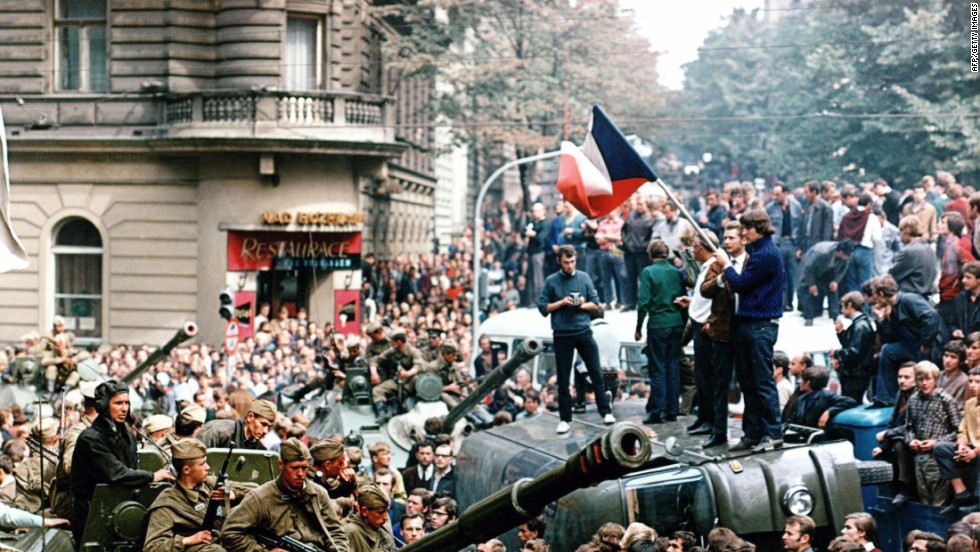
The Warsaw Pact invasion of August 20-21 caught Czechoslovakia and much
of the Western world by surprise. In anticipation of the invasion, the Soviet
Union had moved troops from Russia, along with limited numbers of troops from
Hungary, Poland, East Germany and Bulgaria into place by announcing Warsaw Pact
military exercises. When these forces did invade, they swiftly took control of
Prague, other major cities, and communication and transportation links. Given
the escalating U.S. involvement in the conflict in Vietnam as well as past U.S.
pronouncements on non-intervention in the Eastern Bloc, the Soviets guessed
correctly that the United States would condemn the invasion but refrain from
intervening. Although the Soviet crackdown on Czechoslovakia was swift and
successful, small-scale resistance continued throughout early 1969 while the
Soviets struggled to install a stable government. Finally, in April of 1969,
the Soviets forced Dubcek from power in favor of a hardline communist
administrator. In the years that followed, the new leadership reestablished
government censorship and controls preventing freedom of movement, but it also
improved economic conditions, eliminating one of the sources for revolutionary
fervor. Czechoslovakia once again became a cooperative member of the Warsaw
Pact.
The Soviet invasion of
Czechoslovakia was significant in the sense that it delayed the splintering of
Eastern European Communism and was concluded without provoking any direct
intervention from the West. Repeated efforts in the UN Security Council to pass
a resolution condemning the attacks met with opposition from the Soviet Union,
and the effort finally died away. The invasion did, however, temporarily derail
progress toward détente between the Soviet Union and the United States. The
NATO allies valued the idea of a lessening of tensions, and as a result they
were determined not to intervene. Still, the invasion forced U.S. President Lyndon B. Johnson to cancel a summit
meeting with Soviet leader Leonid
Brezhnev. Although Brezhnev knew this was the most likely outcome of the
invasion, he considered maintaining Soviet control in the East Bloc a higher
priority in the short-term than pursuing détente with the West. As it turned
out, the progress on arms control agreements were only delayed by a few years
in the aftermath of the Prague Spring.
There were also long-term
consequences. After the invasion, the Soviet leadership justified the use of
force in Prague under what would become known as the Brezhnev Doctrine, which stated that Moscow had the right to
intervene in any country where a communist government had been threatened. This
doctrine, established to justify Soviet action in Czechoslovakia, also became
the primary justification for the Soviet invasion of Afghanistan in 1979, and
even before that it helped to finalize the Sino-Soviet split, as Beijing feared
that the Soviet Union would use the doctrine as a justification to invade or
interfere with Chinese communism. Because the United States interpreted the
Brezhnev Doctrine and the history of Soviet interventions in Europe as
defending established territory, not expanding Soviet power, the aftermath of
the Czech crisis also lent support to voices in the U.S. Congress calling for a
reduction in U.S. military forces in Europe.
Timeline:
5 January 1968
Alexandr Dubcek - a reformer - took
over as leader of the Communist Party (KSC).
April 1968
Dubcek's government announced an
Action Plan for what it called a new model of socialism - it removed state
controls over industry and allowed freedom of speech.
For four months (the Prague Spring),
there was freedom in Czechoslovakia. But then the revolution began to run out
of control. Dubcek announced that he was still committed to democratic
communism, but other political parties were set up.
Also, Dubcek stressed that
Czechoslovakia would stay in the Warsaw Pact, but in August, President Tito of
Yugoslavia, a country not in the Warsaw Pact, visited Prague.
3
August 1968
Brezhnev read out a letter from
some Czechoslovakian Communists asking for help. He announced the Brezhnev
Doctrine - the USSR would not allow any Eastern European country to reject
Communism.
20 August 1968
500,000 Warsaw Pact troops
invaded Czechoslovakia. Dubcek and three other leaders were arrested and sent
to Moscow.
The Czechoslovakians did not
fight the Russians. Instead, they stood in front of the tanks, and put flowers
in the soldiers' hair. Jan Palach burned himself to death in protest. Over one
hundred Czechs and Slovaks are killed in the invasion.

No comments:
Post a Comment